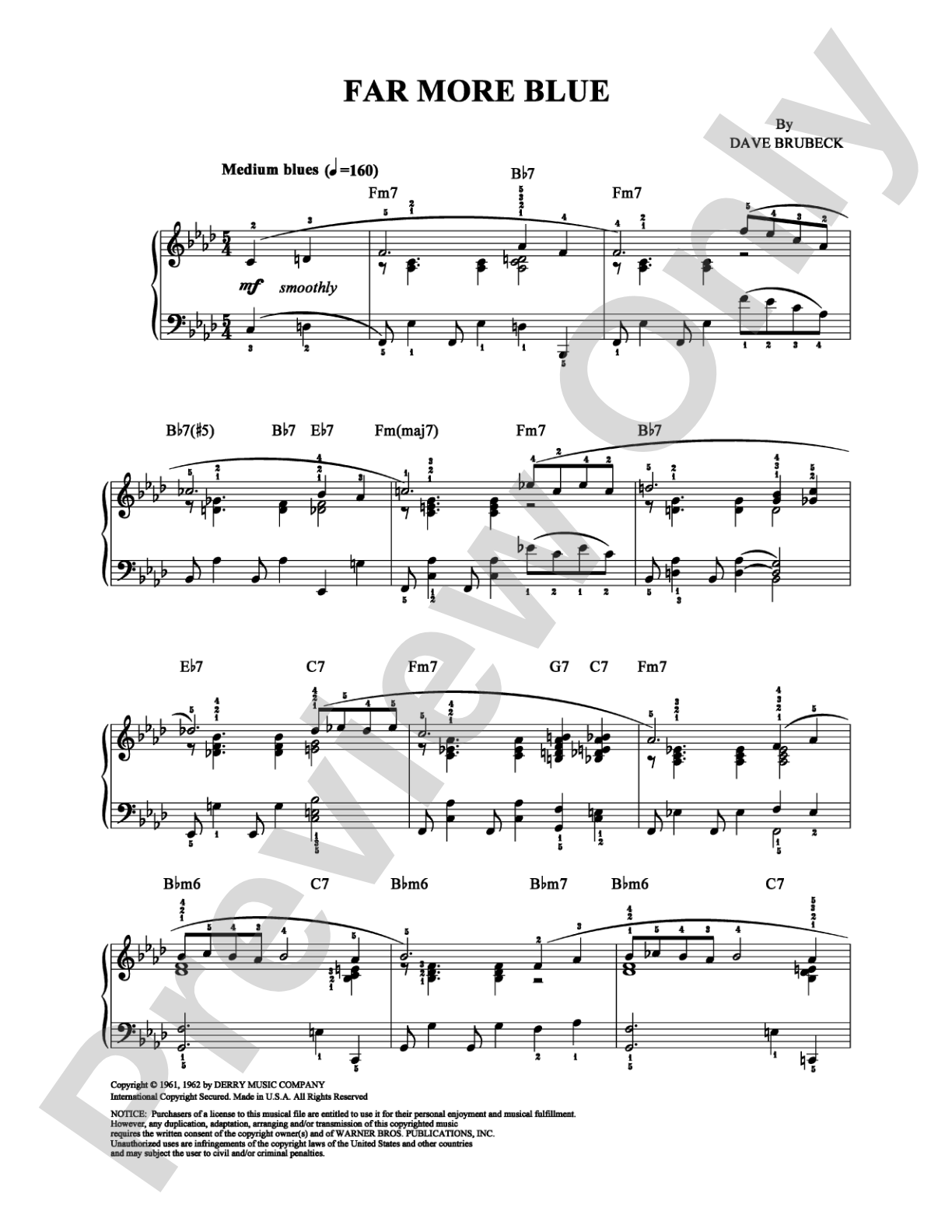
Far More Blue: Piano Digital Sheet Music

Far More Blue: Piano Digital Sheet Music

Dave Brubeck

Item: 00-PS-0000756

Digital Download
$3.99
Description

Far More Blue: Piano Digital Sheet Music isn't in MakeMusic Cloud just yet...but it could be. Let us know you'd like to see it, and you'll help shape what comes next. In the meantime, start a free trial and dive into thousands of interactive titles your students can play along with today.

Sample Audio
No sample audio found.
Sample Video
Additional Details
SKU: 00-PS-0000756

More about this title

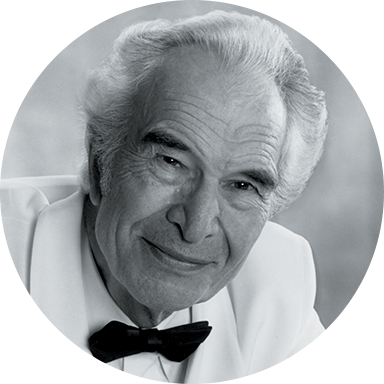
About the Artist: Dave Brubeck

Dave Brubeck

Dave Brubeck was a pianist and composer who bridged jazz improvisation with classical forms throughout his distinguished career. Beginning his studies at the College of the Pacific and later with Darius Milhaud at Mills College following World War II, Brubeck developed a distinctive voice that honored both idioms. His work extended far beyond performance; he created choral pieces, hymns, orchestral works, chamber music, and large-scale compositions for chorus and orchestra. The album "Time Out" became the first jazz recording to sell over a million copies, and his composition "Take Five" achieved legendary status in both jazz and popular culture.

Beyond his musical innovations, Brubeck was a cultural pioneer who actively challenged racial barriers in mid-twentieth-century America. His sacred works, including the mass "To Hope!" and oratorios such as "The Voice of the Holy Spirit" and "Beloved Son," have been performed and recorded internationally by ensembles ranging from cathedral choirs to the London Symphony Orchestra. His contributions earned him the Grammy Lifetime Achievement Award, the Presidential Medal of the Arts from President Clinton, and induction into the American Classical Music Hall of Fame in 2003.

Why we love this

Brubeck's piano writing captures the spontaneity of jazz language within carefully crafted notation, giving pianists a genuine glimpse into how his improvisational mind worked. The piece sits comfortably in recital programming where you need something that speaks to contemporary audiences without sacrificing musical substance. Students and professional pianists alike respond to the accessibility of his melodies paired with the harmonic sophistication that keeps ears engaged.

What to expect

The piece carries the wistful, contemplative quality suggested by its title; blue harmonies and gentle syncopation create a mood that is introspective without being heavy. There's a conversational quality to the writing, as though Brubeck is thinking aloud at the piano, inviting the performer and listener into his reflective process. The overall character balances melancholy with the quiet sophistication that defined so much of his work.

Who it's for

Pianists at intermediate to advanced levels who are drawn to jazz idioms but work primarily from notation will find this piece both accessible and rewarding. It appeals equally to classical pianists expanding into jazz vocabulary and jazz musicians developing their reading skills. Students preparing recital programs benefit from its concert-hall credibility and engaging melodic content.

How to get the most out of it

  • Approach the phrasing with the rubato of speech rather than metronomic precision; Brubeck's compositions breathe like jazz lines even when fully notated
  • Balance chord voicings so that the left hand supports rather than overwhelms the melody, allowing the blues-inflected harmonies to emerge naturally
  • Listen closely to recordings of Brubeck himself to absorb the specific rhythmic feel and articulation choices that define his sound
  • Let space and silence play as active musical elements; resist filling every moment with sound

How to use it

Position this in a recital where it can serve as a bridge between classical and jazz repertoire, or pair it with other works from Brubeck's substantial catalog of notated compositions. The piece works well in intimate performance settings and fits naturally into programs exploring twentieth-century American music. It's equally at home in a jazz recital or a contemporary classical concert.

Skills your students will build

  • Reading and executing jazz chord voicings on piano
  • Balancing notated rhythm with rubato and expressive phrasing
  • Interpreting blue notes and altered harmonies
  • Developing touch and tone control in lyrical, slower passages

You May Also Like