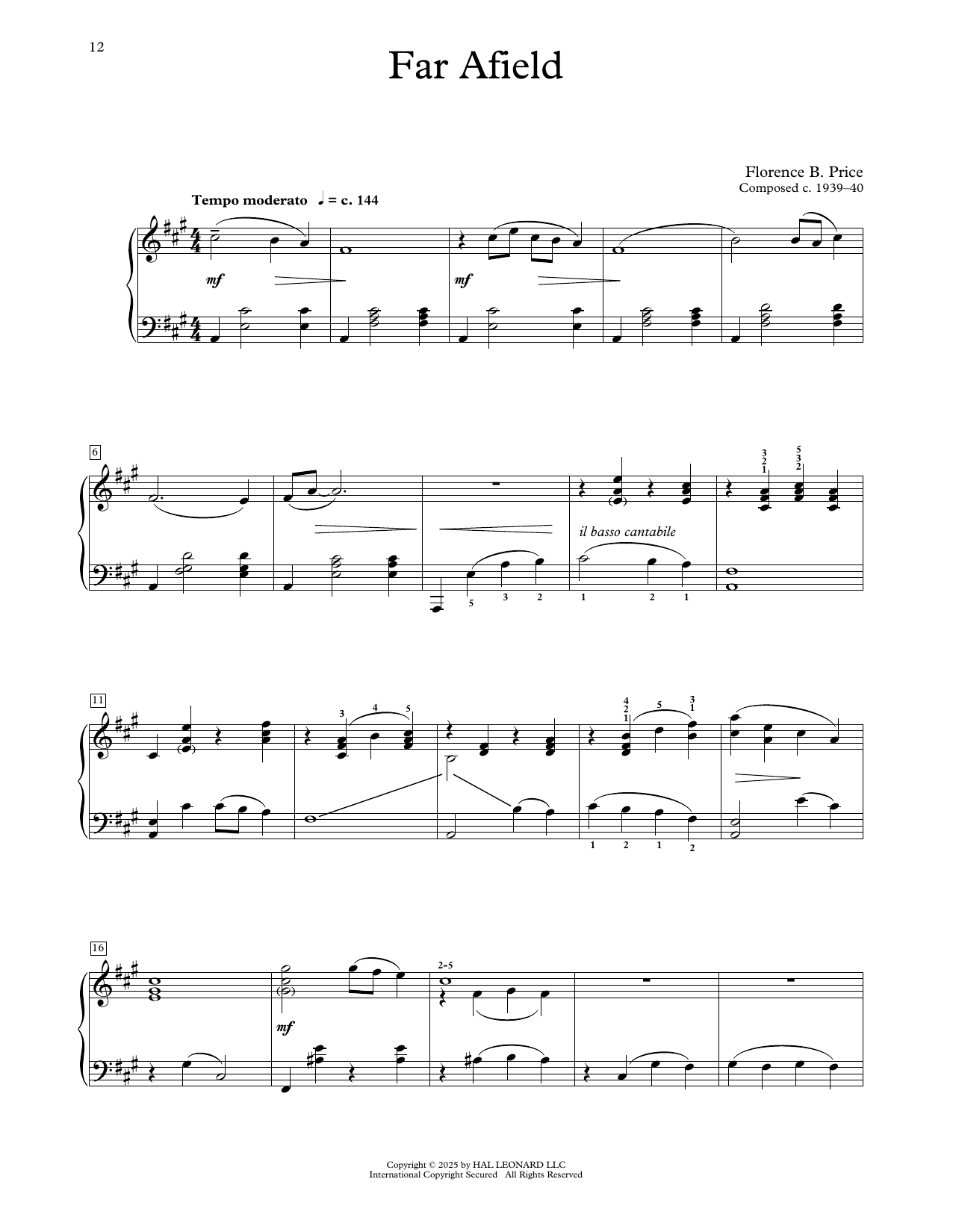
Florence Price (1887-1953) broke barriers as the first African American woman to have a symphony performed by a major American orchestra. Her compositional voice blended classical training with the vernacular traditions of African American music, creating works that were both intellectually rigorous and deeply rooted in her cultural heritage. Price's piano works remain essential to any comprehensive music education because they expand the canon and demonstrate that technical mastery and expressive depth know no demographic boundaries.
Why we love this
Price's educational piano works prove that teaching repertoire and artistic substance are not opposing forces. This piece combines deliberate technical scaffolding with genuine musical voice, so students advance their skills while playing something worth playing.
What to expect
A piece that travels outward with curiosity and grace. The writing opens space for reflection while maintaining forward momentum, inviting the player into a musical conversation rather than a display of technical prowess.
Who it's for
Intermediate pianists gaining confidence with longer forms and layered textures. This works for students ready to move beyond five-finger patterns but still building independence between hands.
How to get the most out of it
Shape the melodic phrases with intention rather than letting them flatten under the fingers; Price's writing rewards clarity and singing tone even at moderate tempos.
Balance the left hand carefully so accompaniment figures support rather than overpower the melody, a common challenge at this level.
Pay attention to any dynamic markings as structural signposts; they often signal where the music turns or develops thematically.
How to use it
Feature this in a recital or student showcase focused on American composers, or use it as a anchor piece in a unit exploring diversity in the classical canon. Its moderate length and technical demands make it suitable for spring performances when students have had time to develop secure fundamentals.
Skills your students will build
Sustaining longer melodic lines across phrase boundaries
Coordinating independent hand patterns with contrasting rhythmic profiles
Interpreting dynamic shapes to clarify harmonic and structural movement
Building secure hand independence at moderate tempo
You May Also Like
Scan to Complete Your Purchase
Use your phone's camera to scan the code below
You'll log in on your phone and the order will be added to your account