
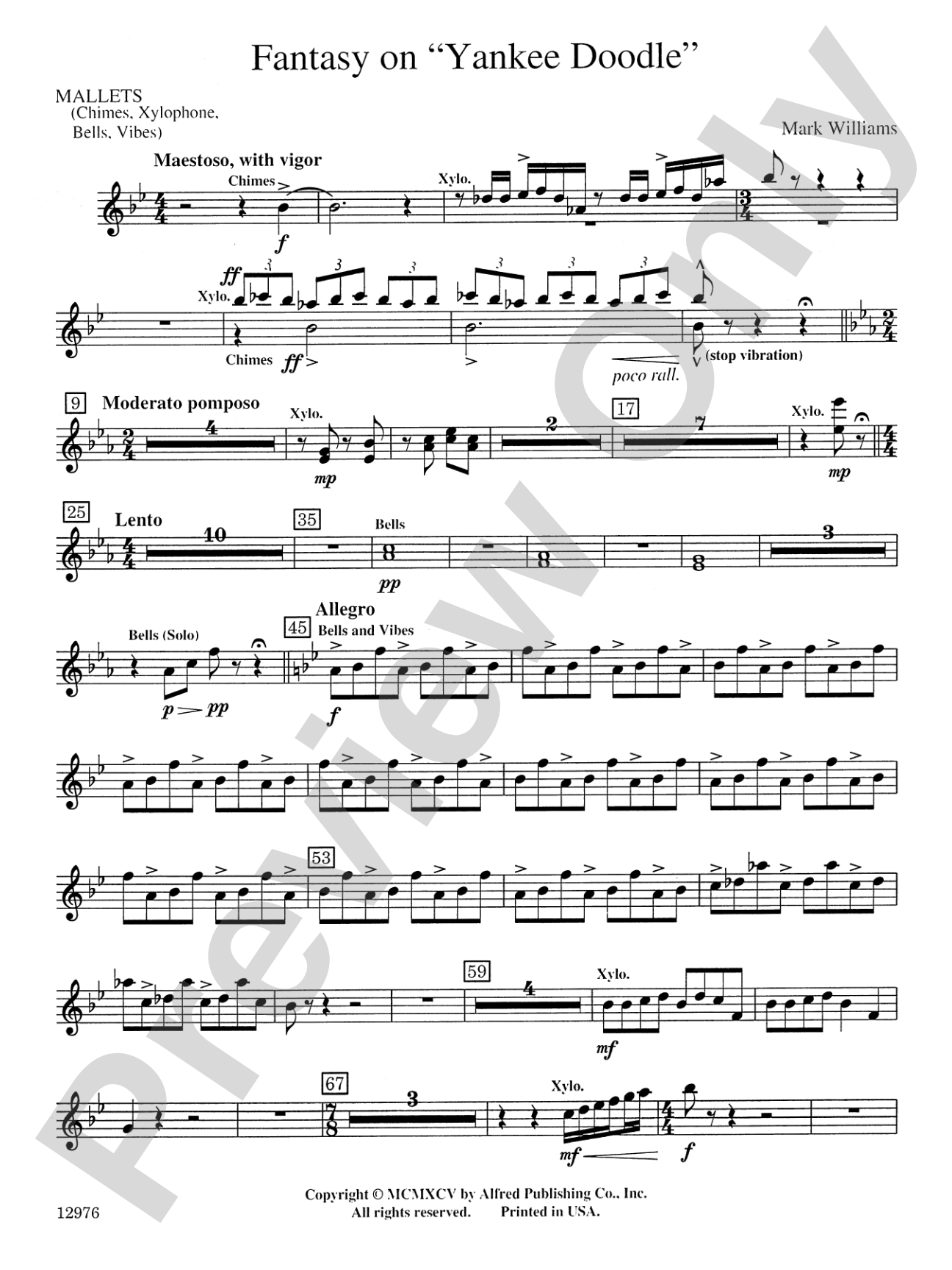

Fantasy on "Yankee Doodle": Mallets
By Mark Williams
Grade: 4 (Medium Difficult)
Item: 00-PC-0000135_M1
$5.99
Pickup currently not available
Description
This is a refreshing and exciting work! Yankee Doodle seems like such a simple melody, but it's amazing how well Mark Williams develops it using a set of variations. Although opened by a humorous statement of the theme by solo tuba, you'll soon find that this is not a novelty piece . . . the varied styles and moods are displayed in well-written music that is perfectly held together by the original theme. Excellent! This title is available in MakeMusic Cloud.


Don't just read it, hear it, play along with it, and watch your students grow with it. In MakeMusic Cloud, Fantasy on "Yankee Doodle": Mallets comes alive with professional accompaniment, adjustable tempo, and built-in practice tools that turn solo practice into real progress.
Open in the Player
Jump straight in and assign it today.
Start Your Free Trial
Open this title and explore the full library in minutes.
Sample Audio
1
Audio File
--:--
0:00
0:00
Sample Video
No sample videos found.
Additional Details
Series:
Alfred Concert Band
Publisher:
Alfred Music
Page Count:
296
SKU:
00-PC-0000135_M1
More about this title
About the Composer: Mark Williams

Mark Williams built his reputation as a composer whose works became staples in school band libraries across North America and beyond. A prolific writer with over 200 published compositions for band, orchestra, and choir, he shaped generations of student musicians through both his original works and his co-authorship of the Accent on Achievement Band Method. His influence extended through countless clinician visits to 34 states, 5 Canadian provinces, and Australia, where he conducted and mentored musicians at all levels.
Educated at Eastern Washington University with degrees in education and a Master's degree, Williams spent his career teaching music in Washington state with a particular focus on elementary band. He performed professionally as a bassoon player and arranger for the 560th Air Force Band, and later served as conductor and artistic director for the Spokane British Brass Band. His contributions to band literature earned him recognition including the Western International Band Clinic's Gralia Competition and multiple ASCAP Special Awards.
Why we love this
Williams takes a melody most students know as simple and transforms it into a genuine concert work that sustains interest through creative variation rather than gimmick. The opening tuba solo immediately signals that this isn't novelty fare; instead, the work showcases sophisticated orchestration and shifting moods that keep both performers and audiences engaged. It's the kind of piece that satisfies contest adjudicators while remaining genuinely fun to rehearse and perform.
What to expect
Familiar yet transformed, like discovering depth in something you thought you knew completely. The writing moves through contrasting moods and textures, from warmly lyrical to buoyant and energetic, all unified by the iconic melody threading through the orchestration.
Who it's for
Intermediate to advanced concert bands seeking a patriotic work that offers genuine musical substance. This arrangement suits groups with solid ensemble skills and individual players capable of handling secondary lines and counter-melodies that support the main theme.
How to get the most out of it
- Balance the humorous tuba entrance carefully so it lands with character but doesn't overshadow the ensemble work that follows.
- Study the varied orchestrations throughout to identify which sections carry the theme in each statement; this clarity helps the band hear the unity beneath the surface variety.
- Shape the dynamic contours thoughtfully during the transitions between sections to maintain forward momentum across the work's longer architecture.
- Rehearse the rhythmic independence between parts in the variation sections; Williams's writing is detailed and rewards precision.
How to use it
Program this as a centerpiece for patriotic concerts or 4th of July celebrations where you want substance alongside sentiment. It also works well as a contest or festival entry that demonstrates both interpretive musicality and technical ensemble control. The work's balance of accessibility and sophistication makes it valuable for programs spanning winter concerts and spring festivals.
Skills your students will build
- Tracking a recurring thematic idea through varied orchestrations and key areas
- Balancing prominence between melody and accompaniment across different sections
- Sustaining ensemble cohesion across contrasting moods and styles within a single work
- Responding to detailed dynamic and articulation markings that shape individual lines