
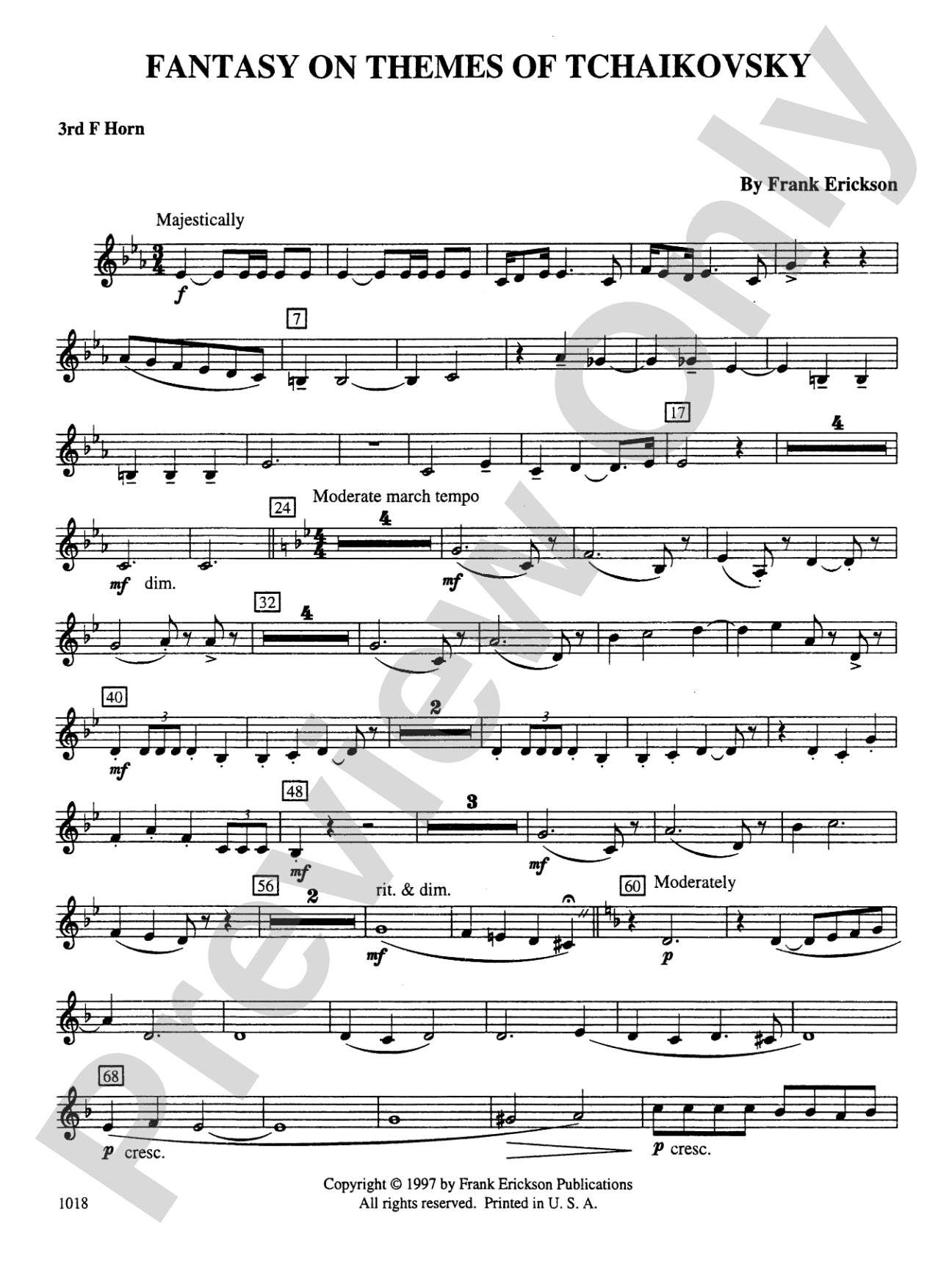

Fantasy on Themes from Tchaikovsky: 3rd F Horn
By Frank Erickson
Grade: 3 (Medium Easy)
Item: 00-PC-0001631_H3
$5.99
Pickup currently not available
Description
Tchaikovsky's musical progress was based upon impulse, rather than upon intellectual conviction. It was his sincere response to emotional impulse and the freedom with which he ranged over almost every field of musical creation which made him as great as he was. Frank Erickson passed away before he could provide rehearsal suggestions for this piece. This was one of his final numbers.


Don't just read it, hear it, play along with it, and watch your students grow with it. In MakeMusic Cloud, Fantasy on Themes from Tchaikovsky: 3rd F Horn comes alive with professional accompaniment, adjustable tempo, and built-in practice tools that turn solo practice into real progress.
Open in the Player
Jump straight in and assign it today.
Start Your Free Trial
Open this title and explore the full library in minutes.
Sample Audio
No sample audio found.
Sample Video
No sample videos found.
Additional Details
Series:
Frank Erickson Publications
Publisher:
Alfred Music
Page Count:
262
SKU:
00-PC-0001631_H3
More about this title
About the Composer: Frank Erickson
Frank Erickson (1923-1996) was an American composer and conductor who earned deep respect in the concert band world for his ability to craft idiomatic music that challenged student musicians while remaining accessible. His compositions and arrangements demonstrate sophisticated harmonic language and orchestration, reflecting his understanding of both the technical capabilities and the developmental needs of young musicians in educational settings.
Erickson's contributions shaped the standard concert band repertoire at the Grade 2-4 level. He understood how to balance musical substance with pedagogical clarity, allowing bands to experience genuine artistry without requiring virtuosic technical demands. His work left a lasting imprint on music educators who valued both integrity and practicality in their programming.
Why we love this
This arrangement captures the sweeping romanticism and emotional depth Tchaikovsky is known for while keeping the technical demands grounded for Grade 3 ensembles. Erickson's orchestration preserves the melodic richness of the original themes while distributing the musical weight in ways that engage all sections of the band. For conductors looking to program something that feels substantial and rewarding without derailing rehearsal focus on fundamentals, this piece delivers genuine concert-quality results.
What to expect
The piece unfolds with the lyrical sweep and orchestral color associated with Russian Romanticism, moving through contrasting themes with the kind of emotional directness that Tchaikovsky himself favored. There's a sense of expansiveness in the writing, as if Erickson opened a window into the composer's world and invited the band to inhabit it alongside him.
Who it's for
This work suits concert bands operating solidly at the Grade 3 level, including high school freshman ensembles, adult community bands, and advanced middle school groups seeking repertoire with concert appeal. Conductors will find it demands solid musicianship and attention to stylistic execution without requiring individual virtuosity or complex rhythmic reading.
How to get the most out of it
- Balance the inner voices carefully to prevent the secondary themes from obscuring the primary melodic line, particularly when multiple woodwind sections carry countermelodies simultaneously.
- Shape the phrase endings with slight ritards and releases rather than abrupt cutoffs; Erickson's harmonic motion often suggests subtle breathing even when the score doesn't explicitly mark it.
- Encourage the horn section to support the transitions between themes with warm, sustained tone; their role as harmonic glue is essential to the piece's flowing character.
- Rehearse the tutti section changes (between full band and reduced textures) deliberately so players understand when they enter and exit the primary material versus secondary accompaniment roles.
How to use it
This fantasy works beautifully as a centerpiece concert selection, pairing naturally with lighter opening works or more contemporary closers on a mixed program. Consider programming it during a unit focused on 19th-century music or when you want to elevate the perceived sophistication of a concert without stepping into advanced technical territory.
Skills your students will build
- Sustaining lyrical phrasing across long melodic lines
- Balancing primary and secondary material within dense harmonic textures
- Responding to subtle dynamic and tempo nuance in romantic-era music
- Coordinating sectional transitions and tutti entries with precision
- Interpreting and executing a masterwork arrangement with stylistic awareness