
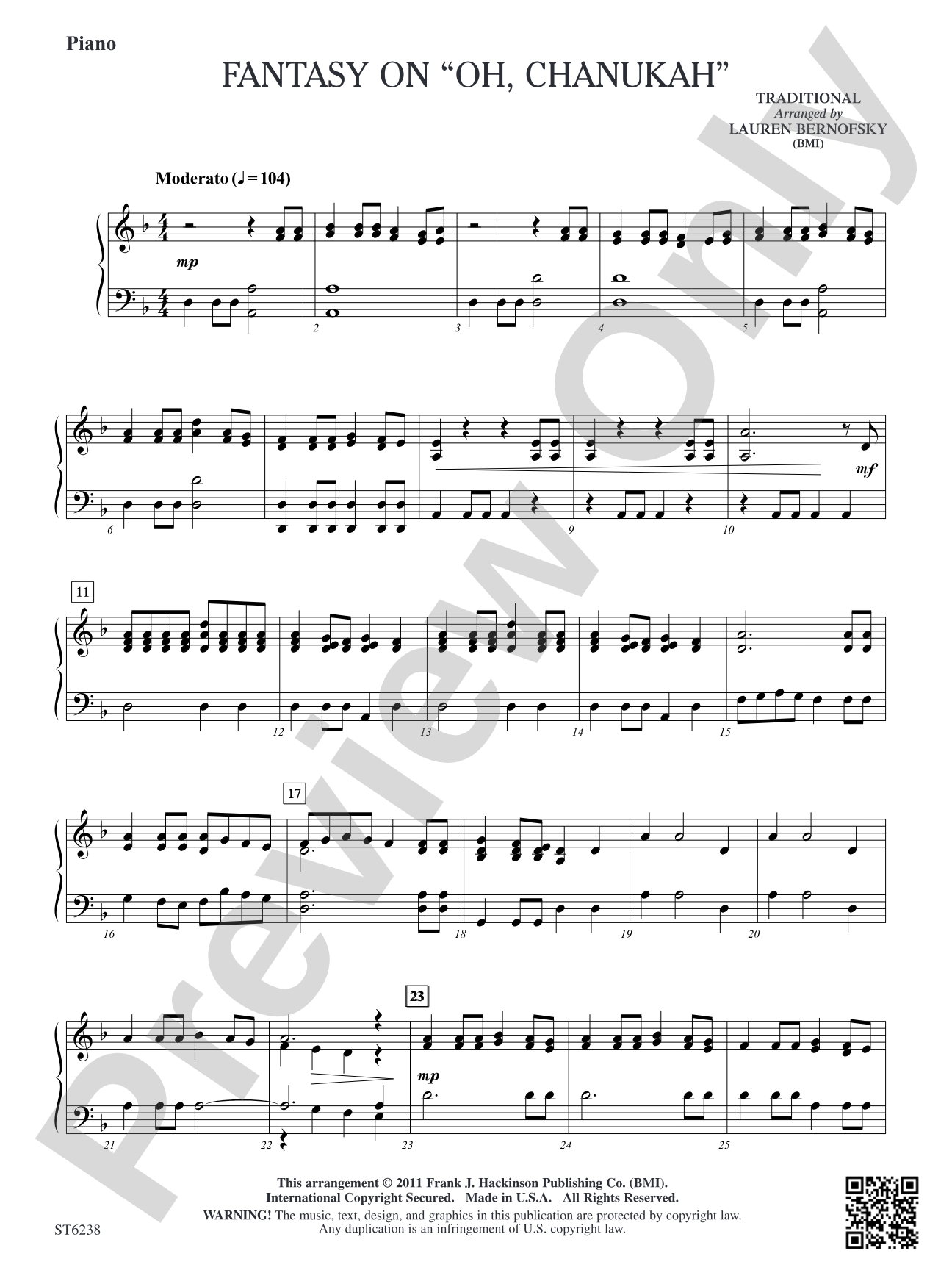

Fantasy on "Oh Chanukah": Piano
Arranged by Lauren Bernofsky
Grade: 2
Item: 98-PC-DST6238_K
$7.00
Pickup currently not available
Description
Here is a lovely setting of the traditional Oh Chanuka melody, but with a new twist: Bernofsky takes motives from the melody and spins them into a fugue. You'll be amazed how such easily-playable parts come together to make a truly impressive effect. Sounds like real symphonic music!


Fantasy on "Oh Chanukah": Piano isn't in MakeMusic Cloud just yet...but it could be. Let us know you'd like to see it, and you'll help shape what comes next. In the meantime, start a free trial and dive into thousands of interactive titles your students can play along with today.
Request This Title
Tell us you want it.
Start Your Free Trial
Explore everything that's ready to play right now.
Sample Audio
1
Audio File
--:--
0:00
0:00
Sample Video
No sample videos found.
Additional Details
Series:
FJH Developing Strings
Publisher:
The FJH Music Company, Inc.
SKU:
98-PC-DST6238_K
More about this title
About the Arranger: Lauren Bernofsky

Lauren Bernofsky has established herself as a composer whose work spans multiple genres and mediums, from solo and chamber music to orchestral, ballet, operatic, and film scores. Her compositions have drawn commissions from regional orchestras, ballet companies, and specialized ensembles across the United States, and her music has been performed internationally. She holds degrees in violin and composition from The Hartt School, the New England Conservatory, and Boston University, and has taught at both the Peabody Institute and Interlochen Center for the Arts.
Bernofsky's work is marked by what critics have called a careful balance between emotional expression and technical sophistication. Her choral composition Prayer of Shantideva won the Dalai Lama Composition Contest and was premiered at a prayer service the Dalai Lama attended. Her string quartet Anacostia Journal appeared on PBS's NOW with Bill Moyers, and her Concerto for Trumpet and Orchestra has been featured in the International Trumpet Guild journal and was the subject of a doctoral dissertation. She has received grants from The National Foundation for the Advancement of the Arts, The American Music Center, and The American Composers Forum.
Why we love this
Bernofsky's arrangement proves that a Grade 2 piece can sound far more sophisticated than its difficulty level suggests. By extracting melodic motives and developing them through fugal writing, she creates the impression of substantial compositional architecture while keeping every part genuinely playable. It's the kind of arrangement that reminds students why they're learning to read music in the first place.
What to expect
The piece opens with the familiar, gentle contours of the traditional melody, then gradually reveals itself as something richer and more intricate. Layers build beneath the surface as the fugal writing takes hold, creating moments of textural complexity that feel orchestral in scope. The return to the original melody lands with the satisfaction of a homecoming after a brief journey into something darker and more sophisticated.
Who it's for
String orchestras at the intermediate level who are ready to engage with genuine structural ideas but still need straightforward, accessible notation and ranges. This arrangement works particularly well for students who have completed their first year of study and are beginning to understand how melodies can be developed and transformed.
How to get the most out of it
- Balance the fugue subject across the different string sections as it passes from part to part. The effect depends on clarity of line rather than volume; younger players often need reminding that the moving line should sing out just enough to be heard without overpowering the harmonic foundation.
- Work the rhythmic precision in the fugal passages at a slower tempo first. Grade 2 ensembles benefit from understanding exactly where each voice enters before adding the conductor's beat and full ensemble sound.
- Shape the phrases that return to the familiar melody with warmth and a slight broadening. These moments of recognition are what give the piece its emotional impact and reward the listener for following the compositional development.
How to use it
This arrangement fits naturally into winter concerts and holiday pops programs, especially when you want to include Chanukah music alongside secular seasonal fare. It also serves as an engaging educational moment in a concert of developing string repertoire, since audiences can immediately recognize the traditional tune and hear how compositional technique transforms it.
Skills your students will build
- Tracking a melodic line as it moves between instrumental parts in imitative texture
- Playing sustained harmonic support while another section carries the primary melodic interest
- Recognizing fugal structure and understanding how a single subject generates an entire musical argument
- Balancing transparency and blend in polyphonic writing