
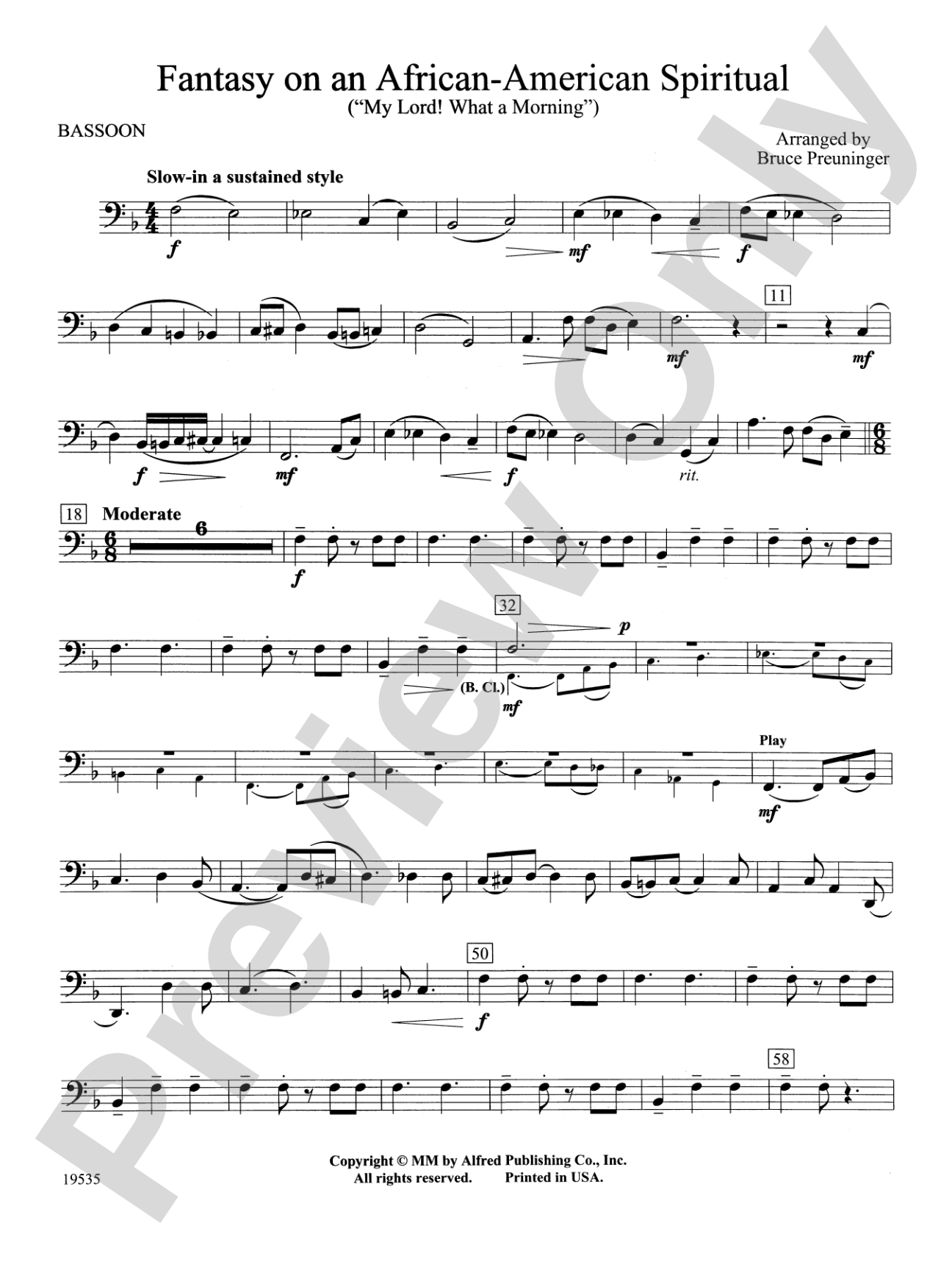

Fantasy on an African-American Spiritual: Bassoon
(My Lord What a Morning)
Arr. Bruce Preuninger
Grade: 3 (Medium)
Item: 00-PC-0000331_B1
$3.00
Pickup currently not available
Description
Bruce Preuninger has successfully managed to capture the sound and feel of the spiritual in the context of a large ensemble. In Fantasy on an African-American Spiritual, the composer has arranged the famous spiritual "My Lord what a Morning," for Grade 3 concert band. It opens with an incredible surge of harmony in chorale style. This leads to the faster main section that features jazzy rhythms with creative percussion accompaniment. This one is a real treat! This title is available in MakeMusic Cloud.


Don't just read it, hear it, play along with it, and watch your students grow with it. In MakeMusic Cloud, Fantasy on an African-American Spiritual: Bassoon comes alive with professional accompaniment, adjustable tempo, and built-in practice tools that turn solo practice into real progress.
Open in the Player
Jump straight in and assign it today.
Start Your Free Trial
Open this title and explore the full library in minutes.
Sample Audio
1
Audio File
--:--
0:00
0:00
Sample Video
No sample videos found.
Additional Details
Series:
Alfred Concert Band
Publisher:
Alfred Music
Page Count:
272
SKU:
00-PC-0000331_B1
More about this title
About the Composer: Bruce Preuninger

Bruce Preuninger earned his Bachelor's degree in Music Education from Eastern Washington University and went on to complete graduate work at Gonzaga University, where he focused on K-12 music curriculum development. His 36-year career in instrumental music education spanned two Washington school districts: Bellevue and the East Valley School District of Spokane. Since retiring from full-time classroom teaching in 2005, his compositions for band have been widely adopted by Alfred Music and have earned recognition on state and international competition programs.
Why we love this
Preuninger understands how to honor the spiritual tradition while making it sound fresh and engaging for young musicians. The progression from stately chorale to syncopated main section gives you real architectural variety, and the creative percussion writing adds color without overcomplicating student parts. This is a piece that sits comfortably in Grade 3 but never talks down to your ensemble.
What to expect
The piece unfolds with the contemplative dignity of a spiritual in its opening moments, creating an atmosphere of reverence and weight. Then it shifts into something alive and rhythmically supple, infusing the familiar tune with jazz inflections and modern percussion colors while keeping its emotional core intact.
Who it's for
This work suits Grade 3 concert bands that are ready for mild harmonic sophistication and rhythmic variety, but don't yet require the technical demands of Grade 4 literature. It's ideal for groups wanting to explore American spiritual traditions in an accessible large-ensemble context, and it works equally well for festival repertoire or concert programming that celebrates cultural depth.
How to get the most out of it
- Balance the opening chorale so the harmonic richness reads clearly; student musicians often compress this section, so give explicit attention to dynamic shaping across the band.
- Establish the groove in the faster section early. The jazzy rhythms need a steady pulse, so lock the rhythm section first before integrating syncopation across the upper voices.
- Let the percussion accompaniment breathe as an integral voice, not as decoration. These parts are carefully crafted to support the spiritual's character, so they deserve rehearsal time alongside the melodic lines.
- Shape phrase endings with attention to the spiritual's call-and-response heritage. Where the writing suggests antiphonal passages, use slight breath space and dynamic tapering to highlight the conversation.
How to use it
Feature this as a concert centerpiece that allows you to speak about American spiritual traditions and their place in band literature. Its Grade 3 accessibility and festival-appropriate length make it suitable for mid-year concert programming, and it pairs well alongside other diverse cultural or sacred works to build thematic programming around heritage and tradition.
Skills your students will build
- Balancing chorale texture with independent harmonic voices
- Reading and executing syncopated rhythms against steady pulse
- Understanding call-and-response form rooted in spiritual tradition
- Coordinate with creative and non-standard percussion accompaniment
- Shaping dynamic contours across a large ensemble to support phrase architecture