
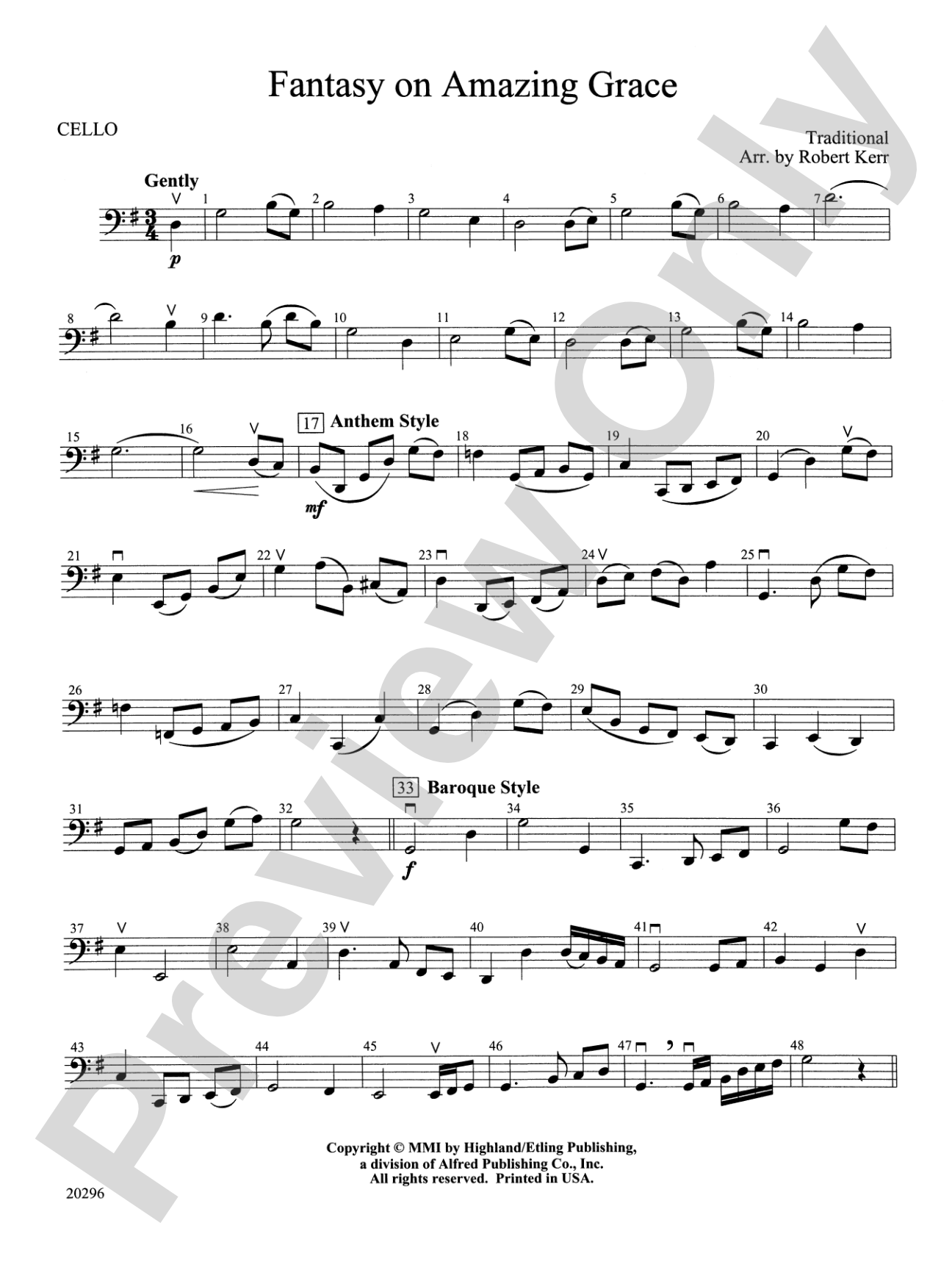

Fantasy on Amazing Grace: Cello
Arr. Robert Kerr
Grade: 4
Item: 00-PC-0000382_VC1
$5.99
Pickup currently not available
Description
Introduce students to the four major time periods of music, all in one piece! This work covers Baroque, Classical, Romantic and early twentieth century, while using what is undoubtedly one of the most beloved of American folk tunes. Inspiring and intriguing, Fantasy on Amazing Grace will touch the heart. This title is available in MakeMusic Cloud.


Don't just read it, hear it, play along with it, and watch your students grow with it. In MakeMusic Cloud, Fantasy on Amazing Grace: Cello comes alive with professional accompaniment, adjustable tempo, and built-in practice tools that turn solo practice into real progress.
Open in the Player
Jump straight in and assign it today.
Start Your Free Trial
Open this title and explore the full library in minutes.
Sample Audio
1
Audio File
--:--
0:00
0:00
Sample Video
No sample videos found.
Additional Details
Series:
Highland/Etling String Orchestra
Publisher:
Alfred Music
Page Count:
124
SKU:
00-PC-0000382_VC1
More about this title
Why we love this
Robert Kerr's arrangement accomplishes something genuinely difficult: it threads four distinct musical styles through a single melody without feeling fragmented or forced. The progression from Baroque counterpoint through Classical clarity into Romantic lyricism and twentieth-century modernism creates a natural arc that teaches period characteristics while maintaining emotional coherence. Your students will hear music history unfold organically, and audiences will recognize each stylistic shift as a deepening rather than a departure.
What to expect
Familiar and revelatory at once. The melody is comforting enough that listeners settle in immediately, but the harmonic language shifts beneath it in surprising ways. By the twentieth-century section, a tune everyone thought they knew has been transformed into something subtly unsettling and beautiful, only to resolve back into grace.
Who it's for
String orchestras at the intermediate level who are ready to tackle structural awareness and stylistic contrasts. This arrangement works for ensembles with mixed reading ability because each section reinforces a specific texture; stronger players anchor the counterpoint while younger musicians lock onto simpler figurations. It's equally suited to concert programming and festival competition.
How to get the most out of it
- Shape the Baroque section with clear articulation and rhythmic precision; the counterpoint needs to breathe independently in each voice without blurring into the texture.
- Allow the Romantic passage to sustain fully; this is where the melody becomes most vulnerable, and strings need permission to sing with generous vibrato.
- Navigate the twentieth-century material with confidence in its dissonance; brief harmonic uncertainty resolves beautifully if players commit to their parts without hedging.
- Use the recorded accompaniment (available separately) to anchor tempo relationships across style changes; the transitions will feel less jarring once the ensemble internalizes where each period begins and ends.
How to use it
Program this as a centerpiece for a concert built around American music or spirituals; it bridges folk tradition and concert sophistication in ways that make both accessible. It also pairs well with other period-specific works, serving as a through-composed answer to repertoire scattered across your season. For festival season, the dramatic arc and pedagogical clarity make it an impressive choice that judges recognize as musically substantive, not just technically flashy.
Skills your students will build
- Identifying and performing stylistic characteristics of four musical periods (Baroque, Classical, Romantic, twentieth century)
- Balancing independent melodic lines in contrapuntal textures
- Sustaining lyrical phrasing across harmonic changes in the Romantic section
- Managing dissonance and modern harmonic language with confidence and intonation
- Responding to conducting transitions between contrasting tempi and textures