
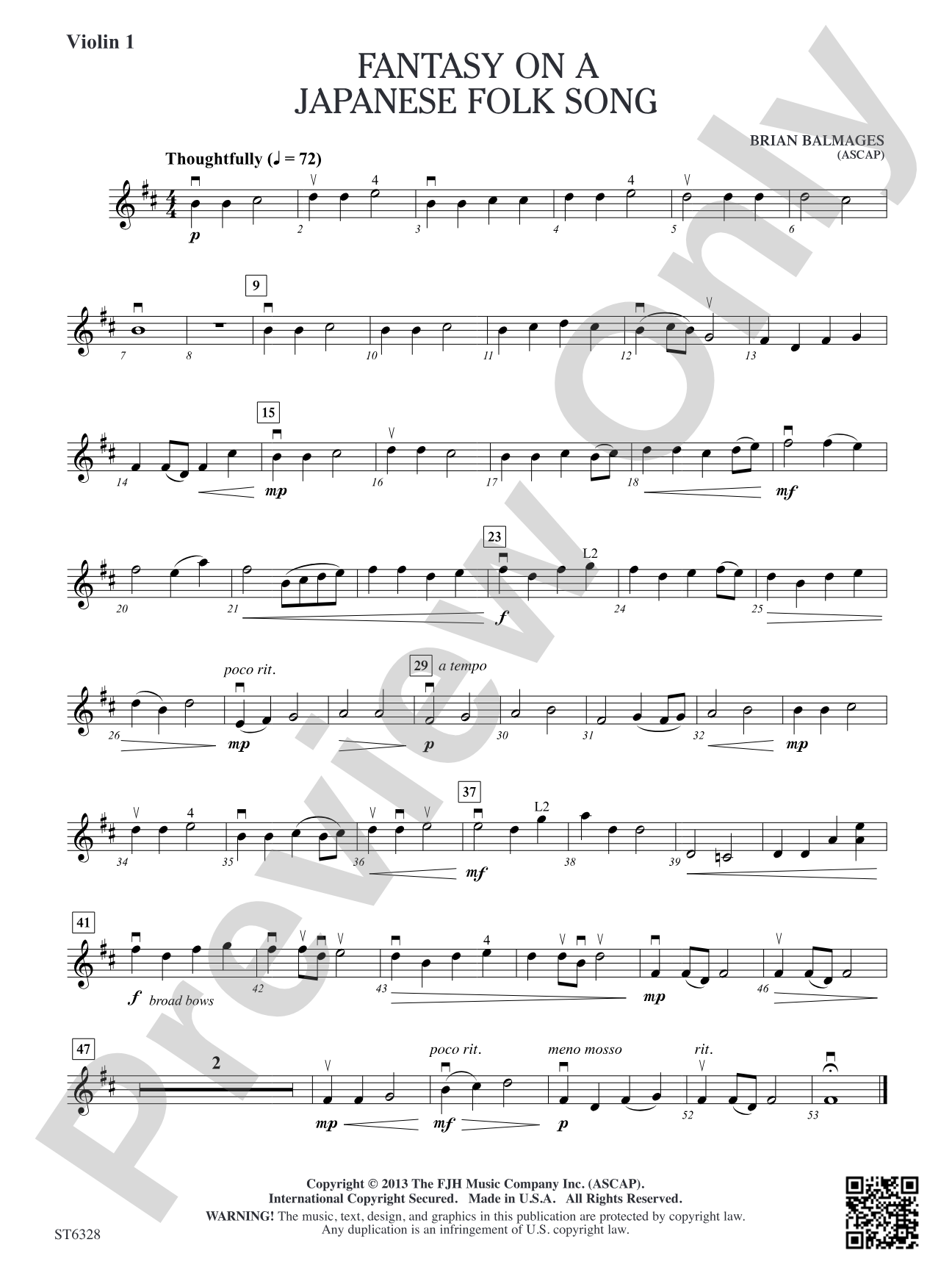

Fantasy on a Japanese Folk Song: Violin 1
By Brian Balmages
Grade: 1.5
Item: 98-PC-DST6328_VN1
$7.00
Pickup currently not available
Description
The haunting melody of "Sakura, Sakura" moves through a series of stunning and beautiful transformations before finally coming to rest in this musical fantasy. Tonal centers switch between minor and major as traditional melodies intertwine with thoughtful countermelodies and contemporary harmonies. Absolutely stunning. (3:45)


Don't just read it, hear it, play along with it, and watch your students grow with it. In MakeMusic Cloud, Fantasy on a Japanese Folk Song: Violin 1 comes alive with professional accompaniment, adjustable tempo, and built-in practice tools that turn solo practice into real progress.
Open in the Player
Jump straight in and assign it today.
Start Your Free Trial
Open this title and explore the full library in minutes.
Sample Audio
1
Audio File
--:--
0:00
0:00
Sample Video
No sample videos found.
Additional Details
Series:
FJH Beginning Strings
Publisher:
The FJH Music Company, Inc.
SKU:
98-PC-DST6328_VN1
More about this title
About the Composer: Brian Balmages

Brian Balmages has built a reputation as a composer and conductor working across orchestral, band, and chamber music with equal facility. His works have been performed by everyone from professional symphony orchestras to elementary school ensembles in major venues including Carnegie Hall, the Kennedy Center, Sydney Opera House, and the Toronto Centre for the Arts. He holds membership in the American Bandmasters Association and has received the A. Austin Harding Award from the American School Band Directors Association, along with the 2020 NBA William D. Revelli Composition Contest award for Love and Light.
Balmages received the inaugural Distinguished Alumni Award from James Madison University's School of Visual and Performing Arts and was later commissioned by the University of Miami to compose music for the inauguration of the institution's 6th president. His music was performed during the 2013 Presidential Inaugural Prayer Service. As a conductor, he regularly guests with all-state ensembles, university orchestras, and professional groups worldwide, with notable appearances at the Midwest Clinic, Western International Band Clinic, and numerous state ASTA conferences. He currently serves as Director of MakeMusic Publications and Digital Education for Alfred and MakeMusic.
Why we love this
Balmages transforms "Sakura, Sakura" into something far more ambitious than a straightforward arrangement. The tonal shifts between minor and major create harmonic interest without overwhelming young string players, while the integration of contemporary writing alongside folk melody teaches ensemble members how traditional material can speak in fresh contexts. At Grade 1.5, this sits at exactly the right balance of accessibility and sophistication for groups ready to move beyond simple melodic works.
What to expect
The piece unfolds with a dreamlike quality, as if the familiar cherry blossom melody is being seen through shifting light. Harmonic colors change the emotional temperature while the core melody remains recognizable, creating a sense of discovery rather than strangeness. By the final measures, the journey feels complete and purposeful, leaving players and audiences with something both beautiful and contemplative.
Who it's for
String orchestras at the Grade 1.5 level who have solid intonation fundamentals and are ready for pieces that expand beyond single-key thinking. This work appeals to groups pursuing festival and contest repertoire that values musicality and cultural awareness alongside technical accessibility.
How to get the most out of it
- Experiment with vibrato placement during the major key sections to brighten the sound while keeping intonation stable across the string sections.
- Mark the tonal center shifts in rehearsal so violins and lower strings understand when harmonic weight moves between them.
- Shape phrases according to the countermelody entrances; they drive the narrative as much as the main "Sakura, Sakura" line does.
- Allow time for the final resolution to breathe; the piece earns its ending, and rushing it undermines the journey through all those transformations.
How to use it
Program this as a bridge piece between traditional folk arrangements and more contemporary compositional approaches, or use it as a showcase for how a single melody can sustain an entire three-minute-plus work through harmonic and textural variation. It works equally well on festival programs, chamber concerts, or student recitals where programming depth matters.
Skills your students will build
- Sustaining tone quality across major and minor tonalities
- Tracking harmonic movement and tonal center shifts
- Balancing a primary melody with active countermelodies
- Responding to subtle dynamic and textural changes
- Understanding how contemporary harmonic language serves traditional material