
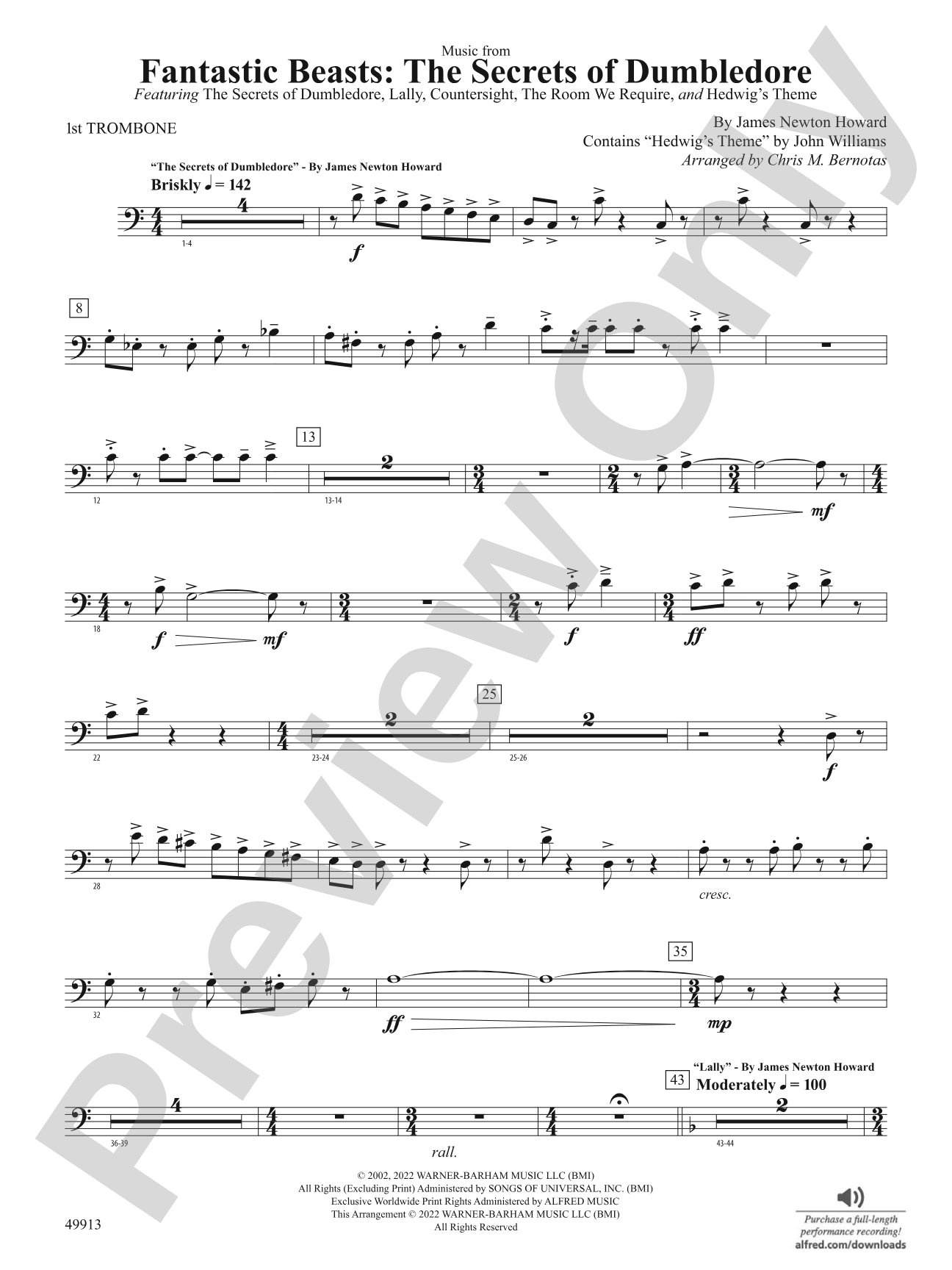

Fantastic Beasts: The Secrets of Dumbledore: 1st Trombone
Featuring: The Secrets of Dumbledore / Lally / Countersight / The Room We Require / Hedwig's Theme
By James Newton Howard, Contains "Hedwig's Theme" by John Williams / arr. Chris M. Bernotas
Grade: 3.5
Item: 00-PC-0018860_TN1
$5.99
Pickup currently not available
Description
Fantastic Beasts: The Secrets of Dumbledore is as musically intriguing as the motion picture's storyline with its stunning music by James Newton Howard. The magic and mystery of this installment of J.K. Rowling's adventure will come to life with this exciting arrangement by Chris M. Bernotas. This arrangement can be performed as a string orchestra alone or with any combination of winds and percussion up to a full orchestra. Featuring these highlights from the score: "The Secrets of Dumbledore," "Lally," "Countersight," "The Room We Require," and "Hedwig's Theme." (4:15)


Don't just read it, hear it, play along with it, and watch your students grow with it. In MakeMusic Cloud, Fantastic Beasts: The Secrets of Dumbledore: 1st Trombone comes alive with professional accompaniment, adjustable tempo, and built-in practice tools that turn solo practice into real progress.
Open in the Player
Jump straight in and assign it today.
Start Your Free Trial
Open this title and explore the full library in minutes.
Sample Audio
1
Audio File
--:--
0:00
0:00
Sample Video
Additional Details
Series:
Pop Concert Full Orchestra
Publisher:
Alfred Music
SKU:
00-PC-0018860_TN1
More about this title
About the Composer: James Newton Howard
James Newton Howard has composed for over 100 films, earning multiple Oscar and Grammy nominations for his work across genres ranging from action blockbusters to intimate dramas. His orchestral writing combines accessibility with sophisticated harmonic language, making his scores engaging for both film audiences and concert performers. Howard's decades of experience scoring major studio productions has made him a master of creating memorable thematic material that translates effectively to the concert hall.
Why we love this
Bernotas's arrangement captures Howard's signature orchestral color while remaining playable at the Grade 3.5 level, a genuinely difficult balance to strike. The flexibility to perform as strings alone or scale up to full orchestra means you can use this with the ensemble you have right now, making it practical for orchestras at different stages of development. The five featured themes are instantly recognizable to students, which translates to genuine engagement and motivation during rehearsals.
What to expect
The music moves between moments of mystery and wonder, with lush harmonic colors that recall the magical atmosphere of the Wizarding World while remaining grounded in Howard's gift for memorable melody. There's a sense of narrative arc throughout the medley, building from intimate themes to broader, more cinematic moments that feel genuinely orchestral despite the Grade 3.5 difficulty level. The arrangement captures both the adventure and the emotional depth of the film's score.
Who it's for
This arrangement serves orchestras with intermediate players (Grade 3.5) who want to perform recognizable, film-based music without sacrificing musicality. It works equally well for ensembles with limited instrumentation, since the string-only option doesn't compromise the arrangement's integrity. Directors seeking accessible but musically substantial repertoire for concerts, festivals, or film-themed programs will find this especially valuable.
How to get the most out of it
- Balance the melodic lines carefully across string sections; Howard's orchestration often layers themes, and clarity requires precise dynamic control from each section rather than relying on volume alone.
- Establish the harmonic foundation in the lower strings and winds before bringing out the upper melodic voices; this layering approach is central to how the score creates its sense of mystery.
- Use the conductor's score to identify which instrumental families carry the primary theme in each section, then rehearse those parts independently before combining; this saves rehearsal time and ensures confident execution.
- Pay particular attention to articulation markings in the winds and brass; small choices in tonguing style will either enhance or blur the magical character the arrangement is designed to evoke.
How to use it
This works beautifully as a concert opener or closing feature, especially if you're building a program around film and media music, contemporary composers, or cross-curricular connections with arts and literature classes. The 4:15 runtime fits efficiently into most concert structures, and the immediate familiarity means audiences connect with it instantly. Consider pairing it with other Howard scores or contemporary film music at similar difficulty levels to create thematic cohesion.
Skills your students will build
- Reading layered orchestral textures and maintaining independent lines while hearing the full ensemble sound
- Balancing melody and accompaniment across string and wind sections
- Executing articulation and phrasing choices that serve narrative and emotional content
- Adapting to flexible instrumentation and making informed decisions about which parts to double or omit
- Responding to conductor cues across extended musical phrases without vertical downbeats to anchor every entrance