
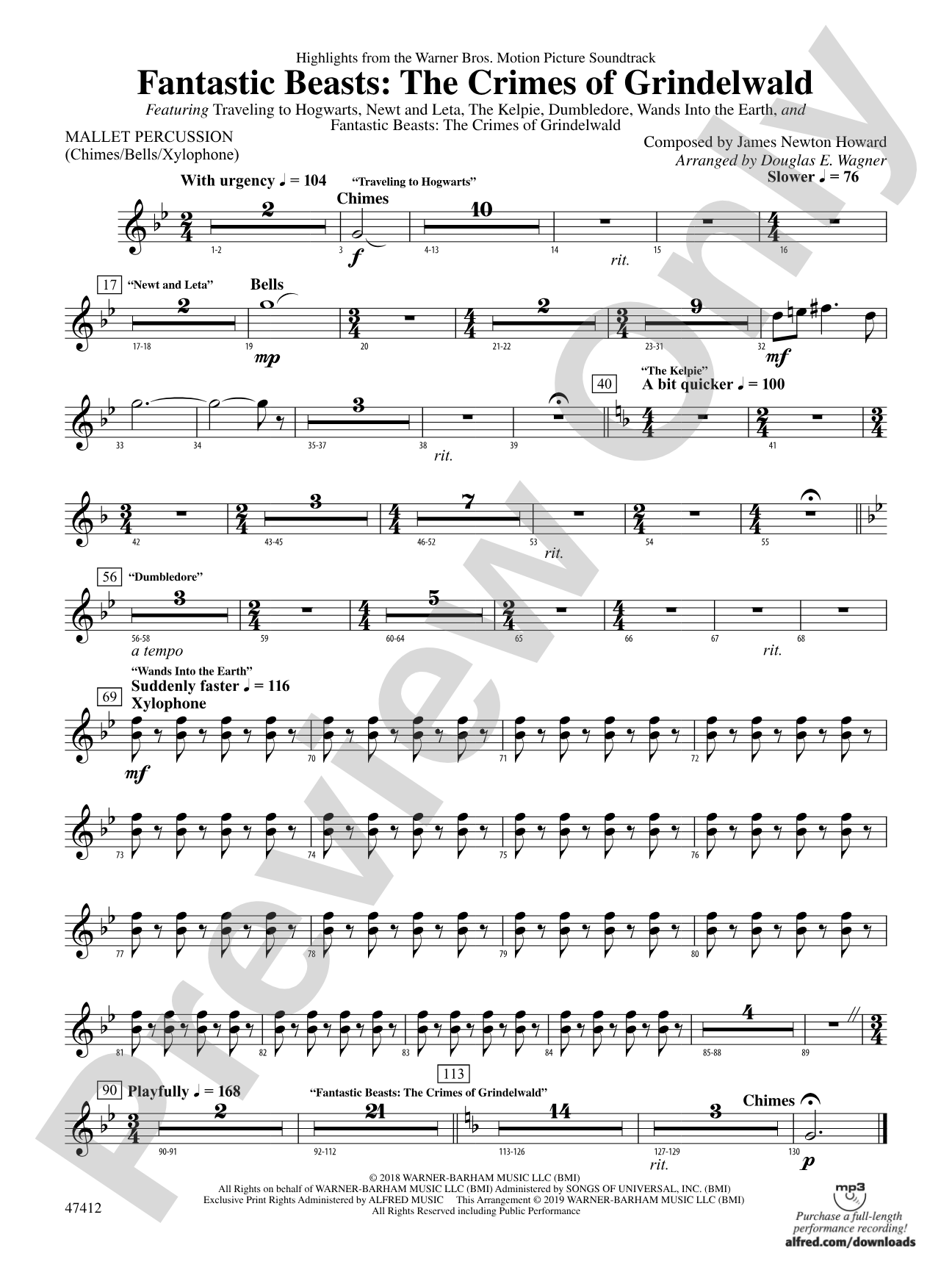

Fantastic Beasts: The Crimes of Grindelwald: Mallets
Featuring: Traveling to Hogwarts / Newt and Leta / The Kelpie / Dumbledore / Wands Into the Earth / Fantastic Beasts: The Crimes of Grindelwald
By James Newton Howard / arr. Douglas E. Wagner
Grade: 2.5 (Easy to Medium Easy)
Item: 00-PC-0017944_M1
$3.00
Pickup currently not available
Description
J. K. Rowling's Wizarding World is awakened again in this emotionally charged, action-packed medley that includes six musical moments drawn from the stunning James Newton Howard soundtrack of the second film in the Fantastic Beasts trilogy. (4:00)


Don't just read it, hear it, play along with it, and watch your students grow with it. In MakeMusic Cloud, Fantastic Beasts: The Crimes of Grindelwald: Mallets comes alive with professional accompaniment, adjustable tempo, and built-in practice tools that turn solo practice into real progress.
Open in the Player
Jump straight in and assign it today.
Start Your Free Trial
Open this title and explore the full library in minutes.
Sample Audio
1
Audio File
--:--
0:00
0:00
Sample Video
Additional Details
Series:
Pop Young Band
Publisher:
Alfred Music
Page Count:
240
SKU:
00-PC-0017944_M1
More about this title
About the Composer: James Newton Howard
James Newton Howard stands among today's most prolific film composers, with a catalog spanning four decades of theatrical releases, television scores, and concert works. His orchestral writing balances accessibility with sophistication, a quality that has made his film music both emotionally resonant and educationally valuable for young musicians. His work on the Fantastic Beasts franchise demonstrates his gift for creating thematic material that remains memorable across multiple hearings while maintaining enough harmonic and orchestral interest to challenge growing ensembles.
Why we love this
Douglas E. Wagner's arrangement distills the emotional arc and cinematic momentum of Howard's original score into a medley that respects the film's storytelling without overwhelming a Grade 2.5 band. The piece moves between introspective moments and driving action sequences, giving conductors real interpretive choices about pacing and balance. Young musicians get to perform music they recognize and care about while developing foundational skills in ensemble blend and phrase shaping.
What to expect
The piece immerses players in a soundscape that shifts between moments of mystery and wonder and sequences of urgency and conflict. Howard's signature orchestral textures translate into rich harmonic colors that young bands can access through careful attention to blend and balance. The four-minute medley maintains forward momentum while allowing space for reflection, mirroring the emotional journey of the film itself.
Who it's for
Concert bands at the Grade 2.5 level, including middle school groups and developing high school ensembles, will find this arrangement accessible without feeling oversimplified. Directors programming popular film music will appreciate that this medley captures the emotional weight and action of the film while remaining within the technical reach of younger musicians. Students familiar with the Fantastic Beasts films will bring genuine engagement to rehearsals and performances.
How to get the most out of it
- Balance the woodwind section carefully during the lyrical passages; these moments establish the emotional foundation that makes the action sequences land with impact.
- Use the natural sectional breaks between the six musical moments to reset ensemble focus and prepare for tonal and stylistic shifts.
- Attend to the dynamic contrast between pianissimo and fortissimo sections; the drama of this medley depends on restraint as much as energy.
- Shape longer phrases by thinking about breath and momentum rather than bar lines, especially in the slower material where younger players often rush.
How to use it
This works well as a feature on a concert celebrating film music or popular entertainment, where it can anchor a thematic set alongside other movie or television scores. It also serves as an engaging finale to a concert program, offering immediate audience recognition and a satisfying conclusion that doesn't demand extended silence for applause. Consider programming it midway through a season to maintain energy and momentum while audiences are learning what your band can accomplish with contemporary material.
Skills your students will build
- Balancing multiple woodwind sections in sustained harmonic passages
- Shifting between contrasting tempos and styles within a single piece
- Reading compound orchestrations that divide traditional band parts
- Shaping longer melodic phrases with intentional dynamics and rubato
- Responding to conductor cues that mark transitions between medley sections