
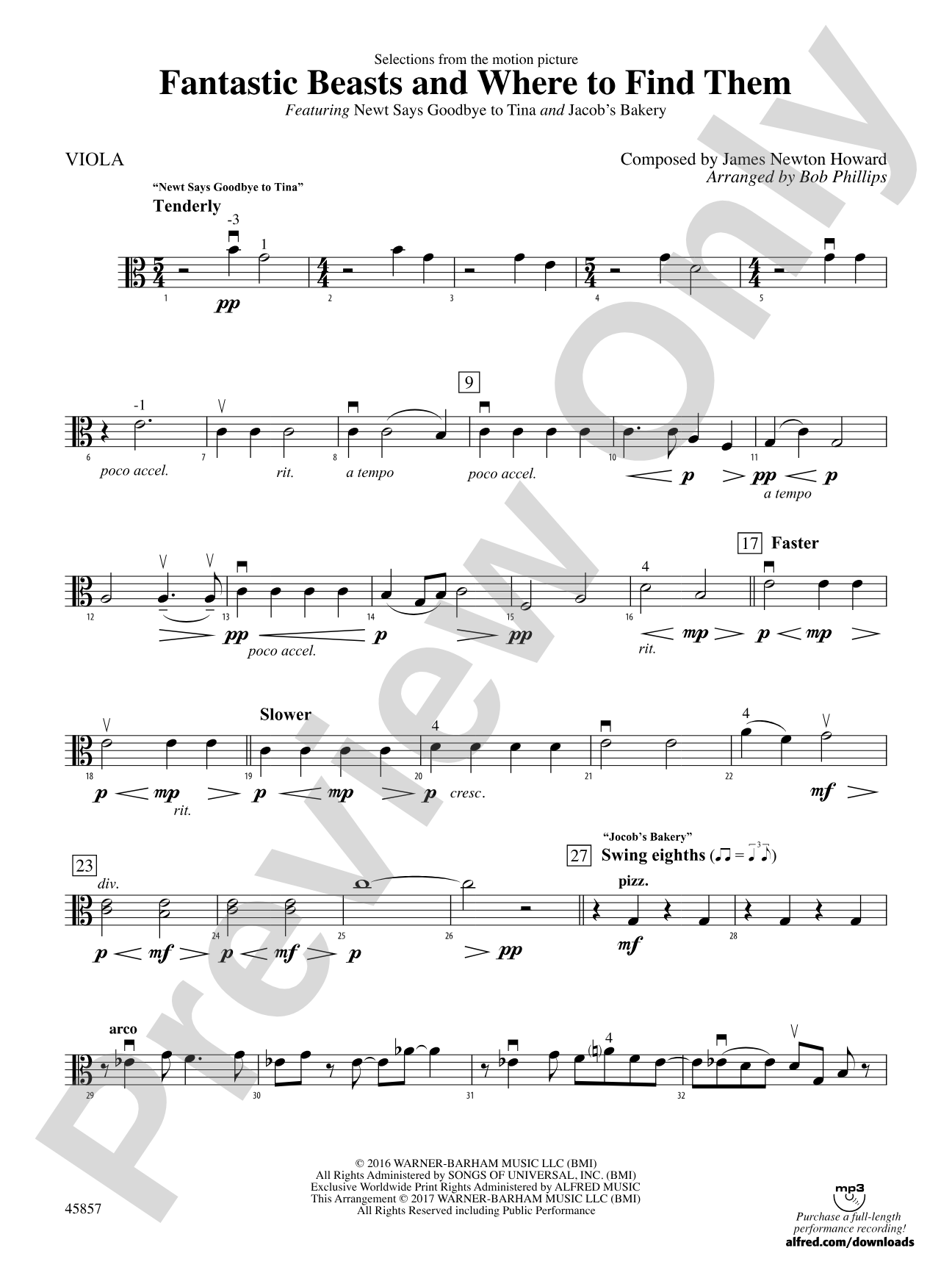

Fantastic Beasts and Where to Find Them: Viola
Featuring: Newt Says Goodbye to Tina / Jacob's Bakery
Composed by James Newton Howard / arr. Bob Phillips
Grade: 3
Item: 00-PC-0017656_VA1
$7.99
Pickup currently not available
Description
Enjoy the fantasy and thrills of the adventures from J. K. Rowling in this delightful setting from Fantastic Beasts and Where to Find Them. Very simple, elegant, and beautiful, this is also a great piece to work on shifting. The violins use 3rd position while the cellos use both 3rd and 4th positions. There are spots that will work nicely in positions other than those marked for the violas and basses if you want to have all sections work on shifting. Featuring "Newt Says Goodbye to Tina" and "Jacob's Bakery." (3:20) This title is available in MakeMusic Cloud.


Don't just read it, hear it, play along with it, and watch your students grow with it. In MakeMusic Cloud, Fantastic Beasts and Where to Find Them: Viola comes alive with professional accompaniment, adjustable tempo, and built-in practice tools that turn solo practice into real progress.
Open in the Player
Jump straight in and assign it today.
Start Your Free Trial
Open this title and explore the full library in minutes.
Sample Audio
1
Audio File
--:--
0:00
0:00
Sample Video
Additional Details
Series:
Pop Concert String Orchestra
Publisher:
Alfred Music
Page Count:
116
SKU:
00-PC-0017656_VA1
More about this title
About the Composer: James Newton Howard
James Newton Howard has scored more than 100 films across multiple genres, earning multiple Grammy and Academy Award nominations. His work spans blockbuster franchises, independent dramas, and animated features, establishing him as one of the most versatile film composers of his generation. In the classroom, his orchestrations serve as accessible entry points to contemporary film scoring and demonstrate how melody, harmony, and orchestration work together to support narrative.
Why we love this
Bob Phillips has crafted an arrangement that captures the warmth and wonder of the Fantastic Beasts score while keeping the technical demands genuinely manageable for a Grade 3 ensemble. The deliberate focus on shifting (violins in 3rd position, cellos in both 3rd and 4th) gives students a specific musical goal that feels purposeful rather than arbitrary, and the marked positions provide flexibility for directors who want to customize the challenge level for different sections.
What to expect
Elegant and cinematic, this setting brings the whimsy and heart of the wizarding world to the concert stage. The arrangement honors Howard's original orchestration in miniature, delivering moments of warmth and wonder that feel far more sophisticated than the technical demands suggest.
Who it's for
String orchestras working at the Grade 3 level who want to program recognizable, emotionally engaging film music without sacrificing technical development. Directors seeking a manageable piece that allows systematic work on position shifting across the entire ensemble will find the built-in pedagogical structure particularly valuable.
How to get the most out of it
- Establish the shifting passages in isolation before running them with the full ensemble. Have violins work the 3rd position writing in the opening passages separately, then integrate gradually with violas and basses to lock the intonation.
- Balance the two themes carefully: 'Newt Says Goodbye to Tina' benefits from warm, singing tone in the upper strings, while 'Jacob's Bakery' needs lightness and clarity to capture its character. Conductor's choice of tempo will determine how much rubato feels natural.
- Use the marked positions as a starting framework, then experiment with alternative positions in violas and basses during sectionals. Students often discover more efficient or comfortable fingerings once they understand the piece's architecture.
- Mark cues clearly between the two themes and any transitions, especially if you're alternating between sections for rehearsal efficiency.
How to use it
Program this alongside other contemporary film scores or fairy tale-inspired pieces to create a themed concert that appeals to student musicians and audiences alike. The Grade 3 accessibility makes it ideal for mid-season programming when ensembles have developed basic technique but are still building confidence with shifting and position work.
Skills your students will build
- Shifting into 3rd and 4th positions with secure intonation
- Playing alternative positions for the same pitch to develop flexibility
- Sustaining long, lyrical lines with consistent tone quality
- Balancing between melody and accompaniment in thematic sections
- Responding to conductor cues between contrasting musical themes