
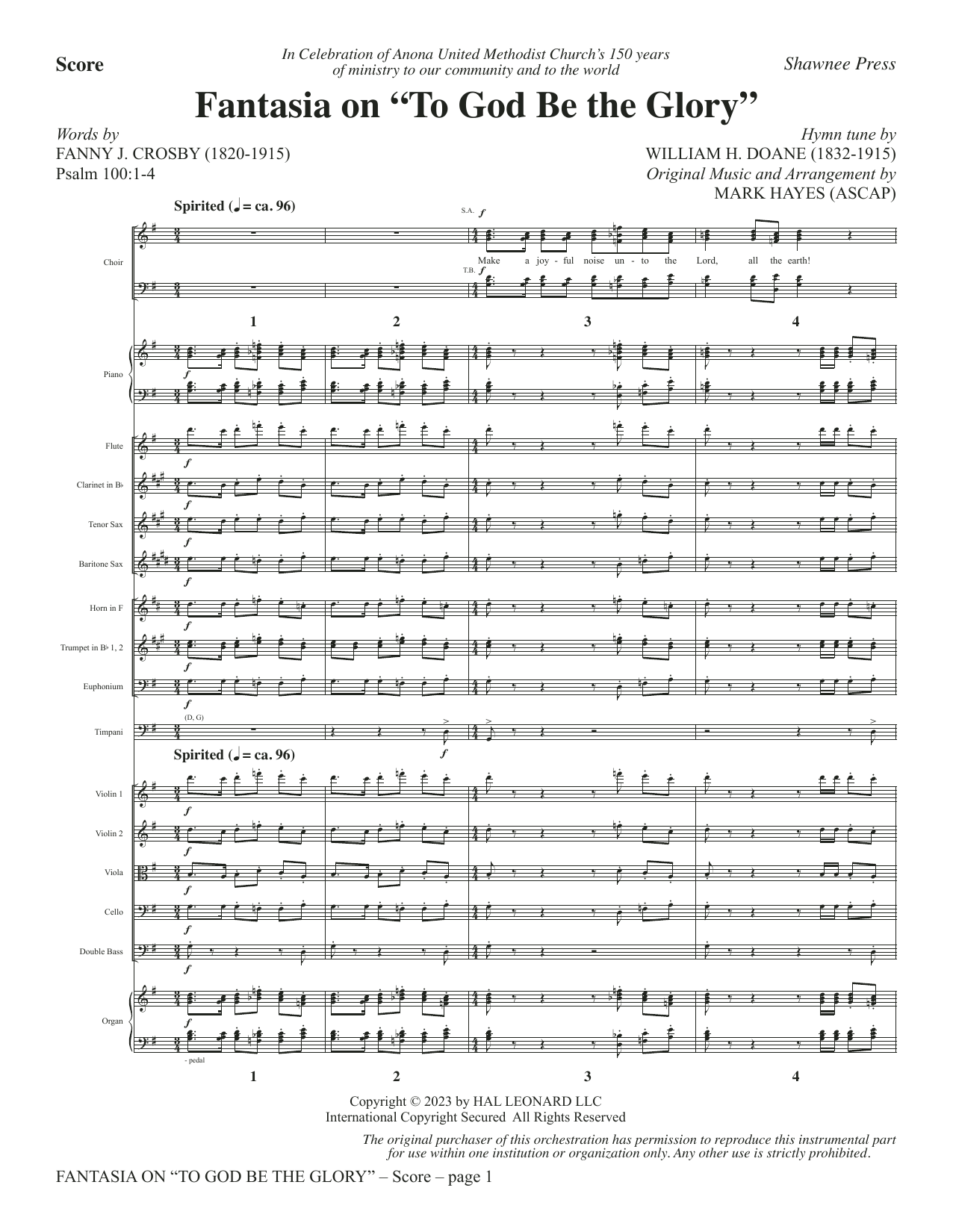

Fantasia On "To God Be The Glory": Choral Instrumental Pak
By William H. Doane / By Fanny J. Crosby / Arranged by Mark Hayes
Item: 35-PK01275653
$74.95
Pickup currently not available
Buy Extra Parts (Digital PDF Download)
Parts Added to Cart!
Description
There is a festive flourish in this epic version of this beloved hymn that is sure to appeal to any worship setting. With dazzling color and brilliant choral texturing, this arrangement is perfectly paced to deliver a praiseworthy message of God's mystery and majesty. Score and Parts (pno, fl, cl, tsx, bsx, hn, tpt 1-2, euph, timp, vn 1-2, va, vc, db) available as a digital download.


Fantasia On "To God Be The Glory": Choral Instrumental Pak isn't in MakeMusic Cloud just yet...but it could be. Let us know you'd like to see it, and you'll help shape what comes next. In the meantime, start a free trial and dive into thousands of interactive titles your students can play along with today.
Request This Title
Tell us you want it.
Start Your Free Trial
Explore everything that's ready to play right now.
Sample Audio
No sample audio found.
Sample Video
No sample videos found.
Additional Details
Publisher:
Hal Leonard
SKU:
35-PK01275653
More about this title
About the Composer: William H. Doane
William H. Doane (1832–1915) was a prolific American composer and music publisher who shaped congregational worship through his distinctive hymn melodies. Working alongside poet Fanny J. Crosby, Doane composed over 2,200 songs, many of which remain central to evangelical and mainstream Protestant hymnals. His gift lay in creating memorable, singable melodies that lodge in a congregation's memory while serving as strong harmonic foundations for arrangement and elaboration.
Doane's output spanned both simple four-part congregational settings and more elaborate instrumental works, making him an essential figure in American sacred music publishing. His melodies have proven remarkably durable, surviving more than 150 years of worship practice and continuing to inspire fresh orchestral treatments by contemporary arrangers.
Why we love this
Mark Hayes' orchestration transforms a beloved hymn into something theater-ready without losing congregational recognition. The arrangement respects the melodic core that generations know while layering instrumental color and harmonic sophistication that rewards both ensemble players and listeners; your instrumentalists gain genuine artistic material, not mere accompaniment filler.
What to expect
Affirmative and radiant. The arrangement swells with triumphant orchestral momentum, weaving hymn-singing intimacy with concert hall grandeur. There is reverence here alongside celebration, creating space for both contemplation and proclamation within a single performance.
Who it's for
Worship settings needing an orchestral treatment substantial enough to carry a special service or seasonal emphasis, with players ranging from intermediate community musicians to accomplished amateurs. Effective for both traditional sanctuaries and contemporary worship spaces where instrumental color matters as much as vocal proclamation.
How to get the most out of it
- Balance the timpani with the string section during the opening statements. The percussion should accent but never overwhelm the foundational harmony.
- Coordinate the woodwind and brass textures in the choral sections. Clarity matters more than volume; each choir voicing needs daylight between instrumental colors.
- Bring the euphonium solo passages forward during rehearsal to ensure the players recognize and lock into their counter-melodic material.
- Let the piano breathe during transitions between sections. This arrangement lives in rubato moments; a steady click track will flatten the pacing.
How to use it
Program this as a processional or recessional moment that anchors a service around themes of thanksgiving or God's character. It also serves as a powerful festival closer where your full ensemble (choir, orchestra, soloists) creates a unified statement rather than a single choir or instrument carrying the text alone.
Skills your students will build
- Interpreting orchestral doubling and color layering in arrangement
- Balance and blend across mixed instrumental choirs (woodwind, brass, strings)
- Sustaining musical line through harmonic elaboration and textural variation
- Coordinating ensemble entrances when material moves across different instrumental families
- Sight-reading unfamiliar orchestral contexts from a known hymn foundation