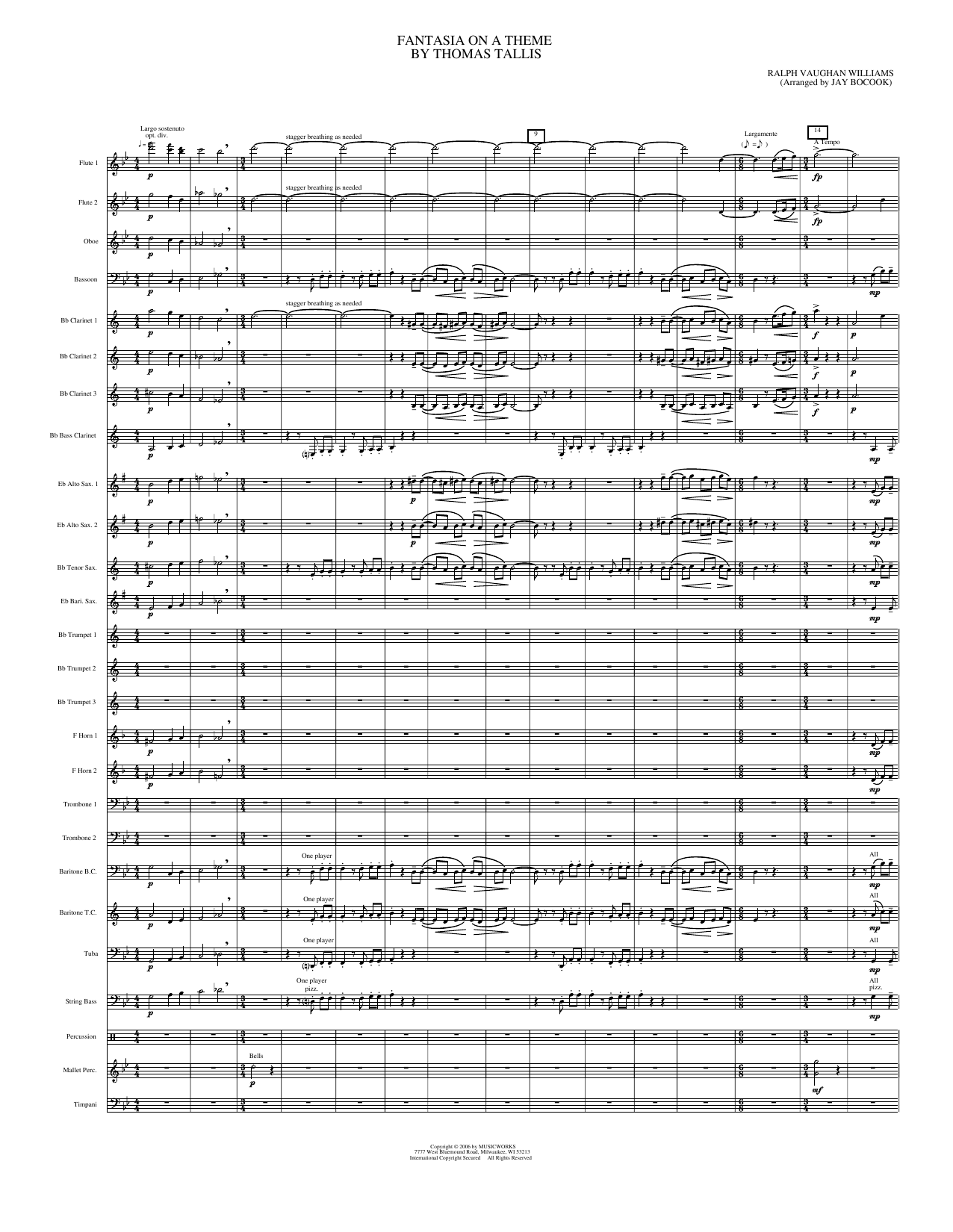
Ralph Vaughan Williams (1872–1958) stands as one of England's most significant composers, and his influence on wind band literature remains profound. He drew deeply from English folk music and Renaissance sources throughout his career, synthesizing these vernacular traditions with sophisticated harmonic language. His arranging work for concert band helped establish the medium as a legitimate vehicle for serious musical expression in the twentieth century.
Why we love this
Bocook's arrangement captures the luminous, contemplative quality of Vaughan Williams's original string fantasia while writing idiomatically for winds and brass. The Grade 3 scoring makes this Renaissance masterwork accessible to developing musicians without sacrificing the harmonic richness and structural sophistication that make the piece endure. Programming this opens conversations about how great composers reimagined historical material and gives your ensemble a chance to inhabit something genuinely substantial.
What to expect
Lyrical and meditative, with moments of quiet dignity that invite introspection. The arrangement unfolds like a gentle turning over of a precious artifact, each new phrase a different perspective on Tallis's elegant theme, wrapped in impressionistic harmony that feels both ancient and timeless.
Who it's for
Concert bands at the intermediate level seeking repertoire with genuine musical depth and historical significance. Directors who want their students to engage with a twentieth-century masterwork that draws from Renaissance sources without overwhelming younger ensembles.
How to get the most out of it
Shape the opening statement of Tallis's tune with long, connected phrasing in the melodic voices; the surrounding harmonic texture should recede slightly to let this timeless melody speak clearly
Balance the orchestration carefully during passages where melodic material passes between sections; each new statement deserves to emerge naturally rather than spike in volume
Attend to the tempo flexibility inherent in the work; Vaughan Williams expects subtle breath and give in the pacing, not a metronomic approach
Work sectional passages to ensure clean voice leading, particularly where inner parts carry important harmonic or countermelodic ideas
How to use it
This works beautifully as a concert centerpiece or as an elegant contrast piece alongside more energetic selections. Consider pairing it with other Renaissance-influenced works or placing it in a program section devoted to composers' explorations of historical material to deepen the thematic resonance.
Skills your students will build
Balancing and blending sustained harmonic textures
Sustaining long melodic phrases with consistent breath support
Following subtle tempo and dynamic shaping in non-metric contexts
Voice leading awareness through harmonic progression
Listening to and responding to multiple simultaneous musical lines
You May Also Like
Scan to Complete Your Purchase
Use your phone's camera to scan the code below
You'll log in on your phone and the order will be added to your account