Fantasia in C: 3rd Trombone Sheet Music Preview

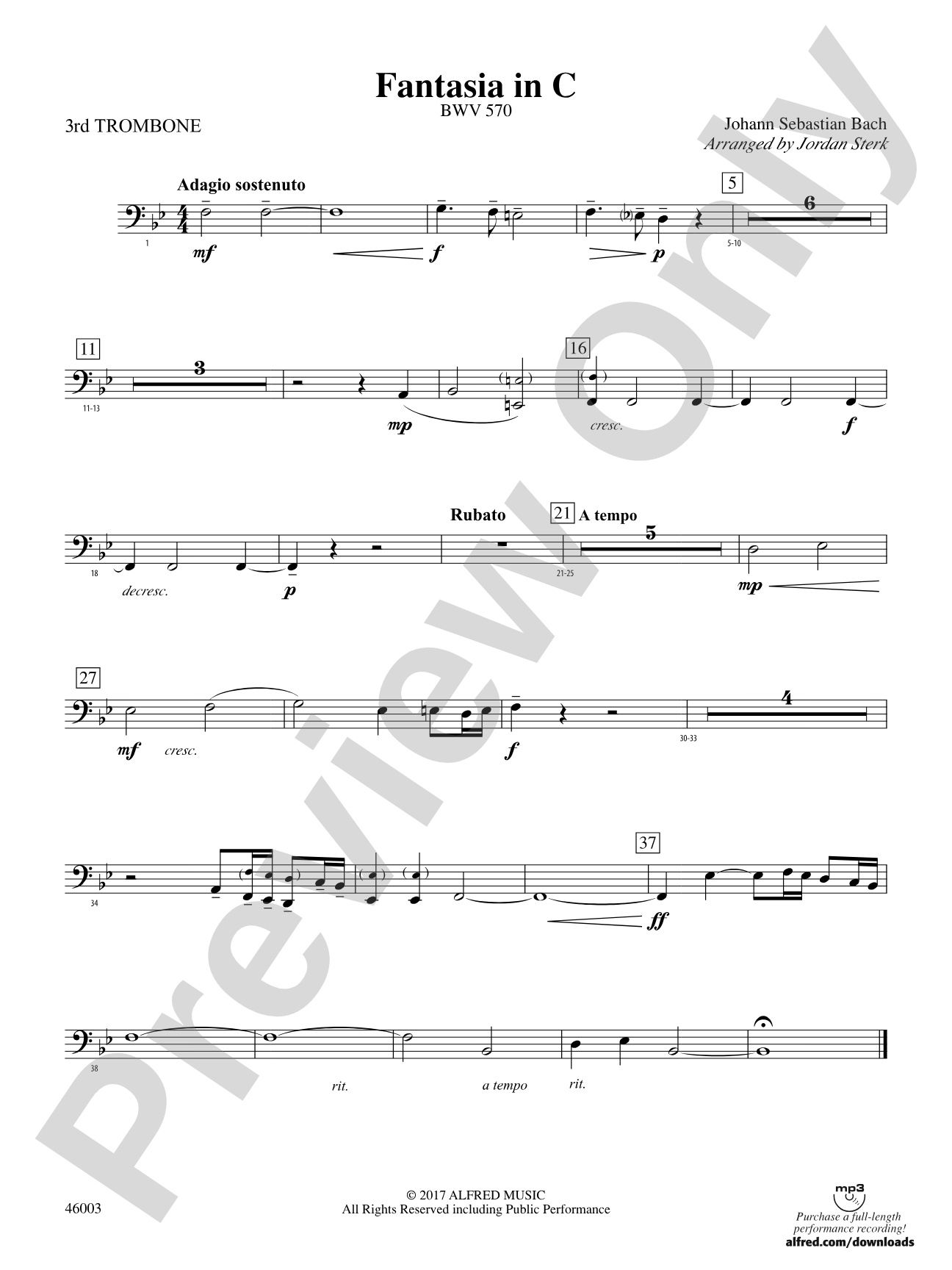
Fantasia in C: 3rd Trombone

BWV 570

By Johann Sebastian Bach / arr. Jordan Sterk

Grade: 3 (Medium)

Item: 00-PC-0017729_TN3

Digital Download
$3.00
Description
This arrangement of the baroque organ work by Johann Sebastian Bach preserves all of the rhythms and style of the original, but transposes to the key of B-flat for more accessibility. (2:30)

Don't just read it, hear it, play along with it, and watch your students grow with it. In MakeMusic Cloud, Fantasia in C: 3rd Trombone comes alive with professional accompaniment, adjustable tempo, and built-in practice tools that turn solo practice into real progress.

Sample Audio
0:00
0:00
Sample Video
Additional Details
Series: Alfred Concert Band
Publisher: Alfred Music
Page Count: 126
SKU: 00-PC-0017729_TN3

More about this title

About the Composer: Johann Sebastian Bach

Johann Sebastian Bach (1685-1750) stands as one of history's most systematic and inventive composers. His mastery of counterpoint, harmonic language, and structural architecture created a foundation that shaped every musical tradition that followed. Though he worked primarily in church and court settings across Germany, his influence extends far beyond his era, making him essential study for musicians at every level.

Why we love this

Jordan Sterk's arrangement honors Bach's intricate voice-leading and baroque sensibility while solving a real accessibility problem for concert bands: the original organ work sits uncomfortably for most ensembles. Moving it to B-flat preserves every rhythmic gesture and stylistic element without forcing compromises, and the 2:30 duration makes this a natural fit for concert or festival programming without requiring an enormous time commitment from rehearsals.

What to expect

Intricate and purposeful, like watching a jeweler assemble a mechanism. Bach's writing generates momentum through layered lines that weave independent paths toward harmonic destinations. The piece feels both intellectual and alive, never static despite its baroque foundation.

Who it's for

Directors working with Grade 3 bands who want to introduce students to Bach's structural thinking and counterpoint without drowning them in technical difficulty. Advanced middle school and less experienced high school ensembles benefit from studying genuine baroque architecture at a manageable level.

How to get the most out of it

  • Emphasize the independence of each voice line, particularly in passages where Bach moves chromatic figures through different sections. This clarity distinguishes baroque counterpoint from homophonic textures.
  • Balance the sustained lines in woodwinds and low brass carefully; Bach's organ registration changes become dynamic shaping opportunities in band voicing.
  • Keep harmonic rhythm steady throughout. The piece's momentum depends on precise ensemble coordination rather than rubato or expressive drag.
  • Highlight the dance-like quality that emerges in faster sections. This is not austere organ music; it swings with baroque rhythmic vitality.

How to use it

Open a concert with this piece to establish a connection to historical repertoire and set an engaged, sophisticated tone. Its length makes it ideal for pairing alongside a contemporary work to highlight how composition language has evolved. Festivals particularly value Bach arrangements that demand real musicianship without requiring virtuosic chops.

Skills your students will build

  • Voice independence and inner part awareness in polyphonic textures
  • Baroque rhythmic articulation and style conventions
  • Chromatic voice-leading and harmonic progression reading
  • Ensemble precision and balance in multi-line writing
  • Sustained tone control and legit phrasing across longer phrases

You May Also Like