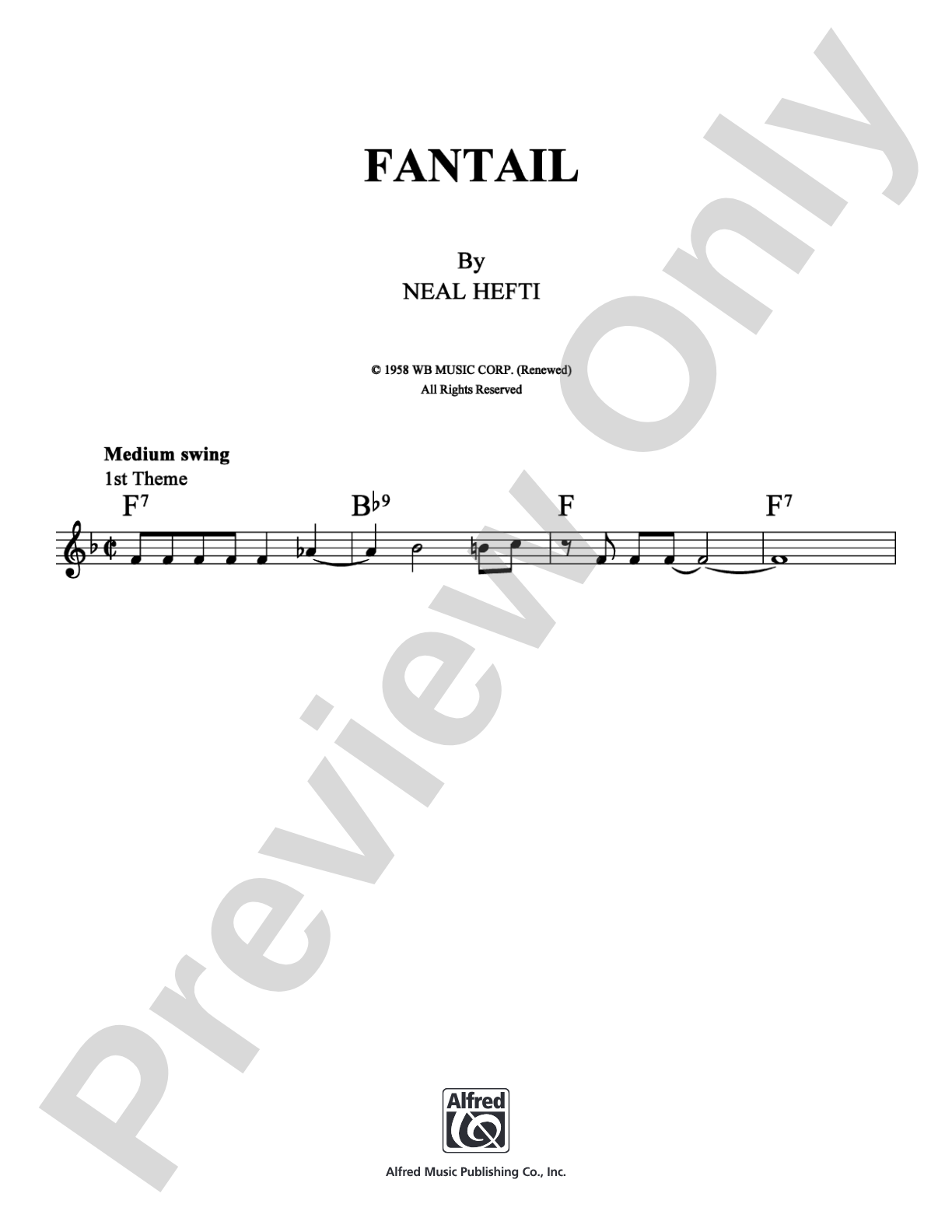
Fantail: Lead Sheet Digital Sheet Music

Fantail: Lead Sheet Digital Sheet Music

Neal Hefti, Count Basie

Item: 00-PS-0009235

Digital Download
$1.99
Description

Fantail: Lead Sheet Digital Sheet Music isn't in MakeMusic Cloud just yet...but it could be. Let us know you'd like to see it, and you'll help shape what comes next. In the meantime, start a free trial and dive into thousands of interactive titles your students can play along with today.

Sample Audio
No sample audio found.
Sample Video
Additional Details
SKU: 00-PS-0009235

More about this title

About the Artist: Count Basie

Count Basie (1904-1984) shaped American jazz through his work as a pianist, organizer, and bandleader. His Kansas City style emphasized rhythmic precision, call-and-response arranging, and the interplay between a tight rhythm section and soloists who had room to breathe. Basie's bands became models for how big bands could swing with economy rather than elaboration.

Why we love this

Fantail gives jazz students and small ensemble directors access to an authentic Basie composition in lead sheet form. The piece represents the kind of melody and harmonic language that bandleaders and soloists need to internalize, and a lead sheet format lets pianists, guitarists, and horn players work from the same skeleton and make real-time decisions about voicing and accompaniment style.

What to expect

Fantail swings with the relaxed confidence of a master bandleader who trusts his players. The melody has shape and personality without demanding show; the harmony sits in the pocket and leaves room for someone to take a solo and own it.

Who it's for

Jazz pianists, guitarists, and small ensemble leaders who want to explore classic big band repertoire at close range. Rhythm section students building comping vocabulary will benefit from decoding Basie's harmonic choices note by note.

How to get the most out of it

  • Nail the time feel before adding ornament. Basie's melodies sit solidly on the beat, so lock the quarter-note pulse before experimenting with how the line breathes.
  • Voice the changes lean. Basie did not favor thick, complex chords; use shells (root, third, seventh) and let the soloist fill the air.
  • Listen to the original recording to hear where Basie places the melody relative to the beat. That phrasing is part of the composition.
  • Mark the form clearly on your chart. Lead sheets can look unmarked; write in A, B, and any repeats so ensemble members stay oriented.

How to use it

Feature this in a jazz history unit where students can trace how Basie's streamlined arranging approach differs from the densely voiced charts of his contemporaries. A small combo or big band can use it as a vehicle for teaching how a lead sheet becomes a full arrangement through rehearsal decisions.

Skills your students will build

  • Reading and interpreting lead sheet notation
  • Voice leading over changes in a swing idiom
  • Comping with space and taste rather than constant movement
  • Understanding form and form marking in jazz standards
  • Listening for and executing authentic swing phrasing

You May Also Like