
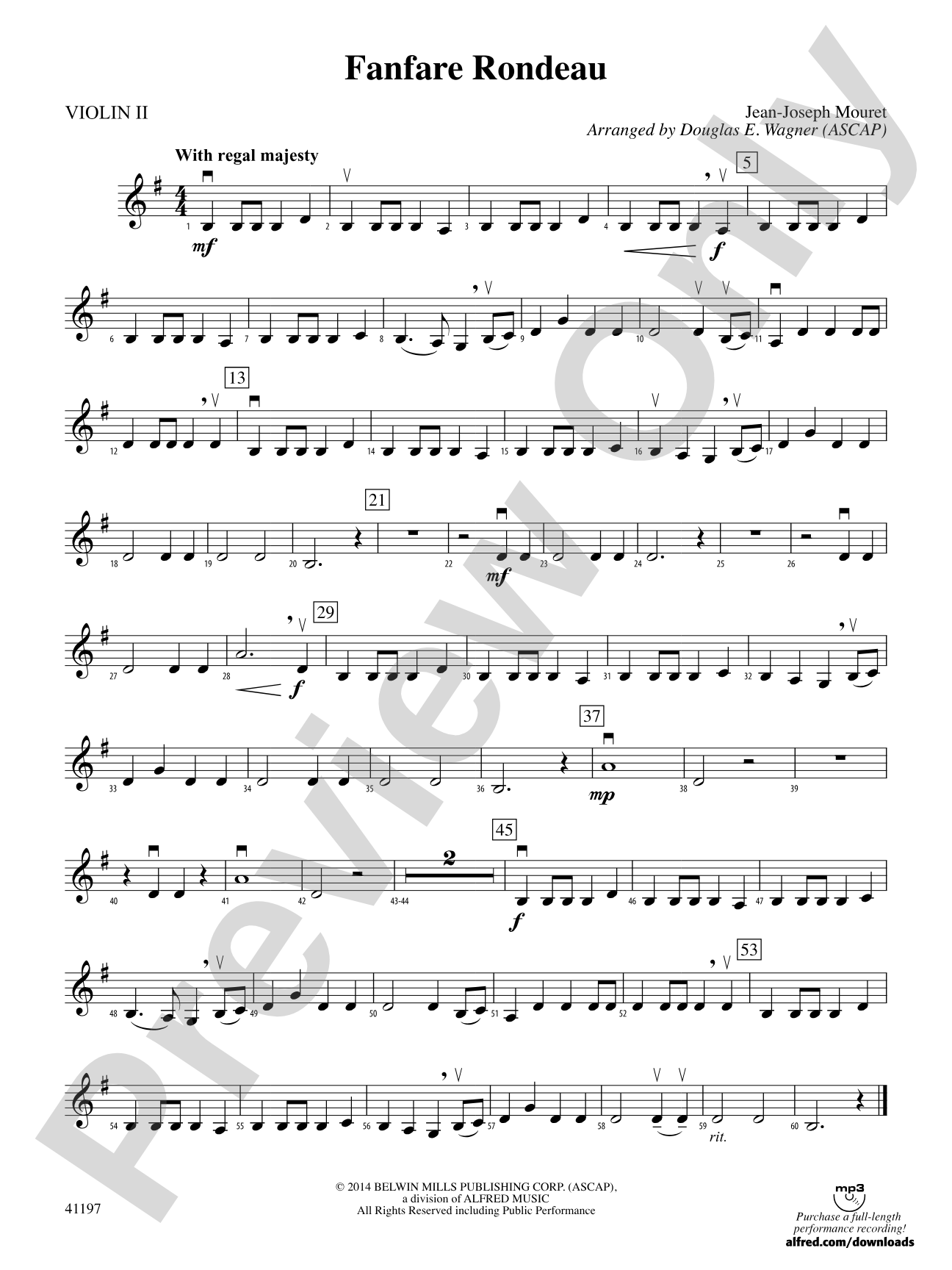

Fanfare Rondeau: 2nd Violin
By Jean-Joseph Mouret / arr. Douglas E. Wagner
Grade: 1.5
Item: 00-PC-0016324_VN2
$3.00
Pickup currently not available
Description
This highly recognizable work is a sure bet for success, especially for beginning players' first experience with the textures of a full orchestra. Audiences will love hearing the 'Masterpiece' theme brilliantly set in this solid scoring, which may also be performed by strings alone. The parts are not difficult and the rondo form should shorten the rehearsal time. (2:30) This title is available in MakeMusic Cloud.


Don't just read it, hear it, play along with it, and watch your students grow with it. In MakeMusic Cloud, Fanfare Rondeau: 2nd Violin comes alive with professional accompaniment, adjustable tempo, and built-in practice tools that turn solo practice into real progress.
Open in the Player
Jump straight in and assign it today.
Start Your Free Trial
Open this title and explore the full library in minutes.
Sample Audio
1
Audio File
--:--
0:00
0:00
Sample Video
Additional Details
Series:
Belwin Beginning String/Full Orchestra
Publisher:
Alfred Music
Page Count:
118
SKU:
00-PC-0016324_VN2
More about this title
About the Composer: Jean-Joseph Mouret
Jean-Joseph Mouret (1682-1738) was a French Baroque composer whose instrumental works remain staples of concert repertoire. Best known for his fanfares and ceremonial music, Mouret crafted pieces that balanced formal elegance with immediate melodic appeal, making his compositions accessible to performers and audiences alike.
His "Rondeau" from the Suites de Symphonies became particularly famous through its use in television broadcasts, introducing generations of listeners to his refined, aristocratic style. For music educators, Mouret's orchestral writing offers an excellent model of clarity and orchestration; his straightforward harmonic language and balanced part writing work well for young ensembles learning to navigate fuller textures.
Why we love this
This arrangement captures everything that makes Mouret's melody timeless while keeping the ensemble parts remarkably straightforward. Young players encounter genuine orchestral textures and sectional independence without wrestling with technical demands, and the rondo structure keeps rehearsal focused on musicality rather than page-turning.
What to expect
Stately and ceremonial, with a melody that feels both familiar and elevated. The rondo structure creates a satisfying sense of return and repetition, giving young players the confidence of recognizing what comes next while hearing how fresh orchestration can transform a repeated section.
Who it's for
This work is ideal for beginning full orchestras encountering multi-section writing for the first time. It works equally well for young string orchestras needing a confident opening concert piece, and the straightforward parts mean a broad range of player abilities can participate successfully in the same ensemble.
How to get the most out of it
- Bring out the signature melody in whichever section holds it (woodwinds, strings, or brass) by having that section play with confident tone while other sections support at a slightly softer dynamic.
- Use the repeating sections of rondo form as opportunities to shift orchestration: lighten the texture on the second A section or add instrumentation on the final repeat to maintain freshness across the 2:30 runtime.
- Balance the brass section carefully in the fanfare passages. Young brass players often play louder than needed; remind them that clarity and rhythmic precision matter more than volume.
- Mark the score to show students where sections enter and exit so they understand their role within the full orchestration rather than focusing only on their own part.
How to use it
Open a concert or festival performance with this piece to establish the quality and polish of your ensemble from the first moments. Its recognizable melody and solid scoring make it an excellent bridge between youth orchestra repertoire and fuller orchestral literature, and the self-contained form means it stands alone without needing programming context.
Skills your students will build
- Tracking multiple orchestral sections within a single musical texture
- Playing in rondo form (ABACA structure) and understanding how formal design shapes rehearsal efficiency
- Balancing part independence with ensemble blend across winds, brass, and strings
- Executing clear articulation in fanfare passages with accurate rhythmic coordination