
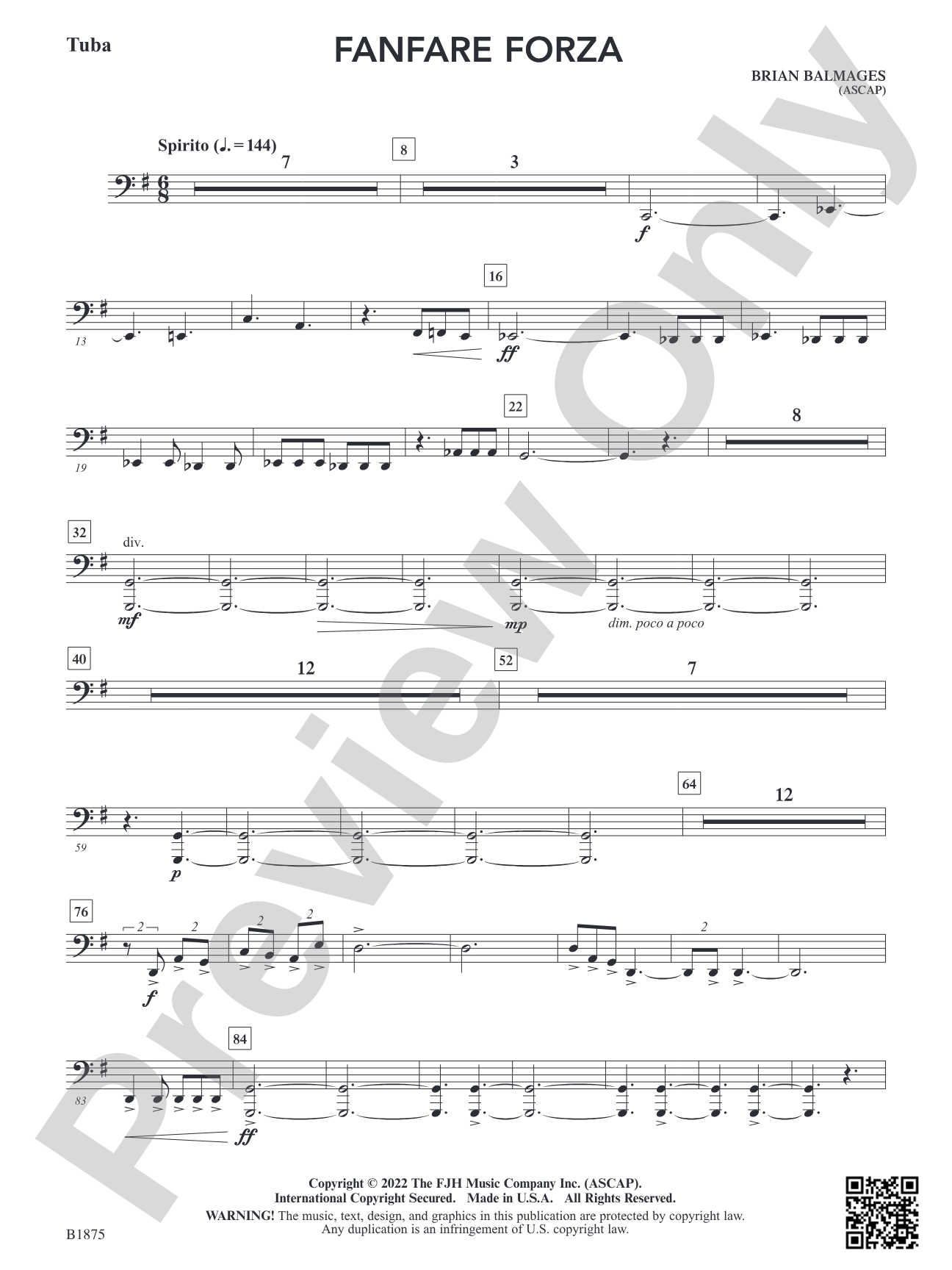

Fanfare Forza: Tuba
By Brian Balmages
Grade: 4
Item: 98-PC-DB1875_TB1
$7.00
Pickup currently not available
Description
This contemporary fanfare will usher in a sense of excitement and anticipation as the music unfolds in dramatic fashion. Bold, rhythmic motives combine with massively powerful lyrical lines spanning a wide gamut of emotions. The kind of opener that may just bring your audience to its feet!


Don't just read it, hear it, play along with it, and watch your students grow with it. In MakeMusic Cloud, Fanfare Forza: Tuba comes alive with professional accompaniment, adjustable tempo, and built-in practice tools that turn solo practice into real progress.
Open in the Player
Jump straight in and assign it today.
Start Your Free Trial
Open this title and explore the full library in minutes.
Sample Audio
1
Audio File
--:--
0:00
0:00
Sample Video
Additional Details
Series:
FJH Symphonic Band
Publisher:
The FJH Music Company, Inc.
SKU:
98-PC-DB1875_TB1
More about this title
About the Composer: Brian Balmages

Brian Balmages has built an international reputation as a composer and conductor working across orchestral, band, and chamber repertoires. His works have been premiered and performed worldwide by ensembles ranging from professional orchestras to school groups, in venues including Carnegie Hall, the Kennedy Center, the Sydney Opera House, and the Toronto Centre for the Arts. He holds membership in the American Bandmasters Association and has received the A. Austin Harding Award from the American School Band Directors Association, along with the 2020 NBA William D. Revelli Composition Contest award for Love and Light.
Balmages served on the faculty at James Madison University and later received a distinguished alumni award from the school's music program. The University of Miami commissioned him to compose music for the presidential inauguration of Dr. Julio Frenk, and his work was performed at the 2013 Presidential Inaugural Prayer Service. As a conductor, he regularly leads all-state ensembles, university bands, and professional groups internationally, with notable guest appearances at the Midwest Clinic, College Band Directors Conference, and state music conferences. He currently directs MakeMusic Publications and Digital Education for Alfred and MakeMusic.
Why we love this
Fanfare Forza delivers exactly what a contemporary opening needs: immediate impact without sacrificing musical substance. Balmages constructs this piece around driving rhythmic figures and sweeping melodic arcs that keep ensemble energy high while remaining accessible at Grade 4, making it a genuine crowd-pleaser that doesn't shortchange your musicians or audience.
What to expect
Bold and kinetic, Fanfare Forza combines rhythmic swagger with genuine lyrical substance. The music builds from bold declarative gestures into sweeping, emotionally expansive lines that span the full range of the ensemble, creating a sense of anticipation and momentum that naturally propels the listener forward.
Who it's for
Band directors seeking a contemporary opener that engages both ensemble and audience at the Grade 4 level. This works equally well for groups preparing for contest or festival appearances and for directors building a program that balances traditional and modern approaches to the fanfare idiom.
How to get the most out of it
- Establish the tempo confidently in the opening measures and resist the urge to rush the rhythmic motives; letting them breathe slightly will sharpen their impact.
- Balance the bold sonorities in the brass against the lyrical passages so the harmonic colors remain distinct; excessive dynamics can blur the emotional range.
- Mark all section entries clearly during rehearsal, particularly where the melody transfers between choir groups, so transitions feel seamless rather than choppy.
- Use the dramatic arc of the piece to shape your phrasing; build gradually through the expanding dynamic ranges rather than hitting peak volume too early.
How to use it
Open your next concert with this piece to establish energy and set an expectant tone for what follows. Its contemporary language and dramatic arc make it ideal for mixed programs that pair classical works with current compositional voices, and it functions equally well in festival or contest contexts where a strong opener distinguishes your ensemble.
Skills your students will build
- Executing rapid, articulated rhythmic patterns with precision and clarity
- Balancing bold unison passages with nuanced dynamic control
- Responding to conducting cues during frequent textural shifts
- Sustaining lyrical phrasing across sections while maintaining ensemble blend
- Managing the technical demands of contemporary harmonic language