
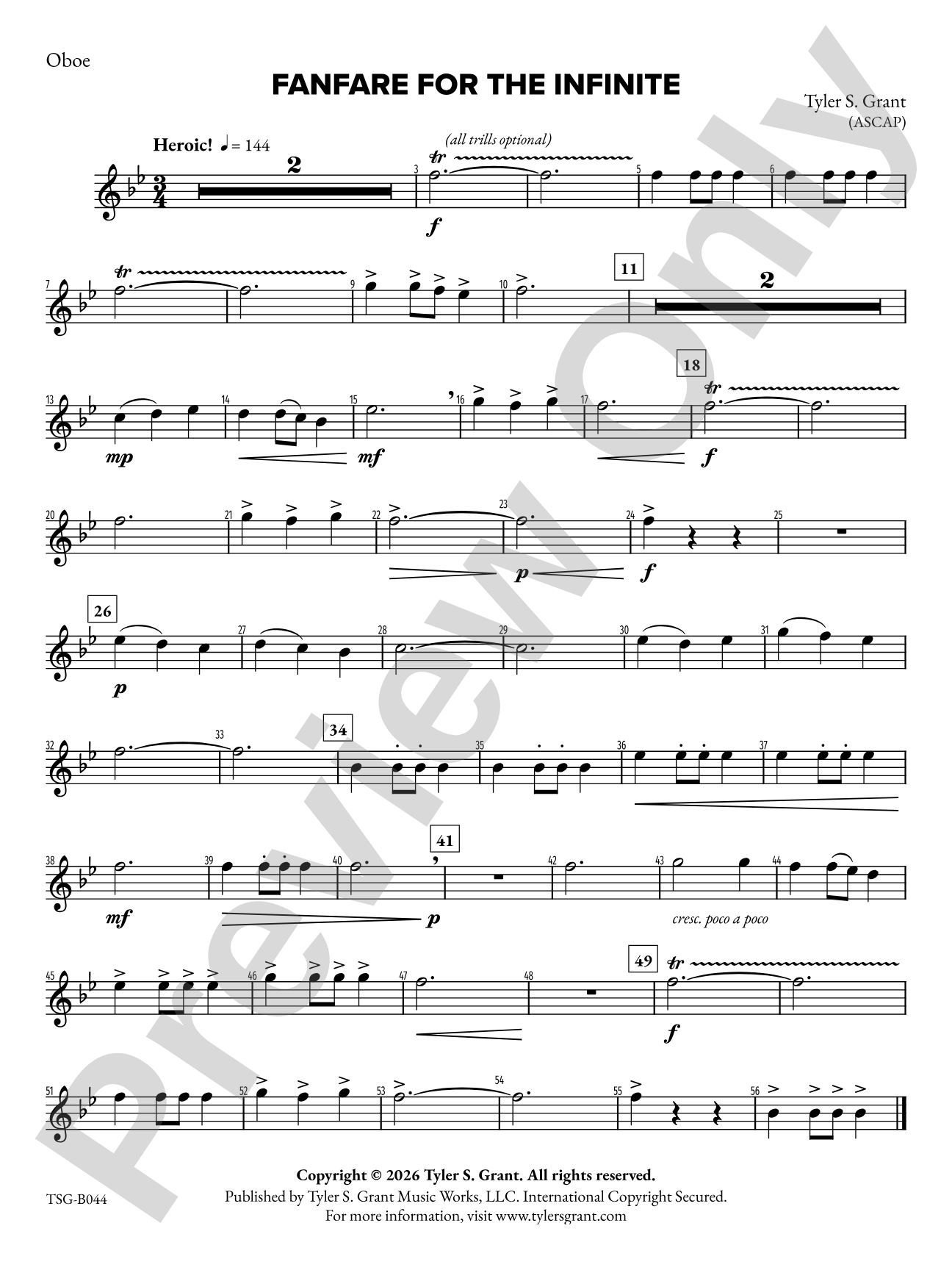

Fanfare for the Infinite: Oboe
Tyler S. Grant
Item: 98-PC-0000069_O1
$3.00
Pickup currently not available
Description
This dynamic fanfare celebrates the infinite potential of your beginning band! Original material blended with motifs from Holst's Jupiter give this work a spirit of sophistication and timelessness. Optional and advanced percussion parts ensure that every percussionist is appropriately challenged no matter the section size. The perfect concert opener!


Fanfare for the Infinite: Oboe isn't in MakeMusic Cloud just yet...but it could be. Let us know you'd like to see it, and you'll help shape what comes next. In the meantime, start a free trial and dive into thousands of interactive titles your students can play along with today.
Request This Title
Tell us you want it.
Start Your Free Trial
Explore everything that's ready to play right now.
Sample Audio
1
Audio File
--:--
0:00
0:00
Sample Video
Additional Details
Publisher:
Tyler S. Grant Music Works
SKU:
98-PC-0000069_O1
Instrumentation:
Concert Band
More about this title
About the Composer: Tyler S. Grant

Tyler S. Grant has built a reputation as a prolific composer whose works appear regularly on state and regional honor ensemble programs. His fanfares and band compositions have been performed at prestigious venues including Carnegie Hall, The Midwest Clinic, and the Macy's Thanksgiving Day Parade. He earned his degree in instrumental music education from the University of Alabama and worked as a school director before transitioning to full-time composing and arranging in 2010.
Grant's approach to composition stems from his dual background in pedagogy and performance. He has conducted clinics with over 100 school programs across 15 states and served as a contributing author for Alfred Music's Sound Innovations series. His mentorship under composer Brian Balmages shaped his commitment to writing music that challenges ensembles while remaining accessible, a philosophy evident in works like Panoramic Fanfare, which won the Dallas Wind Symphony's 2014 Call for Fanfares Competition.
Why we love this
Grant crafts this opening with a clear understanding of what beginning bands need: music that sounds substantial without requiring years of refinement. The integration of Jupiter's melodic DNA into original material gives the piece immediate sophistication, while the tiered percussion parts solve a genuine classroom challenge by keeping advanced players engaged while allowing newer percussionists to participate meaningfully. Bands will hear themselves sounding polished from measure one.
What to expect
Ceremonial and bright, with a sense of occasion that invites the audience into something meaningful. The blend of familiar Holst material with new ideas creates a piece that feels both timeless and fresh, energizing without demanding technical virtuosity. It opens doors rather than standing as a barrier.
Who it's for
Beginning concert bands seeking a concert opener that projects confidence and polish. Ensembles preparing for festival performances or community events will find this piece instantly effective. Directors wanting to build student pride in early repertoire choices will appreciate how the piece treats every voice as essential.
How to get the most out of it
- Anchor the brass pulse with a steady preparatory gesture; the fanfare's impact depends on crisp articulation across the entire section, not volume.
- Balance the original material against the Holst references by bringing out the connecting thematic line in whichever section carries it, rather than letting both layers compete equally.
- Assign the optional and advanced percussion parts strategically during rehearsal to ensure those musicians understand how their material supports the overall texture rather than overshadowing it.
- Mark a clear tempo before the first downbeat and hold it; the fanfare's ceremonial character requires unwavering forward motion.
How to use it
Open your fall or winter concert with this piece to establish an immediate tone of musicianship and care. It pairs well before more intricate concert band fare and gives students a moment to shine before tackling weightier repertoire. For festivals, position it as your opener to settle the ensemble and capture the judges' attention from the downbeat.
Skills your students will build
- Balancing brass-to-woodwind dynamic relationships
- Executing articulation with stylistic precision across sections
- Reading and executing optional parts within a score
- Maintaining steady tempo in ceremonial contexts
- Understanding musical dialogue between original and referenced material