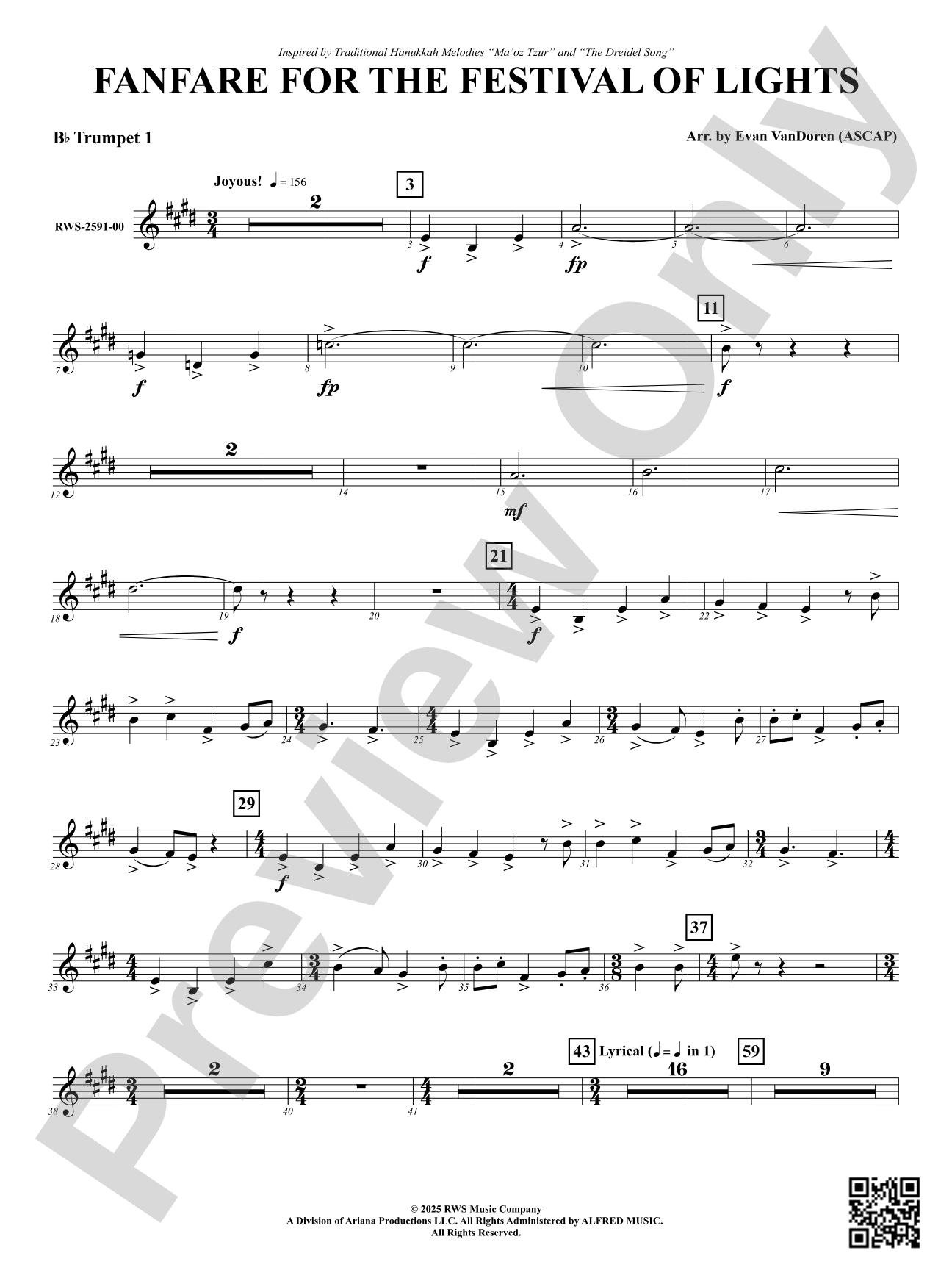
Fanfare for the Festival of Lights weaves two traditional Hanukkah melodies, "Ma'oz Tzur" and "The Dreidel Song" into a colorful, rousing celebration! Evan VanDoren has masterfully crafted an approachable, mature-sounding composition that will challenge your best performers while meeting the needs of your developing players. With optional SATB choral and non-orchestra wind instruments parts, you can get the entire music department involved in your next concert!
Discover MakeMusic Cloud: thousands of interactive titles your students can play along with today.
Evan VanDoren brings a keen sense of orchestration and accessibility to his arranging work, consistently finding ways to write musically sophisticated pieces that don't require virtuosic soloists to succeed. His arrangements honor traditional material while giving it contemporary harmonic depth and orchestral color.
Why we love this
VanDoren strikes an intelligent balance here: the writing sits comfortably for developing players without sacrificing the warmth and sophistication that an audience expects from a concert-closing fanfare. The flexible instrumentation means you're not locked into a single ensemble configuration, and the optional choral parts give you genuine agency to shape the piece around what your program actually contains.
What to expect
Bright and celebratory, with the two interwoven folk melodies giving the piece a clear melodic anchor that audiences recognize immediately. The orchestration adds shimmer and forward momentum without overwhelming the straightforward charm of the source material, creating a fanfare that feels both joyful and substantive.
Who it's for
Orchestra directors programming a Hanukkah concert who need a work that sounds genuinely festive without oversimplifying the composition for developing ensembles. This arrangement also serves conductors seeking to involve multiple departments (orchestra, choir, band) in a single holiday presentation.
How to get the most out of it
Bring the two melodic themes into sharp focus during early rehearsals. Mark the entrances of 'Ma'oz Tzur' and 'The Dreidel Song' clearly in your score so players understand when they're supporting texture versus when they're carrying the line.
Balance the optional choral section carefully if you include it. The voices should float above the orchestra rather than compete; pull back the dynamic levels in any instrumental doublings when the choir enters.
Use the conductor parts to shape phrasing across sectional changes. This piece builds toward moments of celebration, so guard against letting tempo slip during transitions between themes.
If you're omitting the non-orchestra wind parts, have those players double existing orchestral lines rather than sit out entirely. VanDoren's scoring accommodates this flexibility smoothly.
How to use it
Perfect as a closing number for a winter or Hanukkah concert, this piece has enough vigor to send an audience out energized. You could also program it midway through a holiday pops concert to introduce a thematic shift toward celebratory repertoire, or use it as the finale of a multi-ensemble concert where choir and band join the orchestra.
Skills your students will build
Balancing melodic and accompaniment roles across multiple instrumental sections
Coordinating with optional parts and flexible instrumentation
Executing clear sectional transitions and phrase shapes in a through-composed structure
Blending folk melodies with symphonic orchestration
Managing dynamic contrast in a piece that builds toward celebratory climaxes
You May Also Like
Scan to Complete Your Purchase
Use your phone's camera to scan the code below
You'll log in on your phone and the order will be added to your account