
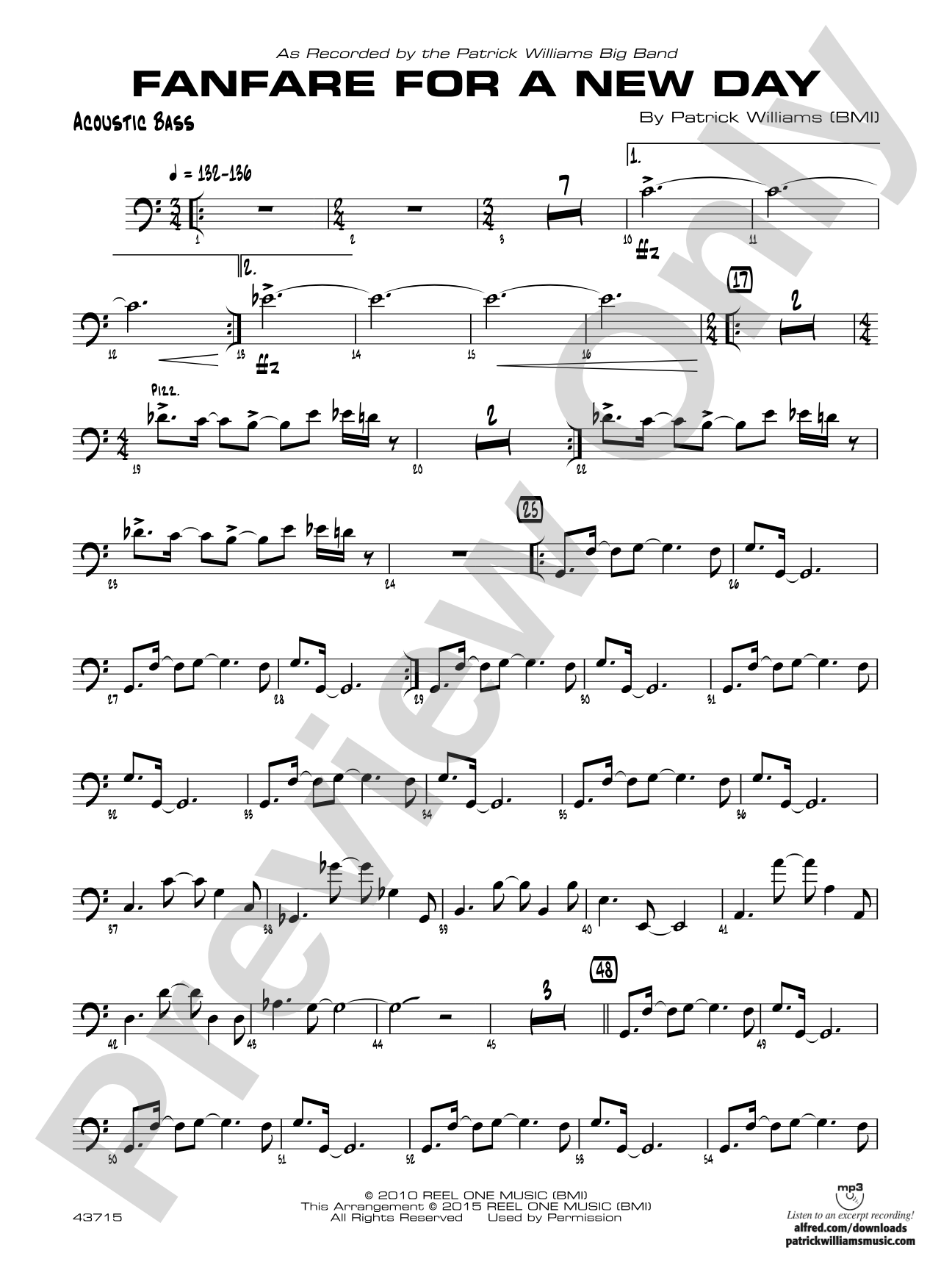

Fanfare for a New Day: String Bass
By Patrick Williams
Grade: 6 (Professional / Very Advanced)
Item: 00-PC-0016837_SB
$3.00
Pickup currently not available
Description
A tour de force ensemble arrangement! This Patrick Williams chart features a grand intro that has optional woodwind doubles for piccolo, flute, and clarinet, along with the optional horn in F parts. Including a sax soli, various space for solos, and a fantastic shout chorus the swing tempo is 132 BPM. Brilliant writing! (9:15)


Don't just read it, hear it, play along with it, and watch your students grow with it. In MakeMusic Cloud, Fanfare for a New Day: String Bass comes alive with professional accompaniment, adjustable tempo, and built-in practice tools that turn solo practice into real progress.
Open in the Player
Jump straight in and assign it today.
Start Your Free Trial
Open this title and explore the full library in minutes.
Sample Audio
1
Audio File
--:--
0:00
0:00
Sample Video
No sample videos found.
Additional Details
Series:
Belwin Jazz: The Patrick Williams Series
Publisher:
Alfred Music
Page Count:
90
SKU:
00-PC-0016837_SB
More about this title
About the Composer: Patrick Williams
Patrick Williams is a three-time Grammy Award winning composer and arranger with a career spanning decades in film, television, and jazz. His work in Hollywood includes scores for major motion pictures and television series, but he remains deeply committed to jazz education and the concert jazz repertoire, creating sophisticated charts that challenge and inspire student ensembles at the highest levels.
Williams brings his orchestral sensibility and harmonic depth to jazz writing, crafting arrangements that demand technical precision while maintaining the improvisational spirit jazz ensembles need to thrive. His contribution to the Belwin Jazz catalog has established him as a go-to voice for directors seeking music that stretches advanced players both musically and technically.
Why we love this
This chart showcases Williams at his most generous: he's written something that sounds utterly professional while giving every section meaningful moments. The optional doubles and soli passages ensure your ensemble stays engaged throughout a nine-minute arc, and the shout chorus finale provides the kind of visceral group experience that keeps students coming back to jazz.
What to expect
Fanfare for a New Day opens with grand ceremony before settling into sophisticated swing. The arrangement feels orchestral in scope, with layered textures and clever voicings that reveal new detail with each hearing. When it reaches the shout chorus, the ensemble transforms into something driving and celebratory, a moment of pure ensemble cohesion that justifies all the rehearsal work.
Who it's for
Directors of Grade 6 jazz ensembles who want contest or festival programming with serious musical substance. This is suitable for established programs with mature rhythm sections and reliable soloist availability; the professional demands mean you need musicians ready to deliver at a high level.
How to get the most out of it
- Establish the swing pulse early in rehearsals separate from the grand intro's rubato quality. The 132 BPM shout chorus represents your true tempo anchor; lock the rhythm section there first, then work backward to the opening.
- Assign soloists well in advance and encourage them to bring specific musical ideas to rehearsal. This is professional-level writing that rewards preparation; soloists who come with developed concepts rather than reading cold will transform the performance.
- Balance the optional woodwind doubles against your available personnel. If you're doubling piccolo and flute, shape the high register carefully so the section sounds unified, not scattered.
- The sax soli and shout chorus require confidence and blend. Run sectional work on rhythmic precision and dynamic control; this is where students hear the difference between playing the notes and playing the music.
How to use it
Reserve this for a finale spot on a concert or festival set where you want to send the audience out energized. The nine-minute length and professional caliber make it a centerpiece number rather than a program opener; pair it with contrasting repertoire that gives your ensemble varied showcasing throughout the set.
Skills your students will build
- Reading complex jazz notation with optional doublings and flexible voicings
- Swing style interpretation at a professional tempo (132 BPM)
- Ensemble balance and blend in a full big-band texture
- Solo preparation and improvisation within sophisticated harmonic frameworks
- Rhythmic precision and coordination across multiple sections
- Stylistic flexibility between rubato introduction and strict swing groove