
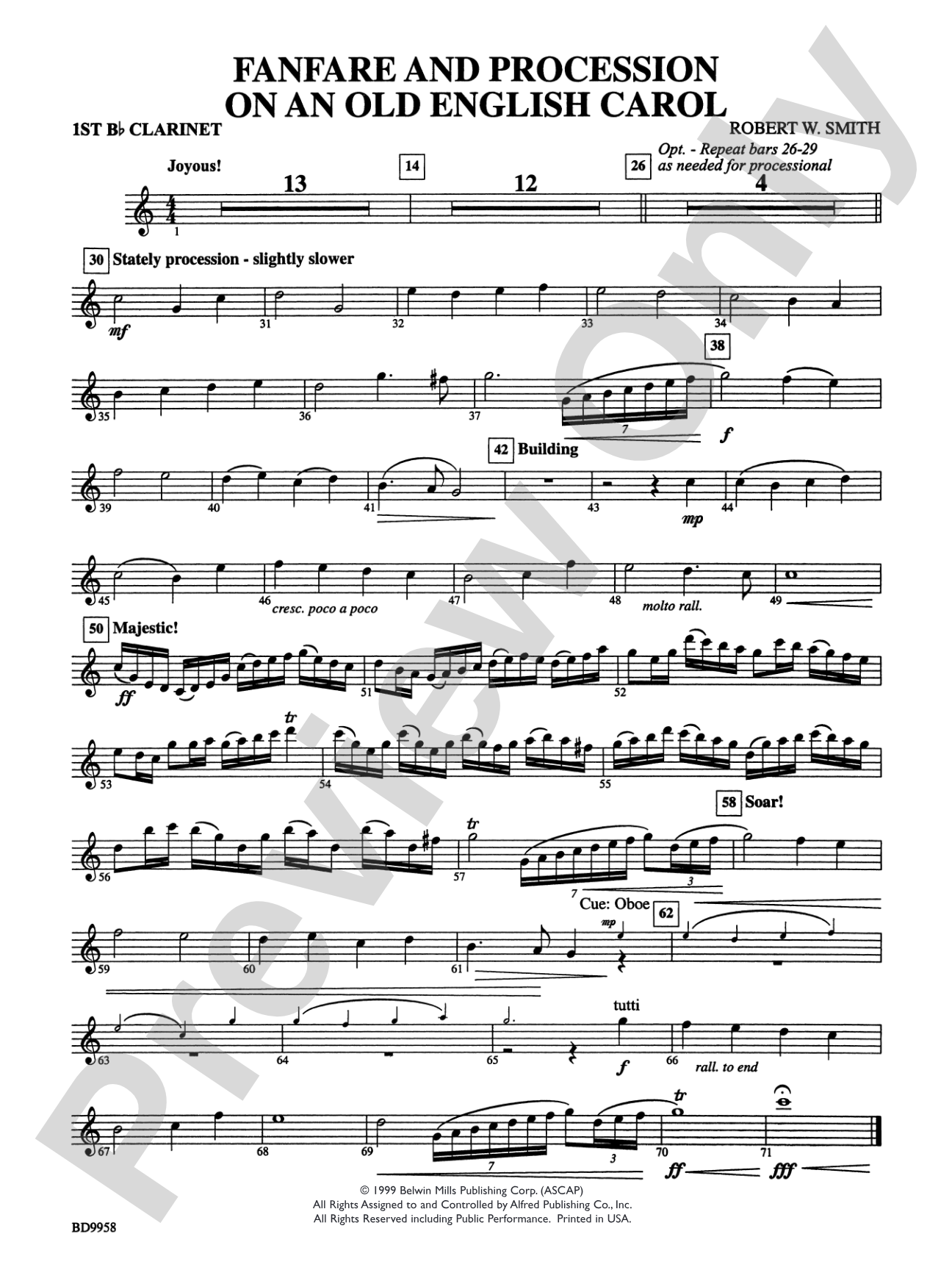

Fanfare and Processional on an Old English Carol: 1st B-flat Clarinet
By Robert W. Smith
Grade: 3 (Medium Easy)
Item: 00-PC-0002112_C1
$5.99
Pickup currently not available
Description
Based on the English carol "Adeste Fidelis," this sparkling new setting was written as an opener for a holiday concert or pageant. With Robert W. Smith's highly inventive trademark use of percussion and soaring wind lines, this work will effectively launch any concert performance. Highest energy! (3:20)


Don't just read it, hear it, play along with it, and watch your students grow with it. In MakeMusic Cloud, Fanfare and Processional on an Old English Carol: 1st B-flat Clarinet comes alive with professional accompaniment, adjustable tempo, and built-in practice tools that turn solo practice into real progress.
Open in the Player
Jump straight in and assign it today.
Start Your Free Trial
Open this title and explore the full library in minutes.
Sample Audio
1
Audio File
--:--
0:00
0:00
Sample Video
No sample videos found.
Additional Details
Series:
Belwin Concert Band
Publisher:
Alfred Music
Page Count:
126
SKU:
00-PC-0002112_C1
More about this title
About the Composer: Robert W. Smith

Robert W. Smith has established himself as one of America's most frequently performed composers of concert band and orchestral music, with more than 400 published works distributed primarily through Alfred Music. He holds degrees from Troy State University (Alabama) and the University of Miami (Florida), and his original compositions have been heard by audiences across North America, Europe, Australia, and Asia.
Beyond the concert hall, Smith's music has appeared in high-profile contexts ranging from Olympic Games broadcasts to the opening of the Macy's Thanksgiving Day Parade, the Ringling Brothers/Barnum & Bailey Circus, and Opening Day at Dodger Stadium. As both a clinician and conductor, he has worked extensively throughout the United States and internationally in Canada, Japan, Australia, Italy, Austria, and the United Kingdom. His symphonic works, including The Divine Comedy and The Odyssey, alongside pieces like The Tempest, have become cornerstones of the developing and intermediate band repertoire.
Why we love this
Smith's gift for orchestration shines in this holiday opener, which takes a familiar carol and reimagines it with genuine sparkle and forward momentum. The percussion writing alone justifies programming it; it's energetic without overwhelming younger ensembles, and the soaring wind lines give your brass and woodwinds satisfying material to sink their teeth into. Your audience will feel the festive lift immediately.
What to expect
The piece carries the ceremonial weight of a fanfare paired with the warmth of a familiar carol, all delivered at a brisk, celebratory tempo. There's pageantry in the processional sections and genuine joy in the soaring melodic writing; nothing about this feels generic or recycled.
Who it's for
Grade 3 bands looking for a concert opener with genuine character and holiday relevance. Directors who want to start a performance with momentum rather than a slow build will find this particularly valuable, and it works equally well for groups with developing ensembles or more confident musicians.
How to get the most out of it
- Balance the processional opening so the carol melody emerges clearly above the rhythmic foundation; resist the urge to let the percussion drive overwhelm the harmonic colors.
- Shape the wind lines with long phrases rather than stopping at every bar line; the soaring quality depends on continuous musical direction.
- Ensure the percussion section understands the style distinction between fanfare articulation (crisp, defined) and processional groove (steady, locked in); this contrast drives the piece's energy.
- Temper the highest energy passages with clarity rather than pure volume; at Grade 3, balance and precision will read as excitement more effectively than raw sound.
How to use it
Open your winter concert with this to establish an immediate festive mood and give your audience an energetic first impression. Pair it with slower or more introspective carol arrangements later in the program to create dynamic variety, or use it as the bridge piece between your opening march and a longer holiday work.
Skills your students will build
- Maintaining steady tempo through contrasting fanfare and processional sections
- Balance and blend when supporting soaring wind lines with harmonic foundation
- Precision articulation in percussion parts that drive forward momentum
- Shaping longer melodic phrases across changes in orchestration