
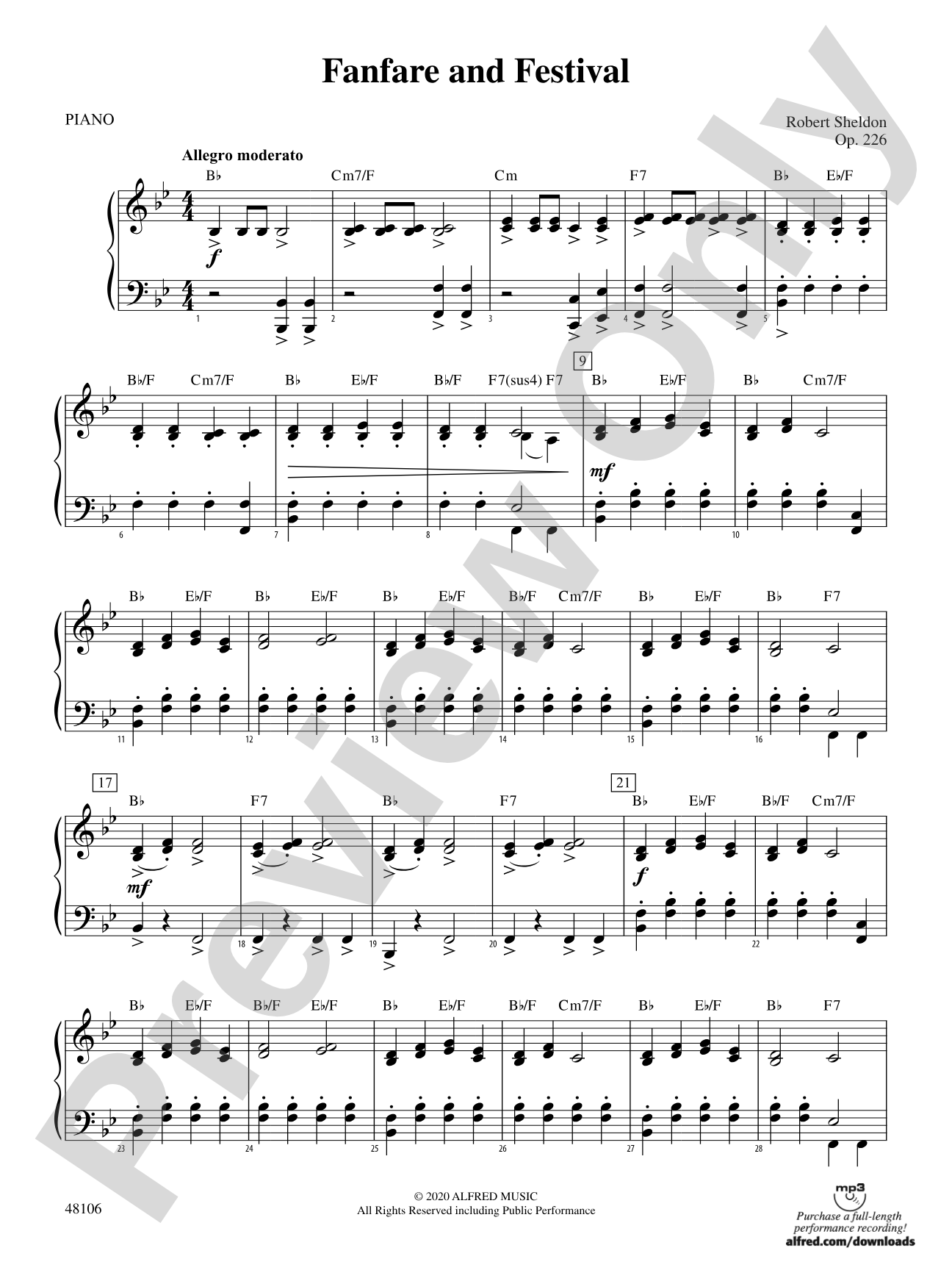

Fanfare and Festival: Piano Accompaniment
By Robert Sheldon
Grade: 1 (Easy)
Item: 00-PC-0018539_K
$3.00
Pickup currently not available
Description
Fanfare and Festival by Robert Sheldon is a bright and tuneful opener that makes a bold statement, yet is playable by the youngest of bands. This pieces uses only the first six notes taught, no dotted rhythms and no rolls in the percussion! (2:05) Correlated to Sound Innovations, Book 1, Level 4. This title is available in MakeMusic Cloud.


Don't just read it, hear it, play along with it, and watch your students grow with it. In MakeMusic Cloud, Fanfare and Festival: Piano Accompaniment comes alive with professional accompaniment, adjustable tempo, and built-in practice tools that turn solo practice into real progress.
Open in the Player
Jump straight in and assign it today.
Start Your Free Trial
Open this title and explore the full library in minutes.
Sample Audio
1
Audio File
--:--
0:00
0:00
Sample Video
Additional Details
Series:
Sound Innovations for Concert Band
Publisher:
Alfred Music
Page Count:
138
SKU:
00-PC-0018539_K
More about this title
About the Composer: Robert Sheldon

Robert Sheldon's compositions appear on contest and concert stages worldwide, and his music is performed by ensembles of all levels. Beyond his work as a composer, Sheldon co-authored Sound Innovations for Concert Band, the pedagogical framework that connects directly to this piece. His accolades include recognition from the American School Band Director's Association, Phi Beta Mu, and ASCAP.
Sheldon regularly conducts All-State and Regional Honor Bands, and his clinician work has taken him to universities across the United States and internationally to Japan, Canada, Italy, Germany, Australia, and China. His compositions have been performed at Carnegie Hall, Orchestra Hall, Boston's Symphony Hall, the Sydney Opera House, and the Kennedy Center. In 2020, VanderCook College of Music awarded him an honorary doctorate in recognition of his contributions to wind band music.
Why we love this
Sheldon understands what a developing band needs: immediate success without compromise. The piece sounds confident and celebratory while respecting the technical reality of young ensembles, making it an ideal opener that builds morale without exposing players to frustration. Its direct correlation to Sound Innovations Book 1 means your students play material they've already learned in their method work, solidifying their confidence and ownership of the repertoire.
What to expect
Fanfare and Festival announces itself with brightness and purpose. The opening feels ceremonial and proud without a hint of pretension, and the tuneful writing ensures every student feels the forward momentum of a real concert band composition. It's the sound of young musicians discovering what they can do together.
Who it's for
Beginning concert bands that have completed the early stages of Sound Innovations Book 1 and are ready for their first substantial performance piece. This works equally well for directors introducing young ensembles to contest or festival performance, where musical impact and instrumental confidence are both essential.
How to get the most out of it
- Establish a crisp, energetic tempo from the downbeat. The brightness of this piece depends on forward motion and clarity in the articulation.
- Balance the melody line across your ensemble rather than concentrating it in first parts. Many young bands tend to weight sound in the soprano voices; distribute the tune so every section hears themselves contributing to the musical line.
- Let the percussion shine without overwhelming the band. Because there are no rolls or complex rhythms, each percussion entrance is a clear articulation point—use those moments to mark form and energy.
- Rehearse the opening unison passage with special attention to dynamic control. Young bands often play louder when playing together; work toward a unified forte that feels bold without forcing tone.
How to use it
Open a fall or winter concert with this piece to set an energetic tone and showcase your ensemble's preparation. Its compact duration (2:05) makes it an excellent transition between a student soloist or small ensemble and a longer feature work. For festival circuits, this works as your opener because it establishes confidence early and leaves the audience ready for what comes next.
Skills your students will build
- Playing in unison and maintaining blend across multiple sections
- Reading and executing sustained forte dynamic at the beginning of a phrase
- Executing clear, articulated releases in response to conductor cues
- Reinforcing foundational pitch and rhythm reading using only the first six notes of the instrument