Fanfare and Call to the Post Sheet Music Preview

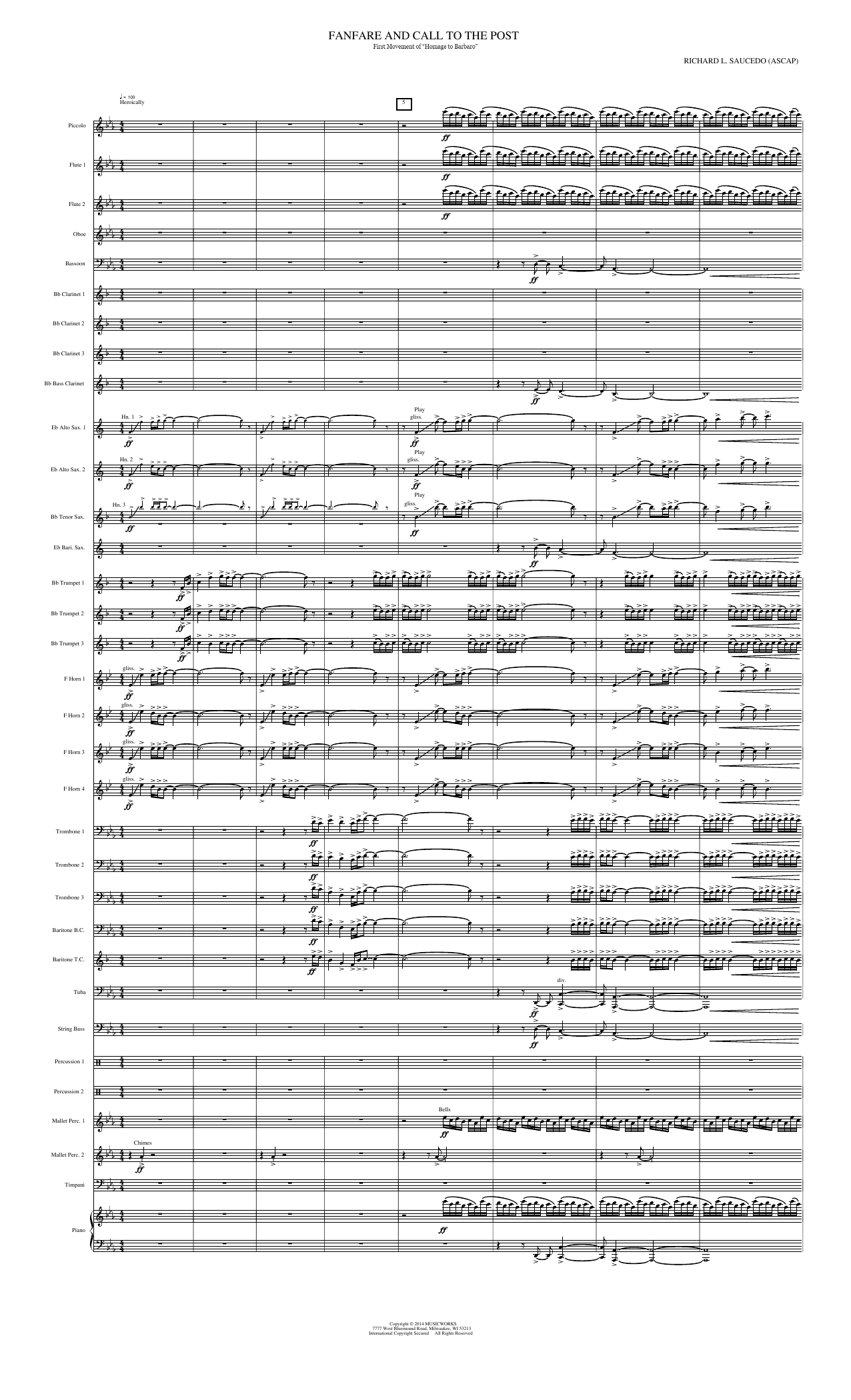
Fanfare and Call to the Post: Concert Band Conductor Score & Parts

By Richard L. Saucedo

Grade: 4

Item: 35-PK00427056

Digital Download
$70.00

Buy Extra Parts (Digital PDF Download)

Product Price Quantity
Fanfare and Call to the Post - Full Score $70.00

Parts Added to Cart!

Description
Fanfare and Call to the Post

Fanfare and Call to the Post: Concert Band Conductor Score & Parts isn't in MakeMusic Cloud just yet...but it could be. Let us know you'd like to see it, and you'll help shape what comes next. In the meantime, start a free trial and dive into thousands of interactive titles your students can play along with today.

Sample Audio
No sample audio found.
Sample Video
Additional Details
Publisher: Hal Leonard
SKU: 35-PK00427056

More about this title

About the Composer: Richard L. Saucedo

Richard L. Saucedo

Richard L. Saucedo shaped the Indiana band landscape during his 31 years as Director of Bands and Performing Arts Chairman at Carmel High School, retiring in 2013. His ensembles claimed state and national titles across concert, jazz, and marching categories; Carmel's Wind Symphony I performed at the Music for All National Festival three times and earned Indiana State Champion honors in 2013, while the Marching Greyhounds finished in the top ten at BOA Grand Nationals for 17 consecutive years, capturing national championships in 2005 and 2012.

Beyond his tenure at Carmel, Saucedo has established himself as an arranger and composer for marching bands, choral ensembles, concert bands, and orchestras. He earned recognition as Indiana's Bandmaster of the Year (1998-99) and Outstanding Music Educator (2010), followed by induction into the Music for All Hall of Fame (2015) and Drum Corps International Hall of Fame (2022). His work with elite ensembles includes serving as brass arranger and composer for the Cavaliers, contributing to five DCI world championships, and currently serving as music ensemble coordinator for the Blue Devils. Saucedo holds membership in the American Bandmasters Association and serves as a Senior Educational Consultant for Music for All and Bands of America.

Why we love this

Saucedo brings championship-level clarity to a piece that announces itself immediately. Grade 4 repertoire often struggles to balance accessibility with genuine musical substance, but this fanfare lands with authority while remaining fully within reach of developing bands. The writing reflects decades of experience shaping ensembles that compete at the highest levels, yet it never sacrifices musicianship for difficulty.

What to expect

Bright, declarative, and purposeful. This is music that announces something important, built on clean harmonic progressions and straightforward rhythmic material that lets each section shine. There's genuine pageantry here without pretension.

Who it's for

Grade 4 concert bands preparing for festival or contest programming will find a piece that commands respect without overreaching beyond students' capabilities. Directors seeking something ceremonial that doesn't require extensive rehearsal time benefit from Saucedo's economical yet impactful scoring.

How to get the most out of it

  • Establish the fanfare's pulse as absolutely steady from the opening; a metronome or practice recording will help the winds and brass lock in to avoid the natural tendency to rush ceremonial material.
  • Balance the brass section carefully so the call emerges clearly without the woodwinds disappearing. This is particularly crucial if your ensemble skews toward larger instrumentation.
  • Shape the phrase endings with slight breath releases rather than full stops. Fanfares live through their forward momentum even when resting.

How to use it

Open a concert with this piece to establish energy and command attention from the first measures. It pairs effectively alongside more introspective works, providing structural contrast and showcasing your ensemble's ability to execute clean, confident brass writing at higher volumes.

Skills your students will build

  • Executing sustained tones with even dynamic support across full ranges
  • Balancing multi-part brass and woodwind textures while maintaining independence
  • Interpreting ceremonial style and phrasing without exaggeration
  • Sight-reading straightforward harmonic progressions and standard rhythmic patterns

You May Also Like