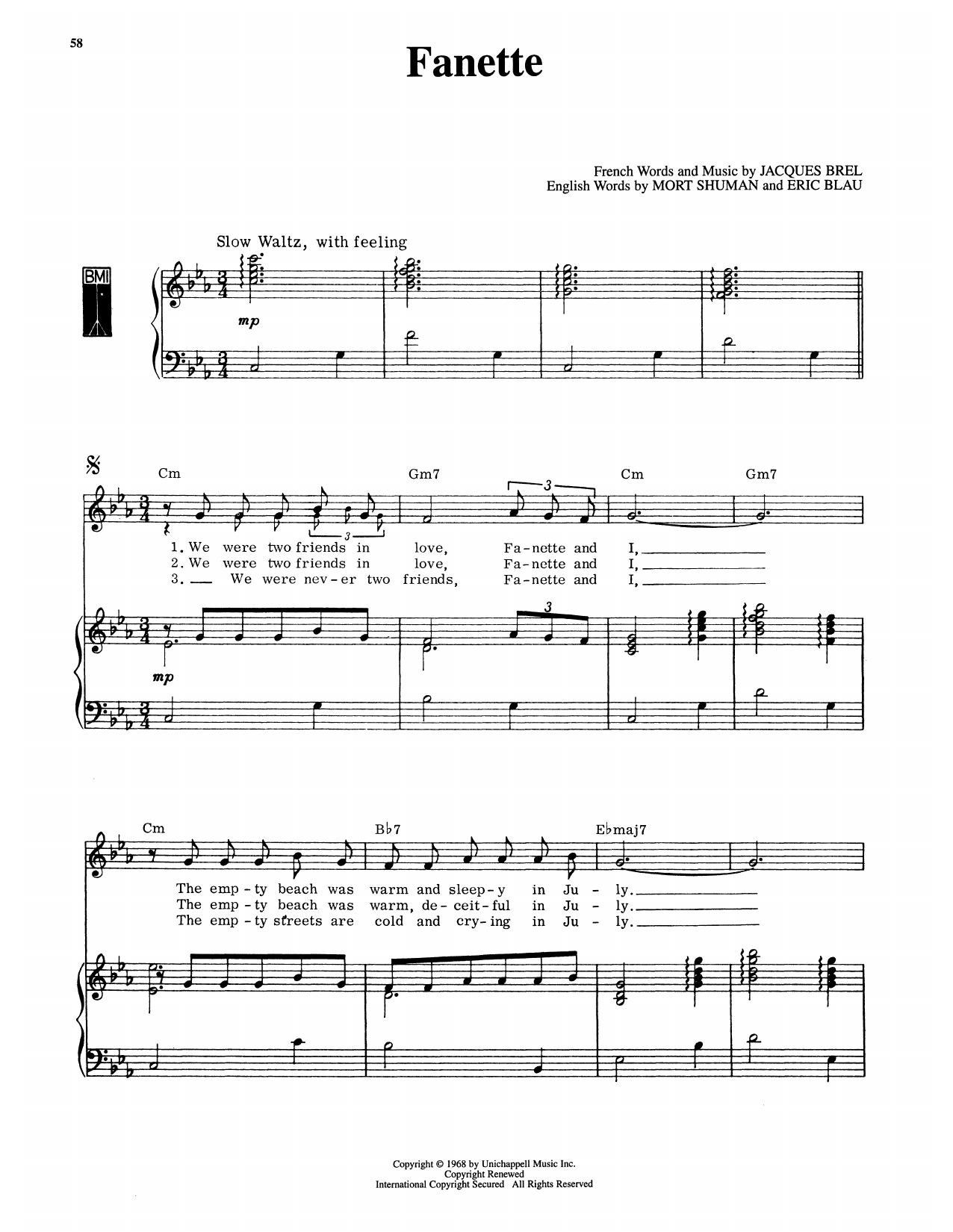
Fanette (from Jacques Brel Is Alive And Well And Living In Paris) Sheet Music Preview

Fanette (from Jacques Brel Is Alive And Well And Living In Paris): Piano Vocal

By Jacques Brel / As performed by Eric Blau

Item: 35-DS01740737

Digital Download
$5.99
Description

Fanette (from Jacques Brel Is Alive And Well And Living In Paris): Piano Vocal isn't in MakeMusic Cloud just yet...but it could be. Let us know you'd like to see it, and you'll help shape what comes next. In the meantime, start a free trial and dive into thousands of interactive titles your students can play along with today.

Sample Audio
No sample audio found.
Sample Video
Additional Details
Publisher: Hal Leonard
Page Count: 4
SKU: 35-DS01740737

More about this title

About the Composer: Jacques Brel

Jacques Brel (1929-1978) was a Belgian singer-songwriter whose sophisticated cabaret style and emotionally raw lyrics redefined what popular song could accomplish. His work bridged classical vocal tradition and contemporary music theater, earning him international recognition that extended far beyond France and Belgium. In the American theater, Brel's catalog became the foundation for "Jacques Brel Is Alive and Well and Living in Paris," an off-Broadway revue that introduced English-speaking audiences to his unflinching explorations of love, loss, and human complexity.

For music educators, Brel's compositions offer something increasingly rare in vocal literature: songs that demand both technical maturity and emotional intelligence. His melodies sit naturally in the voice while his harmonic language stays sophisticated enough to challenge serious students. Songs like "Fanette" demonstrate why Brel remains essential repertoire for teaching singers to navigate the space between art song and theater.

Why we love this

Brel's vocal writing sits in that perfect middle ground where the music serves the text without pretension. "Fanette" gives singers a chance to work with nuanced, character-driven material that doesn't rely on belting or theatrical excess, making it ideal for teaching musical storytelling through restraint and understatement.

What to expect

Intimate and wry, with a touch of melancholy beneath the surface. The music unfolds like a conversation with someone you know well, never pushing for effect but always honest. There's restraint here, but not coldness; the emotional weight comes through in what remains unsaid as much as what's sung.

Who it's for

Solo singers preparing material for recital, audition, or cabaret-style performance contexts, and voice teachers looking for sophisticated vocal literature that develops interpretive maturity. It's particularly valuable for students ready to move beyond standard art song into theatrical song that demands real artistic choices.

How to get the most out of it

  • The piano part deserves as much attention as the vocal line. Too many singers treat the accompaniment as mere support; let the harmonic movement inform your phrasing and dynamic shape.
  • Resist sentimentality. Brel's lyrics often contain irony or dark humor beneath the surface. Find the specificity of the character and situation rather than performing a generalized emotional state.
  • Pay close attention to the breath marks Brel indicates in the score. His phrasing often works against predictable vocal phrase lengths, creating a more conversational, intimate quality.

How to use it

This works beautifully in a cabaret or song recital program, particularly when you're programming a sequence of contrasting characters or emotional landscapes. Pair it with other twentieth-century art songs or with other selections from the Brel revue to create a thematic program around European vocal tradition.

Skills your students will build

  • Phrasing against musical bar lines to match linguistic stress and breath
  • Character interpretation in theater song versus traditional art song
  • Harmonic listening and response to pianist's accompanimental support
  • Sustaining emotional truth without exaggeration or sentimentality

You May Also Like