
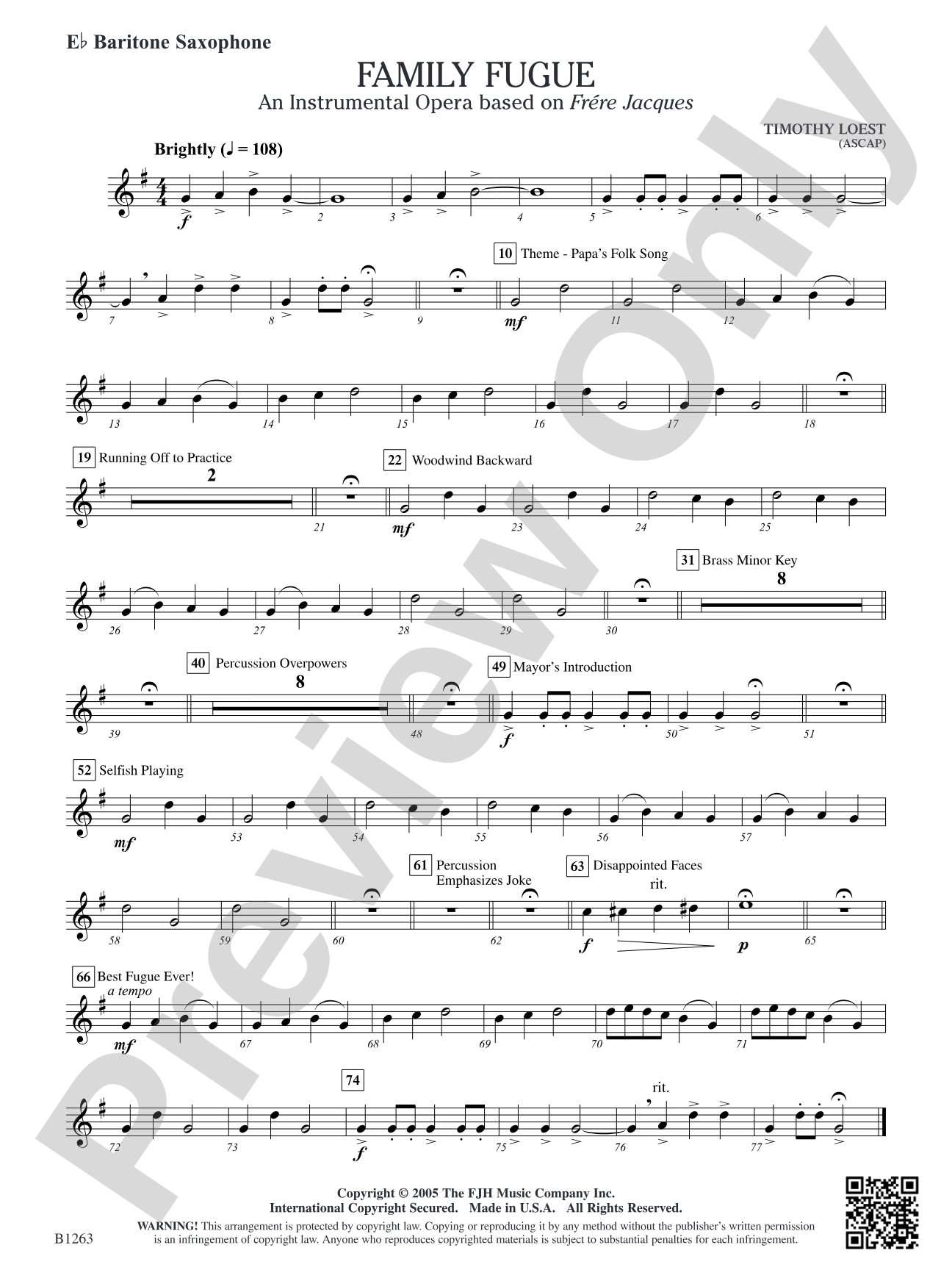

Family Fugue: E-flat Baritone Saxophone
By Timothy Loest
Grade: 1
Item: 98-PC-DB1263_BTX
$7.00
Pickup currently not available
Description
Inspired by Prokofiev's Peter and the Wolf, Family Fugue uses a narrator to blend the familiar folk song Frére Jacques with a delightful story line of the misadventures of three characters: Woodwind, Brass, and Percussion. An educational gem, this innovative work is ideal for teaching major and minor tonality, melodic retrograde, dynamic contrast, and of course, fugue form. Consider using a school administrator or local celebrity as your narrator. Easy to put together, great for recruiting, and forever memorable!


Family Fugue: E-flat Baritone Saxophone isn't in MakeMusic Cloud just yet...but it could be. Let us know you'd like to see it, and you'll help shape what comes next. In the meantime, start a free trial and dive into thousands of interactive titles your students can play along with today.
Request This Title
Tell us you want it.
Start Your Free Trial
Explore everything that's ready to play right now.
Sample Audio
1
Audio File
--:--
0:00
0:00
Sample Video
No sample videos found.
Additional Details
Series:
FJH Beginning Band
Publisher:
The FJH Music Company, Inc.
SKU:
98-PC-DB1263_BTX
More about this title
About the Composer: Timothy Loest

Timothy Loest has spent over thirty years in the middle school classroom, where his deep understanding of young musicians directly shapes everything he writes. His compositions have reached audiences far beyond the band room: his work Cloud Gate drew over 5,000 listeners at Chicago's Millennium Park in 2017, and his music has been featured on The Tonight Show, Good Morning America, and other national broadcasts. In 2022, he founded Fanfare Music Press to publish high-quality band compositions and arrangements.
Loest's credentials span both composition and pedagogy. He holds degrees from Illinois State University and Northwestern University, maintains ASCAP membership, and has contributed to several widely-adopted method books including Measures of Success and the Warm-ups and Beyond series. His work at F.E. Peacock Middle School in Illinois earned him the Illinois Grade School Music Association's Cloyd Myers Memorial Award for Excellence in Music Education in 2017. He regularly accepts commissions and can be reached through his website.
Why we love this
The narrative frame transforms a basic music theory lesson into genuine theater. Pairing a school administrator or community voice with Frére Jacques gives your ensemble a theatrical anchor that students remember for years, making concepts like fugue form and retrograde stick through storytelling rather than drill. At Grade 1, this strikes an unusually effective balance between technical instruction and performance entertainment.
What to expect
Charming and cleverly constructed, with moments of genuine wit. The familiar melody anchors everything, but the harmonic language and structural play keep adults and experienced listeners engaged. There's a lightness here that never feels dumbed-down, and the combination of folk song, narrative, and formal musical architecture creates something you'll hear audience members humming on the way out.
Who it's for
Beginning concert bands who need a concert piece that teaches genuine musical concepts without sacrificing entertainment value. Any program looking to engage administrators, parents, or skeptical community members will find this immediately accessible. It also works beautifully as a recruiting tool for younger students who hear upperclassmen performing something this engaging.
How to get the most out of it
- Let your narrator own the stage during intros and transitions. This is their moment to establish character; the band locks in during the musical passages, creating natural pacing shifts.
- Highlight the section that features each family member separately before they combine in the fugue. This sequential introduction helps the audience track the formal structure without needing to read along.
- Balance dynamic contrast deliberately. The minor tonality sections should sit noticeably darker than the major, making the tonal shift audible even from the back of the auditorium.
- Rehearse the narrator with the band multiple times before performance. Timing around entrances and the fugal overlap demands precision that reading through once will not provide.
How to use it
Program this early in a concert as a warmup piece that establishes your band's personality and draws the audience in. It pairs naturally with heavier concert fare later in the program, offering a tonal contrast and giving your ensemble a chance to show range. The digital format and straightforward orchestration mean minimal prep time, making it ideal for mid-year concerts when rehearsal schedules are tight.
Skills your students will build
- Understanding major and minor tonality through direct melodic comparison
- Recognizing and executing fugue form with multiple voices entering sequentially
- Reading and performing melodic retrograde (backward melodic line)
- Controlling dynamic contrast to support narrative and formal structure
- Ensemble coordination during complex overlapping sections
- Following a conductor while tracking a narrator's independent pacing