
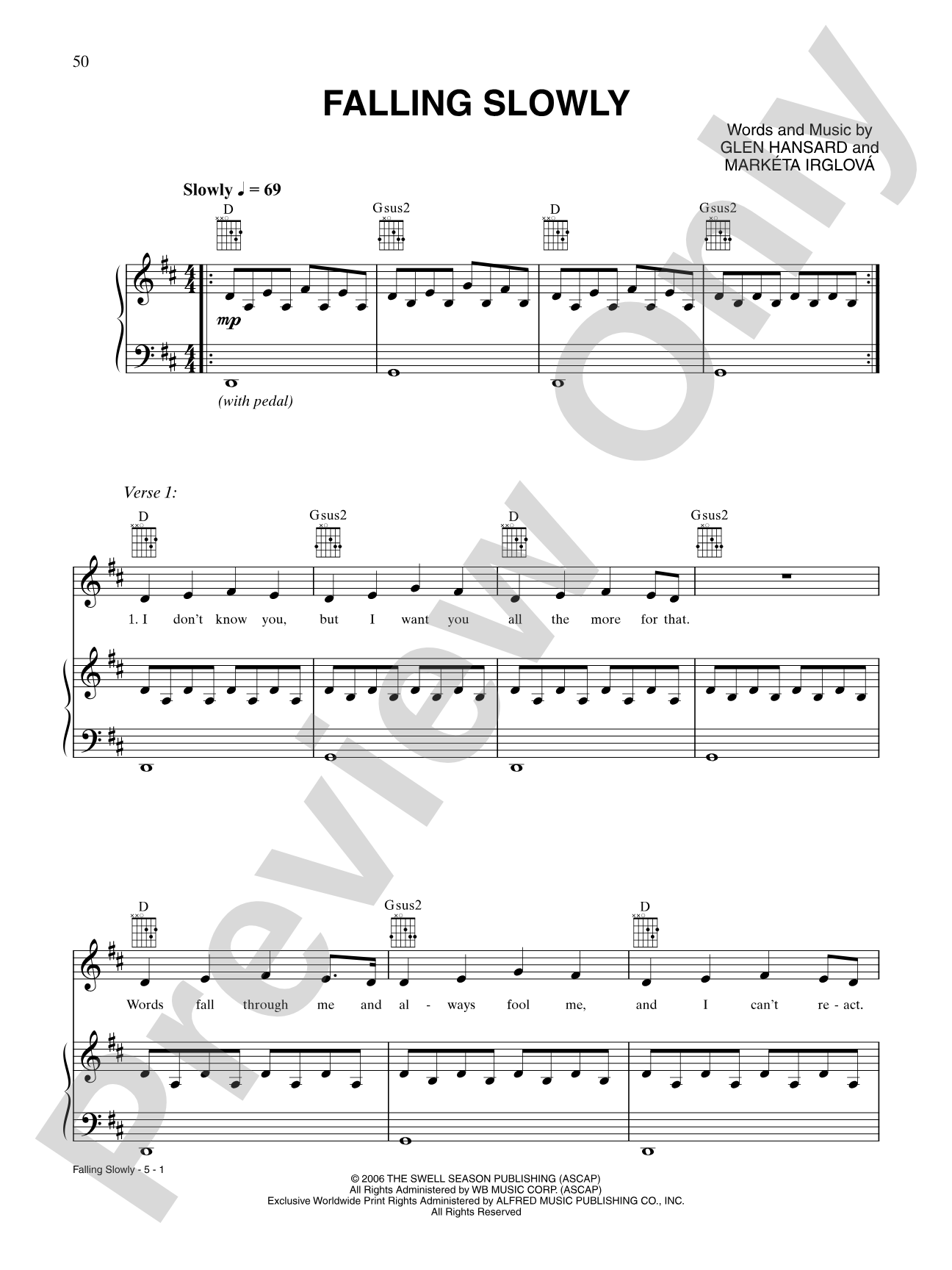

Falling Slowly: Piano/Vocal/Chords
The Biggest Movies * The Greatest Artists (Deluxe Annual Edition)
By various artists and composers
Item: 00-PS-0015699
$4.99
Pickup currently not available
Description
From pop gems to epic movie and television themes, these are the tunes to play in 2013! This collection of more than 140 pages of sheet music captures the year's most memorable songs and themes to play and sing for a lifetime. Titles: Anything Could Happen (Ellie Goulding) * Blown Away (Carrie Underwood) * Catch My Breath (Kelly Clarkson) * Downton Abbey: The Suite (from Downton Abbey) * Everybody Talks (Neon Trees) * Falling Slowly (Josh Groban) * Girl on Fire (Alicia Keys) * Good Morning Beautiful (Jim Brickman featuring Luke McMaster) * Good Time (Owl City and Carly Rae Jepsen) * Hard to Love (Lee Brice) * Home (Phillip Phillips) * Lights (Ellie Goulding) * Locked Out of Heaven (Bruno Mars) * The Mission (from Argo) * Misty Mountains (from The Hobbit: An Unexpected Journey) * Silver Lining (Crazy 'Bout You) (Jessie J [from The Silver Linings Playbook]) * Stars (Grace Potter and the Nocturnals) * Thinkin Bout You (Frank Ocean) * A Thousand Years (Christina Perri) * Two Black Cadillacs (Carrie Underwood) * A Very Respectable Hobbit (from The Hobbit: An Unexpected Journey) * When I Was Your Man (Bruno Mars).


Discover MakeMusic Cloud: thousands of interactive titles your students can play along with today.
Sample Audio
No sample audio found.
Sample Video
No sample videos found.
Additional Details
Series:
Greatest Pop & Movie Hits
Publisher:
Alfred Music
Page Count:
144
SKU:
00-PS-0015699
More about this title
About the Composer: Glen Hansard
Glen Hansard is an Irish musician and composer best known as the frontman of the indie rock band The Frames. His songwriting draws from folk, rock, and alternative influences, often exploring themes of love, loss, and human connection with poetic simplicity. Hansard gained international recognition through his collaborative work on film soundtracks, most notably co-composing "Falling Slowly" with Markéta Irglová for the 2006 film "Once," a song that won the Academy Award for Best Original Song.
Why we love this
"Falling Slowly" opens this collection with immediate emotional authenticity. The song's conversational melody and intimate harmonic language feel refreshingly spare compared to the production-heavy pop hits that surround it, giving singers and pianists a genuine moment to connect with lyrical storytelling.
What to expect
Intimate and conversational, with the quality of two people sitting across from each other sharing something true. The harmonic language is folk-rooted but sophisticated, moving between major and minor in ways that mirror the emotional uncertainty of the lyric. There's restraint throughout; nothing is wasted on excess.
Who it's for
This arrangement serves singers and pianists preparing art song recitals, singer-songwriter performers, and music students exploring contemporary film scoring. It works equally well for solo piano study and for vocal-piano partnerships.
How to get the most out of it
- Treat the vocal line as spoken conversation rather than theatrical delivery; the power comes from restraint and clarity of text.
- Use the piano part to establish the emotional foundation early. Those opening chords set the entire tone, so practice them with consistent voicing and gentle dynamics before introducing the melody.
- Shape the melody in natural phrases that follow the song's narrative arc. Resist pushing volume during the chorus; this song builds tension through harmonic movement, not intensity.
- Coordinate breath marks between vocalist and pianist so silence feels intentional, not accidental. The space between phrases is as important as the music itself.
How to use it
Program this as a bridge between classical art song and contemporary repertoire, or use it to anchor a recital section exploring film and theatrical music. Its modest instrumentation and emotional directness make it an effective transition piece between more elaborate arrangements.
Skills your students will build
- Balancing vocal melody with harmonic accompaniment in a sparse texture
- Interpreting dynamics and phrasing in contemporary singer-songwriter idiom
- Coordinating vocal and piano parts through silence and breath
- Understanding how folk and pop song structures differ from classical forms