Falling Leaves: Chimes Sheet Music Preview

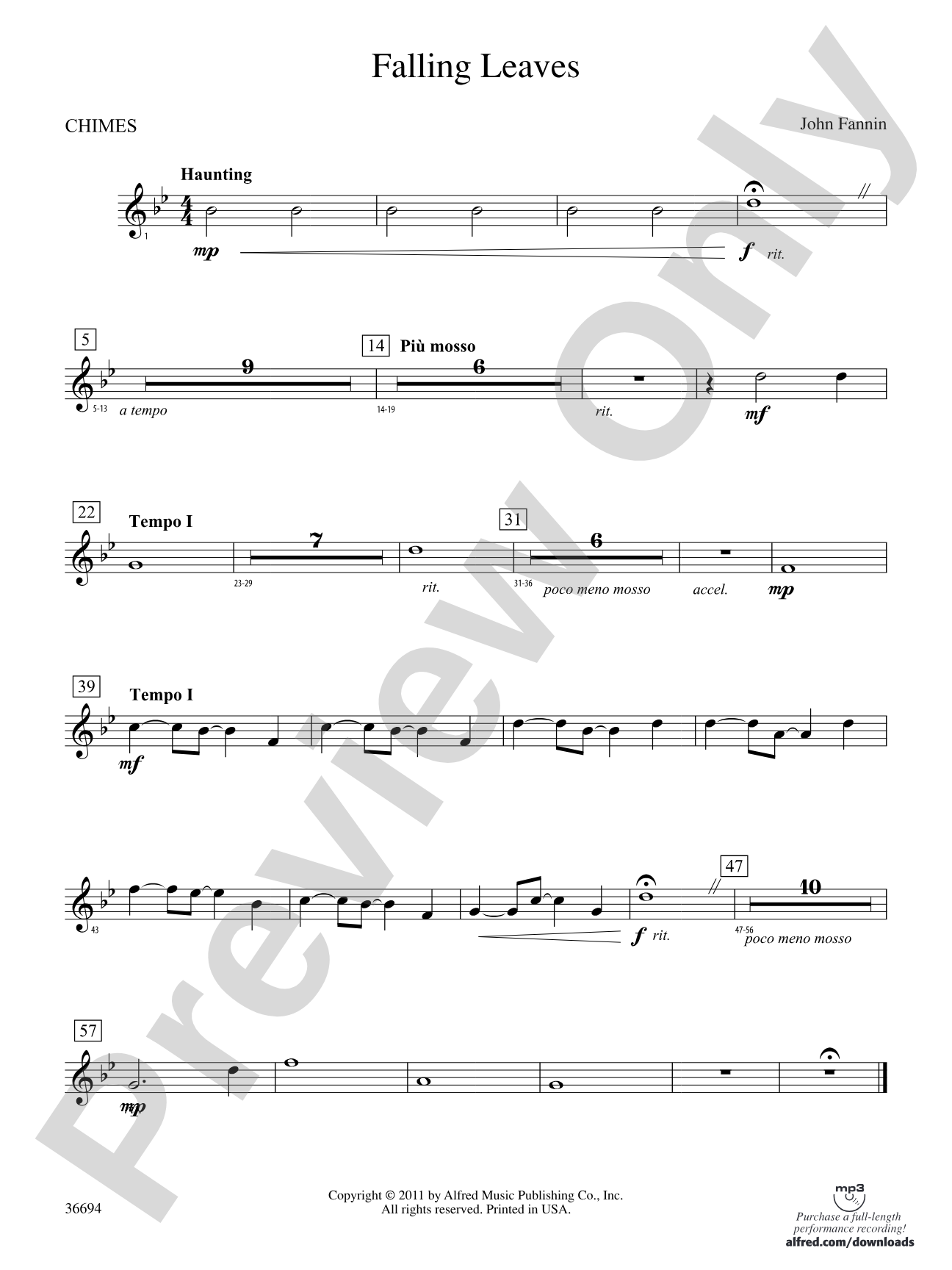
Falling Leaves: Chimes

By John Fannin

Grade: 2 (Medium Easy)

Item: 00-PC-0015122_CH

Digital Download
$3.00
Description
Falling Leaves is a lush ballad that provides an opportunity for ensembles at any level to explore rubato, tenuto, and vibrato. The inspiration for this work was a beautiful fall day when the leaves were turning color and falling from the trees, creating a stunning scene. This title is available in MakeMusic Cloud.

"This haunting work will program well in a change-of-pace moment, and the rehearsals should bring attention to phrasing, style, balance, and blend."
- The Instrumentalist

Don't just read it, hear it, play along with it, and watch your students grow with it. In MakeMusic Cloud, Falling Leaves: Chimes comes alive with professional accompaniment, adjustable tempo, and built-in practice tools that turn solo practice into real progress.

Sample Audio
0:00
0:00
Sample Video
Additional Details
Series: Young Symphonic
Publisher: Alfred Music
Page Count: 128
SKU: 00-PC-0015122_CH

More about this title

About the Composer: John Fannin

John Fannin

John Fannin built his career developing young musicians across the Southwest and beyond. Before joining Murray State University in 1995 as Assistant Director of Bands, he directed programs at five secondary schools in New Mexico and Arizona. During his 25 years at Murray State, he transformed the Racer Marching Band from 85 to 300 members and led the ensemble to appearances at the Bands of America Grand National Championships in 2006 and 2012.

Fannin's contributions to music education have earned recognition across multiple states: the 2017 Max Carman Outstanding Teacher Award, the 2009 KMEA University Teacher of the Year, and the Phi Beta Mu Outstanding Contributor to Band in Kentucky, among others. As owner of Fannin Musical Productions LLC, he continues to serve as a clinician, guest conductor, and creative resource for bands nationwide and internationally. His concert band compositions have been published by Alfred Music Publishing and others.

Why we love this

Fannin crafts a score that rewards attention to nuance without demanding technical virtuosity. The piece teaches what ensemble balance and phrase shaping actually sound like, making it ideal for mid-level bands ready to move beyond note-reading into musical interpretation. Directors will appreciate how the work serves a genuine change-of-pace function in concert programming while deepening musicianship throughout the section.

What to expect

A quiet moment of reflection inspired by autumn's visual beauty. The music unfolds with the gentle inevitability of leaves descending, offering space and air within the harmonic language while maintaining emotional clarity throughout.

Who it's for

Grade 2 concert bands seeking accessible yet musically substantial repertoire. This score works equally well for groups preparing for festival adjudication or building a balanced concert program with ensemble members at intermediate skill levels.

How to get the most out of it

  • Shape the melodic phrases with careful attention to the rubato markings; allow the line to breathe rather than pulse strictly in time.
  • Balance the inner voices so they support the primary melody without overwhelming it; use dynamic control to highlight harmonic movement.
  • Encourage vibrato in the sustained tones, particularly in the woodwind and brass sections, to add warmth and richness to the balladic texture.
  • Use sectional rehearsals to isolate tenuto articulations and ensure consistent interpretation across like instruments before full ensemble work.

How to use it

Position this piece in the middle of a concert to provide genuine textural contrast and give your audience a moment to lean in and listen closely. Its contemplative character works beautifully between more energetic selections and allows directors to demonstrate that effective programming requires both variety and intentional pacing.

Skills your students will build

  • Rubato and flexible tempo execution
  • Tenuto articulation and control
  • Vibrato production and consistency across sections
  • Long-line phrasing and musical architecture
  • Dynamic balance and blend in exposed passages
  • Sectional independence while maintaining ensemble unity

You May Also Like