
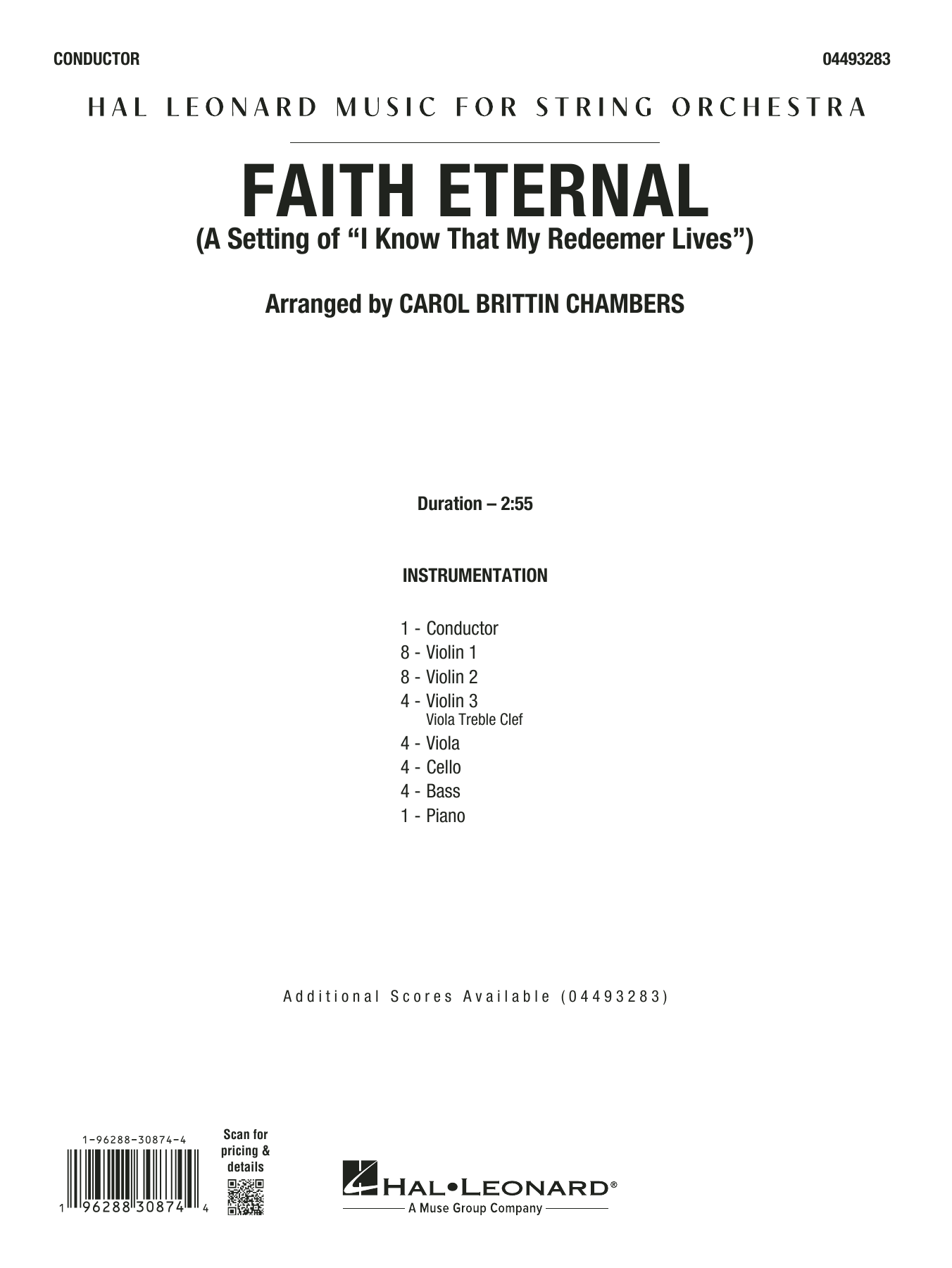

Faith Eternal: String Orchestra Conductor Score & Parts
Arranged by Carol Brittin Chambers
Grade: 2
Item: 35-PK01594098
$60.00
Pickup currently not available
Buy Extra Parts (Digital PDF Download)
| Product | Price | Quantity |
|---|---|---|
| Faith Eternal - Conductor Score (Full Score) | $7.50 | |
| Faith Eternal - Violin 1 | $7.00 | |
| Faith Eternal - Violin 2 | $7.00 | |
| Faith Eternal - Violin 3 (Viola Treble Clef) | $7.00 | |
| Faith Eternal - Viola | $7.00 | |
| Faith Eternal - Cello | $7.00 | |
| Faith Eternal - Bass | $7.00 | |
| Faith Eternal - Piano | $7.00 |
Parts Added to Cart!
Description
This lush and gorgeous setting of the beloved hymn for string orchestra is an excellent showcase for your string orchestra's musicianship. With scoring that mirrors early level literature and shifting in the 1st violins that includes high E naturals, this piece offers a comfortable addition for more developed orchestras while also providing a rewarding and attainable challenge for younger orchestras.


Faith Eternal: String Orchestra Conductor Score & Parts isn't in MakeMusic Cloud just yet...but it could be. Let us know you'd like to see it, and you'll help shape what comes next. In the meantime, start a free trial and dive into thousands of interactive titles your students can play along with today.
Request This Title
Tell us you want it.
Start Your Free Trial
Explore everything that's ready to play right now.
Sample Audio
No sample audio found.
Sample Video
No sample videos found.
Additional Details
Publisher:
Hal Leonard
SKU:
35-PK01594098
More about this title
About the Arranger: Carol Brittin Chambers

Carol Brittin Chambers founded Aspenwood Music, LLC and maintains an active presence as both composer and arranger while serving on the music faculty at Texas Lutheran University in San Antonio. Her work appears regularly on the J.W. Pepper Editor's Choice List and Bandworld Top 100, and she has received commissions annually for concert band, marching band, orchestra, and chamber ensembles. She won the 2019 WBDI Composition Competition and has orchestrated marching shows for high school and college programs nationwide, including The Crossmen Drum Corps.
Before her university appointment, Chambers taught band and private lessons for years in the North East Independent School District and performed regularly with the Mid-Texas and San Antonio Symphonies. She holds a Master of Music in Trumpet Performance from Northwestern University and a Bachelor of Music Education from Texas Tech University, having studied with Vincent Cichowicz, John Paynter, Arnold Jacobs, James Sudduth, and Will Strieder.
Why we love this
Chambers has crafted an arrangement that respects the hymn's dignity while giving strings a genuinely musical showcase. The high E naturals in the first violin line introduce a tasteful technical element without demanding virtuosity, making this an ideal piece for orchestras seeking substance without overreach.
What to expect
Lush and contemplative, this arrangement wraps the familiar hymn melody in warm string colors. The piece breathes with organic phrasing and gentle movement, creating moments of reflection that feel earned rather than sentimental.
Who it's for
String orchestras with developed musicianship who want to program a reverent, accessible piece without sacrificing substance. The Grade 2 difficulty makes this approachable for younger ensembles while providing genuine musical reward for more experienced groups.
How to get the most out of it
- Balance the hymn's reverent character by having the violas and cellos establish a warm harmonic foundation; their moving lines deserve clarity beneath the first violin melody.
- Shape the first violin line with long, connected phrasing rather than stopping at bar lines. This hymn arrangement rewards singers and listeners alike when violins breathe as a vocalist would.
- Draw attention to the orchestration shifts, particularly when scoring moves between sections. These changes in texture prevent the arrangement from becoming predictable across multiple verses.
How to use it
Consider opening a spring concert with this arrangement to set a thoughtful mood, or pair it with lighter fare to demonstrate your orchestra's range in a single program. Its spiritual character also serves well at ceremonies, memorials, or interfaith events where musical substance matters.
Skills your students will build
- Sustaining legato phrasing across longer melodic lines
- Reading and executing high positions in the first violin part
- Balancing inner voices to support the primary melody
- Responding to subtle shifts in orchestration and texture
- Controlling dynamics within hymn-like harmonic progressions