Fairest of the Fair: Bassoon Sheet Music Preview

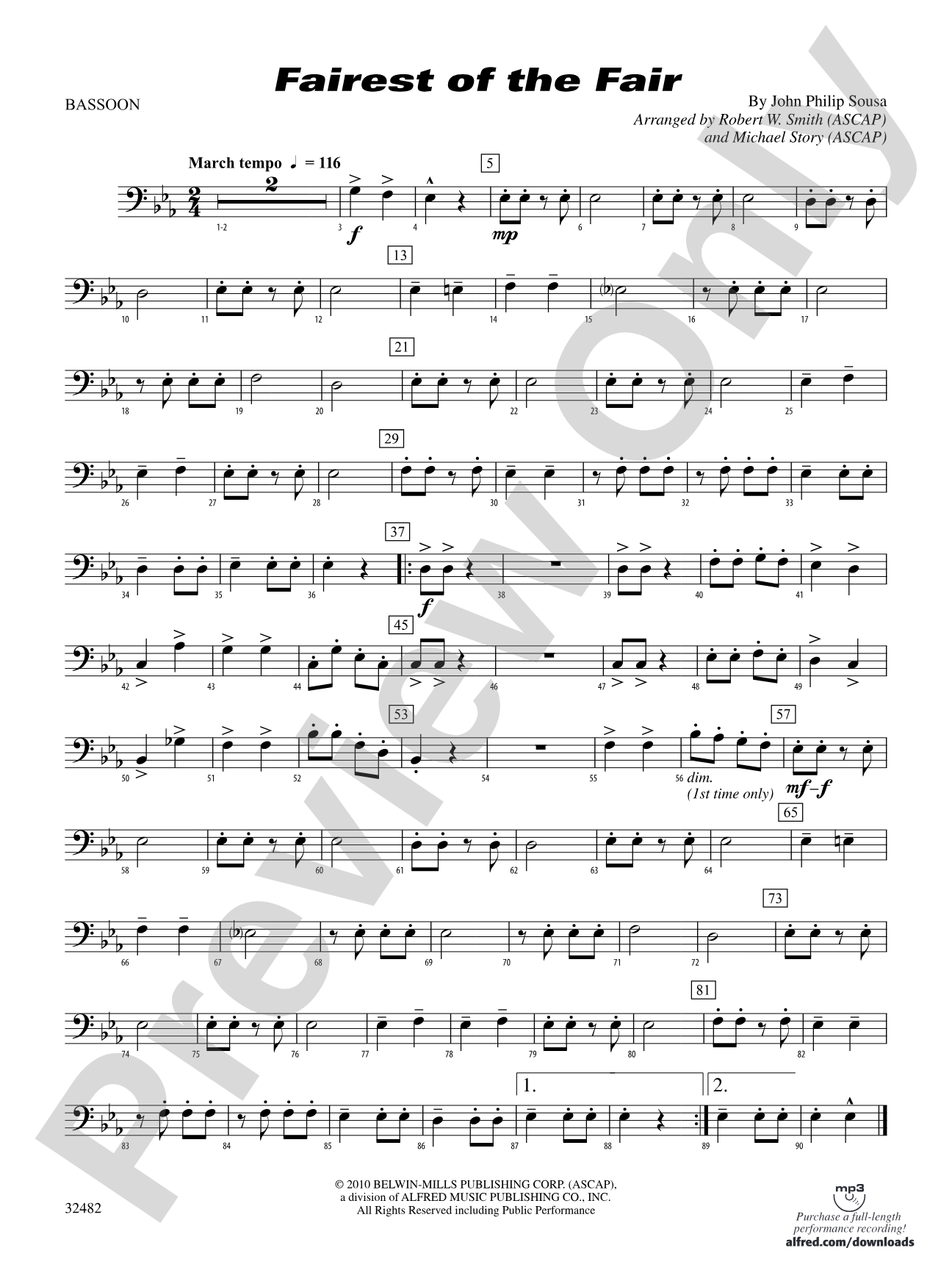
Fairest of the Fair: Bassoon

By John Philip Sousa / arr. Robert W. Smith and Michael Story

Grade: 2 (Easy)

Item: 00-PC-0014364_B1

Digital Download
$3.00
Description
Of his more than 130 marches, written in 1908, "Fairest of the Fair" remains one of John Philip Sousa's most popular marches. Robert Smith and Michael Story have teamed up to create this developing band version ideal for any second year ensemble. This title is available in MakeMusic Cloud.

Don't just read it, hear it, play along with it, and watch your students grow with it. In MakeMusic Cloud, Fairest of the Fair: Bassoon comes alive with professional accompaniment, adjustable tempo, and built-in practice tools that turn solo practice into real progress.

Sample Audio
0:00
0:00
Sample Video
Additional Details
Series: Band Expressions
Publisher: Alfred Music
Page Count: 126
SKU: 00-PC-0014364_B1

More about this title

About the Composer: John Philip Sousa

John Philip Sousa (1854-1932) was an American conductor and composer whose prolific output of military marches earned him the title "The March King." He led the United States Marine Band for twelve years and later formed his own ensemble, composing over 130 marches that became staples of American concert bands and remain fundamental to the repertoire today.

Sousa's marches are models of compositional clarity: strong melodic lines, purposeful harmonic progressions, and infectious rhythmic drive. His work shaped the concert band as we know it, and his marches continue to serve as benchmarks for teaching ensemble balance, style, and the joy of collective music-making.

Why we love this

This arrangement by Smith and Story captures everything that makes Sousa's marches teachable: clear textures, intuitive part writing, and music that students genuinely want to play. Second-year bands can sound polished and confident here without drowning in technical demands, and the march form itself teaches structural listening in a way that engages even younger musicians.

What to expect

Spirited and brassy. The march unfolds with infectious energy and a sense of occasion, anchored by straightforward harmonic progressions and melodies that lodge immediately in the ear. There's a confidence here—the kind students feel when they're playing music that matters and sounds complete.

Who it's for

Second-year concert bands with developing musicianship and growing technical control. This arrangement scales Sousa's famous march to an accessible difficulty level without compromising the character that makes it recognizable and rewarding to perform.

How to get the most out of it

  • Keep the forward momentum steady throughout. Sousa's marches thrive on consistent pulse; resist the temptation to sag in the lyrical sections.
  • Balance the trio against the main theme. The contrasting key and character should feel refreshing, not subordinate.
  • Articulate the march rhythms crisply, especially in the lower voices. Clean articulation gives the arrangement its military character and drive.
  • Let the melody sing over the accompaniment. Even at this grade level, students can hear the difference between buried and supported themes.

How to use it

Program this as an opener or closer on a concert to set a confident, celebratory tone. It pairs naturally with other Sousa marches or with lighter classical repertoire, and it's equally at home at a pep rally or ceremonial event. The familiarity of the tune makes it an excellent teaching tool for discussing arrangement and orchestration with student musicians.

Skills your students will build

  • March form and structure (exposition, trio, return)
  • Melodic independence across sections
  • Dynamic control and phrasing in sustained lines
  • Rhythmic clarity and articulation in march style
  • Balance between melody and accompaniment
  • Ensemble blend at Grade 2 difficulty

You May Also Like