Melody Bober composes with her students' growth at the center of her creative process, crafting pieces that build technique while deepening musical understanding and joy. She holds a bachelor's degree in music education from the University of Illinois at Champaign-Urbana, earned summa cum laude, and a Master of Arts in piano performance from Minnesota State University, Moorhead, where she studied under accomplished mentors including Joel Shapiro and Andrew Froelich.
Her teaching spans public schools for two decades, university instruction, and an active private piano studio in Minnesota. Beyond the studio, Bober serves as a church pianist, accompanist, and former music director. Her reputation as both an innovative composer and dynamic clinician has made her a sought-after presenter at piano teacher conventions and workshops throughout North America.
Why we love this
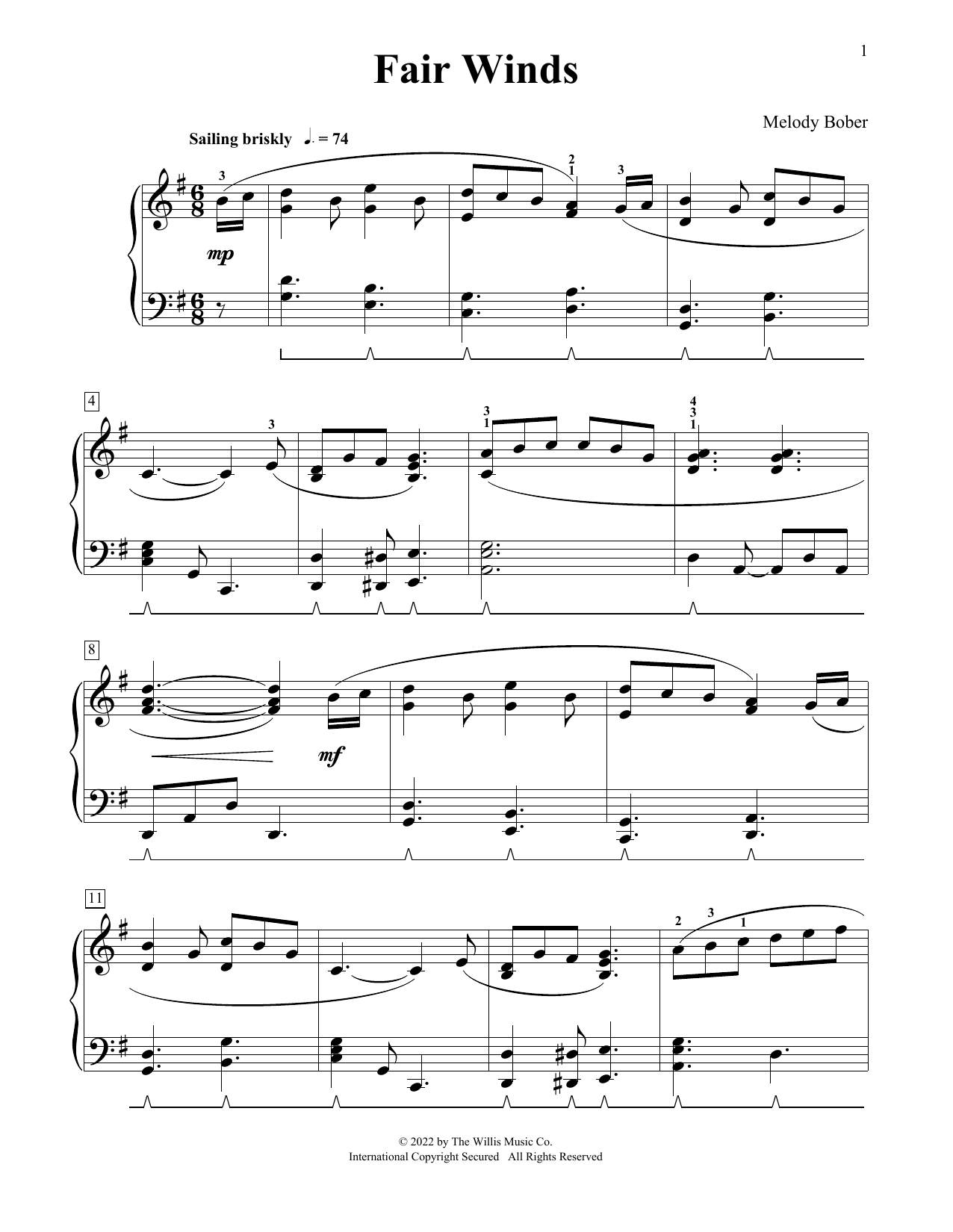
Bober writes with remarkable clarity about what early intermediate pianists need to hear and play. Fair Winds combines accessible harmonic language with genuinely engaging melodic writing, the kind of piece students actually want to practice rather than tolerate.
What to expect
Fair Winds evokes a sense of buoyant forward motion and open space, like stepping onto a path with clear skies ahead. The music feels assured without being showy, offering the satisfaction of playing something that sounds considered and refined.
Who it's for
Early intermediate pianists who are developing independence between hands and seeking repertoire that rewards careful voicing and musical maturity. This piece works equally well for students preparing for recitals or festivals and for teachers building a balanced teaching library.
How to get the most out of it
Let the melody sing over a supported but never heavy accompaniment; the left hand should provide foundation without overshadowing the right hand's primary voice.
Pay attention to phrase breathing and shape each phrase with subtle dynamic contour, even where not explicitly marked.
Honor the title by imagining movement and direction in the music; avoid a static, plodding approach to the pulse.
How to use it
Include this on a student recital to showcase early intermediate artistry alongside more technically demanding pieces, or use it as a teaching piece to develop interpretive skills before advancing to more complex repertoire. Its three-page length and moderate difficulty make it ideal for end-of-unit assessments or studio performance days.
Skills your students will build
Voicing and balancing melodic lines against accompaniment patterns
Shaping phrases with dynamic awareness and phrasing without explicit markings
Maintaining steady tempo while attending to musical expression
Right-hand independence and facility in moderate ranges
Left-hand foundation technique supporting the right hand's priority
You May Also Like
Scan to Complete Your Purchase
Use your phone's camera to scan the code below
You'll log in on your phone and the order will be added to your account