
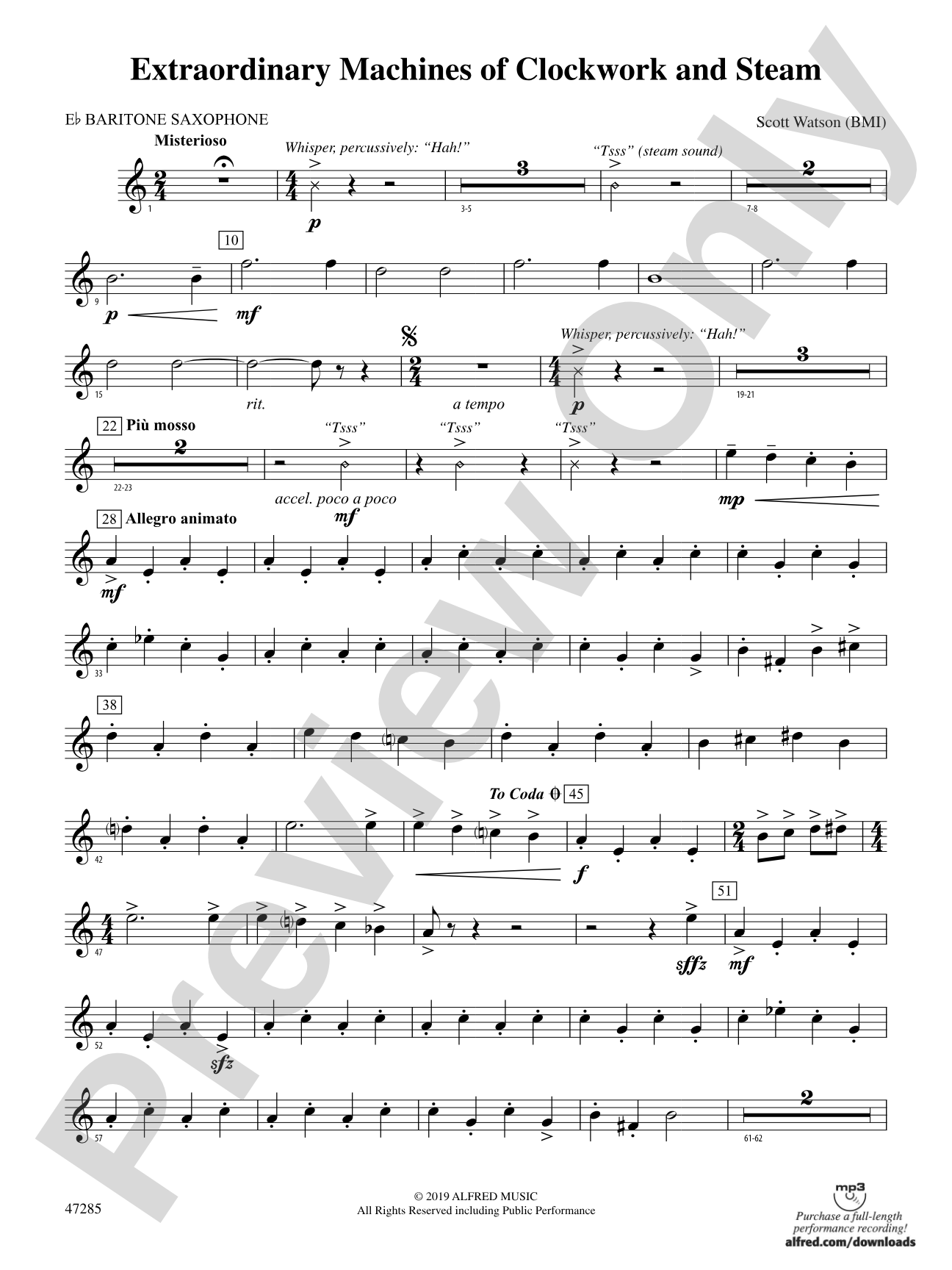

Extraordinary Machines of Clockwork and Steam: E-flat Baritone Saxophone
By Scott Watson
Grade: 3
Item: 00-PC-0017898_BTX
$3.00
Pickup currently not available
Description
This imaginative piece brings the magical sounds of steampunk to your concert band. Enter the world of Jules Verne, H. G. Wells, and others whose fascinating, limitless view of the future---from a Victorian vantage point---presented all sorts of fanciful contraptions: forward-looking modes of transportation, time travel, weaponry, and more! This title is available in MakeMusic Cloud.


Don't just read it, hear it, play along with it, and watch your students grow with it. In MakeMusic Cloud, Extraordinary Machines of Clockwork and Steam: E-flat Baritone Saxophone comes alive with professional accompaniment, adjustable tempo, and built-in practice tools that turn solo practice into real progress.
Open in the Player
Jump straight in and assign it today.
Start Your Free Trial
Open this title and explore the full library in minutes.
Sample Audio
1
Audio File
--:--
0:00
0:00
Sample Video
Additional Details
Series:
Young Symphonic
Publisher:
Alfred Music
Page Count:
284
SKU:
00-PC-0017898_BTX
More about this title
About the Composer: Scott Watson

Scott Watson brings three decades of classroom experience to his work as a composer and educator. After leading the instrumental program at Parkland School District in Allentown, Pennsylvania, where he directed high school bands and coordinated the elementary strings and band curriculum across multiple schools, he joined the faculty at Cairn University as Associate Professor of Music. His 120-plus published works for concert band, string orchestra, and chamber ensembles reflect his dual grounding in contemporary classical music and the practical needs of student musicians.
Watson's compositions have reached audiences at major venues including the Academy of Music in Philadelphia, the Midwest Clinic in Chicago, and the White House. He serves as an exclusive composer and clinician for Alfred Publications, contributes to their Sound Innovations series, and authored the widely respected text Using Technology to Unlock Musical Creativity (Oxford University Press, 2011). His work as a guest conductor and workshop presenter keeps him connected to the band directing community nationwide.
Why we love this
Watson captures the visual spectacle of steampunk without losing sight of what makes a Grade 3 band piece engaging and playable. The orchestration balances accessible writing with genuine compositional craft, so your ensemble sounds sophisticated without requiring virtuosic chops. Programming a piece this inventive proves to students that concert band repertoire can be as imaginative as it is musical.
What to expect
Imagine gears turning, steam hissing, and mechanical arms whirring to life. The music evokes movement and invention, with moments of whimsy balanced against passages of forward momentum and industrial precision. There's a sense of wonder woven throughout, as if witnessing the fantastical machines of Jules Verne spring to life on stage.
Who it's for
Concert bands at the Grade 3 level looking for repertoire that engages audiences and performers alike with a fresh concept. Directors seeking music that rewards good intonation and ensemble listening without demanding advanced technique will find this title fits squarely in the festival and concert repertoire sweet spot.
How to get the most out of it
- Establish a steady mechanical pulse early in rehearsal. Use a metronome during sectionals to lock in the rhythmic precision this score demands, particularly in passages where the band voices interlock like gear teeth.
- Highlight the color changes between sections by asking players to listen across the ensemble rather than only within their own voice part. This develops awareness of how individual lines create larger orchestral shapes.
- Allow time for the ensemble to absorb the programmatic intent. Play a brief video clip or share images of Victorian-era machines and airships before rehearsals; composers like Watson write more expressively when performers understand the story.
- Balance clarity with momentum in the faster passages. Mark a few key transition points in the score so the ensemble knows where the conductor is driving toward and can maintain shape without dragging.
How to use it
This works beautifully as a concert opener that immediately captures audience attention and sets a theatrical tone for the evening. It pairs well with other light contemporary works or standard classics, offering programming variety without excessive difficulty. Consider it for a concert themed around imagination, literature, or music inspired by visual art.
Skills your students will build
- Rhythmic precision in ensemble contexts (locking moving lines together)
- Balance and blend across voice parts with multiple simultaneous melodic lines
- Dynamic control and color changes to support programmatic intent
- Sectional independence while maintaining collective sound
- Expressive interpretation of narrative and imagery in music