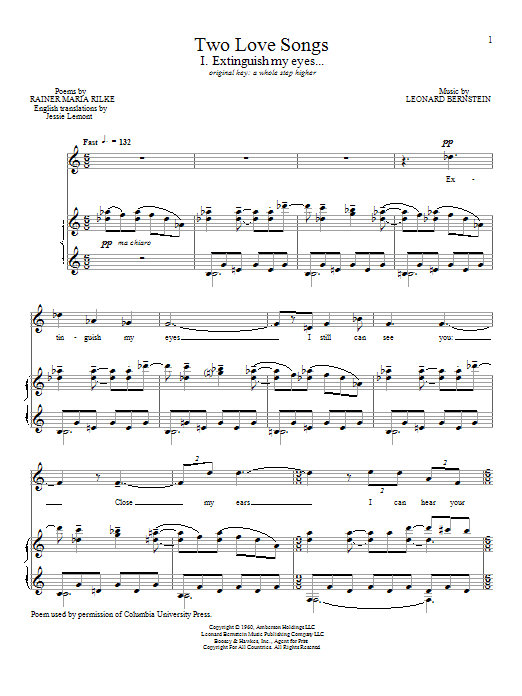
Extinguish My Eyes Sheet Music Preview

Extinguish My Eyes: Piano Vocal

As performed by Leonard Bernstein

Item: 35-DS00249201

Digital Download
$5.99

One moment…

One moment…

Description

Extinguish My Eyes: Piano Vocal isn't in MakeMusic Cloud just yet...but it could be. Let us know you'd like to see it, and you'll help shape what comes next. In the meantime, start a free trial and dive into thousands of interactive titles your students can play along with today.

Sample Audio
No sample audio found.
Sample Video
Additional Details
Publisher: Hal Leonard
Page Count: 5
SKU: 35-DS00249201

More about this title

About the Artist: Leonard Bernstein

Leonard Bernstein (1918-1990) was an American conductor, composer, and educator whose influence shaped twentieth-century music across concert halls, Broadway stages, and living rooms through his Young People's Concerts. His compositional voice combined accessibility with structural sophistication, drawing from jazz, Jewish liturgical music, and European modernism without sacrificing emotional directness. For singers and pianists, his vocal works offer the rare combination of vocally grateful writing and harmonically adventurous accompaniment.

Why we love this

Bernstein's setting of this Rilke text captures introspective intensity without resorting to melodrama, making it ideal for advanced singers developing interpretive nuance and emotional restraint. The piano writing demands serious musicianship from accompanists while remaining within reach for strong collaborative pianists, creating a genuine partnership rather than mere support.

What to expect

A moment of profound stillness and vulnerability, where the speaker turns inward with philosophical weight. The harmonic language mirrors this introspection, moving through unexpected tonal areas that feel both unsettling and strangely inevitable, creating an atmosphere of quiet searching.

Who it's for

Advanced high school singers, college vocalists, and program soloists seeking substantial art song repertoire that sits comfortably in the voice while challenging interpretive maturity. Pianists comfortable with twentieth-century harmonic language and sensitive accompanists will find rewarding collaborative material here.

How to get the most out of it

  • Study the harmonic language in isolation first; Bernstein's chromatic voice leading and unexpected resolutions reward careful listening and create opportunities for nuanced dynamic shaping.
  • Coordinate rubato between voice and piano through rehearsal rather than assuming instinctive agreement; the emotional pacing matters more than metronomic precision, but both performers must move together.
  • Shape phrases through breath and silence as much as through sound; the introspection here lives in what you don't force.

How to use it

Position this in a recital program where it can breathe alone or paired with other Bernstein or contemporary settings of Rilke, creating a sophisticated second half or concert centerpiece. It works equally well in art song recitals and as an audition selection for singers demonstrating vocal control and musical maturity.

Skills your students will build

  • Phrasing and interpretation in contemporary art song
  • Harmonic analysis of twentieth-century chromatic voice leading
  • Collaborative communication between vocalist and accompanist
  • Dynamic control and emotional restraint in introspective material
  • Sustained singing without relying on lyrical momentum

You May Also Like