Extinguish My Eyes Sheet Music Preview

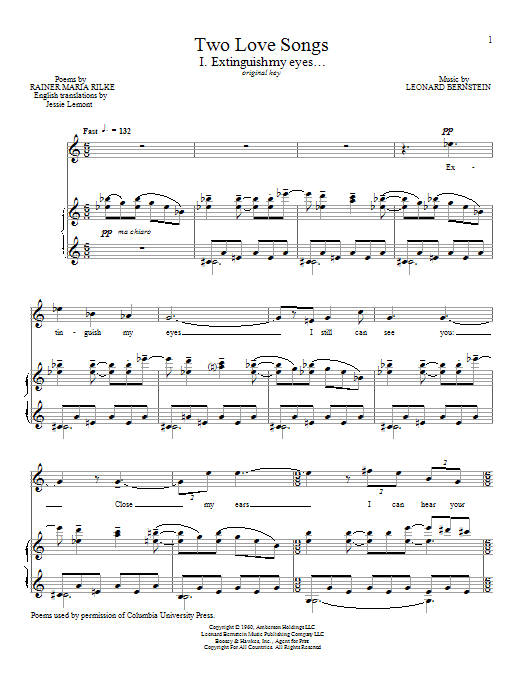
Extinguish My Eyes: Piano Vocal

As performed by Leonard Bernstein / As performed by Richard Walters

Item: 35-DS00249195

Digital Download
$5.99

One moment…

One moment…

Description

Extinguish My Eyes: Piano Vocal isn't in MakeMusic Cloud just yet...but it could be. Let us know you'd like to see it, and you'll help shape what comes next. In the meantime, start a free trial and dive into thousands of interactive titles your students can play along with today.

Sample Audio
No sample audio found.
Sample Video
Additional Details
Publisher: Hal Leonard
Page Count: 5
SKU: 35-DS00249195

More about this title

About the Artist: Leonard Bernstein

Leonard Bernstein (1918-1990) was an American composer, conductor, and educator whose output spanned symphonies, ballets, operettas, and art songs. His facility across musical styles was matched only by his gift for melody and his ability to write idiomatically for the human voice. Bernstein's vocal writing combines the harmonic sophistication of his concert music with an instinctive understanding of what singers can express.

Why we love this

Bernstein's art songs demand that singers engage with text on an intellectual and emotional level while navigating his characteristically rich harmonic language. This piece sits at the intersection of modernism and lyricism, offering advanced students a gateway into 20th-century vocal literature without sacrificing beauty or communicative directness.

What to expect

Introspective and searching, with the weight of intimate confession. Bernstein's harmonic language pulls in unexpected directions, creating moments of harmonic suspension that mirror the emotional uncertainty at the song's core.

Who it's for

Advanced high school vocalists, college singers preparing art song recitals, and young professionals building their 20th-century repertoire. The piece rewards singers with developed musicianship and comfort navigating chromatic harmony.

How to get the most out of it

  • Balance the independence of the piano part with the vocal line; Bernstein's accompaniment is never merely supportive, and the interplay between voice and keyboard is essential to the song's architecture.
  • Shape the line through harmonic changes rather than forcing artificial phrasing; let the underlying chord progressions suggest where breath and direction naturally occur.
  • Collaborate with your pianist early on vowel formation and ensemble clarity, since the richer the harmonic texture, the more important unified diction becomes.

How to use it

This works beautifully on a recital exploring Bernstein's vocal legacy alongside his more well-known theatrical output, or as part of a broader 20th-century American art song program. It also pairs naturally with other modernist song literature from the same era.

Skills your students will build

  • Reading chromatic harmony and non-diatonic chord progressions
  • Maintaining stylistic integrity while navigating angular melodic lines
  • Coordinate phrasing with a complex piano accompaniment
  • Expressive text interpretation in contemporary vocal music

You May Also Like