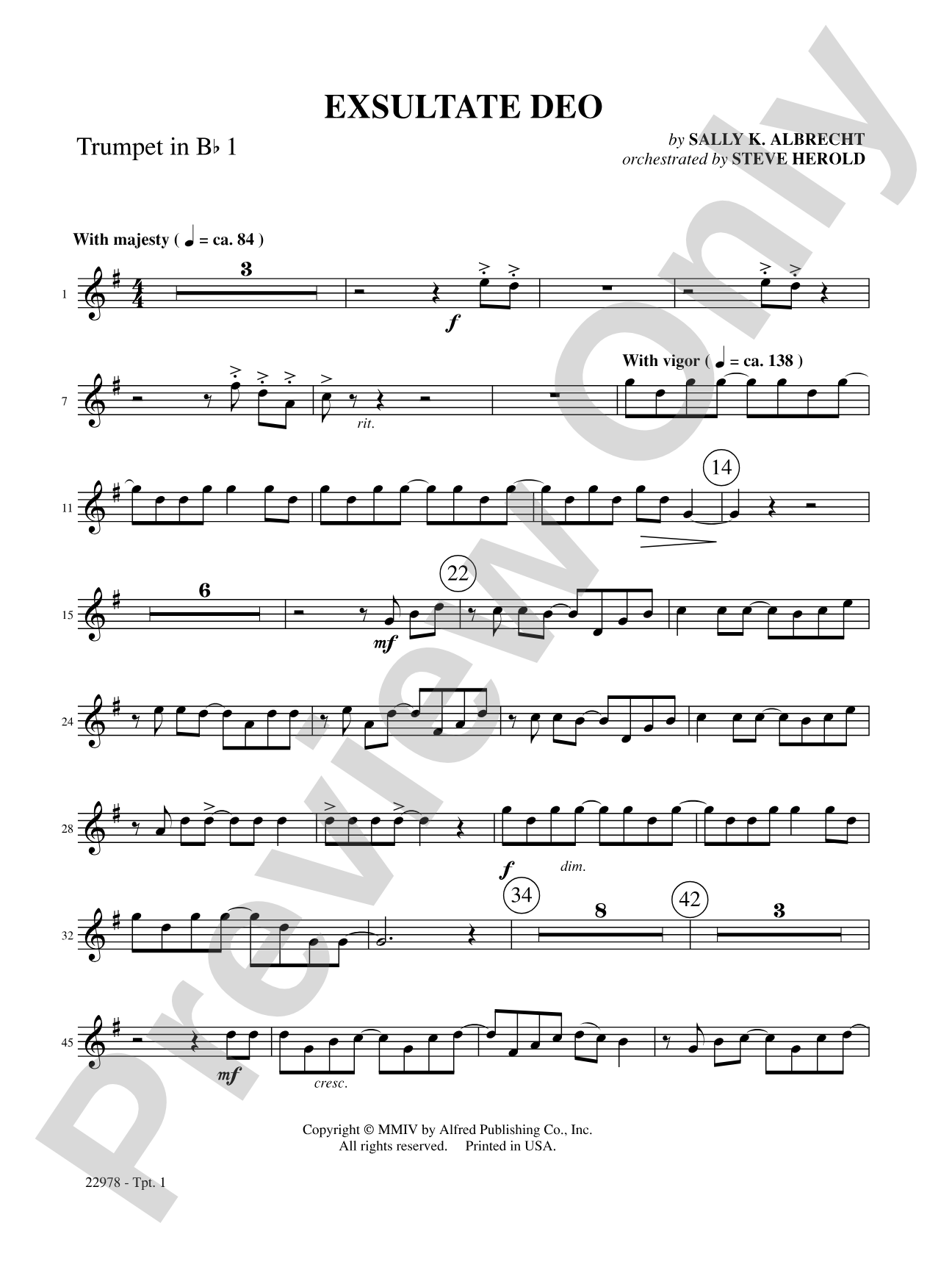
Exsultate Deo: 1st B-flat Trumpet Sheet Music Preview

Exsultate Deo: 1st B-flat Trumpet: Choral SoundPax

Music by Sally K. Albrecht

Item: 00-PC-0000611_T1

Digital Download
$3.00
Description
Includes parts for 2 French horns, 2 trumpets, 2 trombone, timpani, percussion, and synthesizer.

Don't just read it, hear it, play along with it, and watch your students grow with it. In MakeMusic Cloud, Exsultate Deo: 1st B-flat Trumpet: Choral SoundPax comes alive with professional accompaniment, adjustable tempo, and built-in practice tools that turn solo practice into real progress.

Sample Audio
0:00
0:00
Sample Video
Additional Details
Series: Alfred Choral Designs
Publisher: Alfred Music
SKU: 00-PC-0000611_T1
Instrumentation: SoundPax

More about this title

About the Composer: Sally K. Albrecht

Sally K. Albrecht

Sally K. Albrecht has shaped American choral music for over three decades, first as Director of School Choral, Vocal, and Elementary Publications at Alfred Music, then as a prolific composer in her own right. With more than 600 choral publications and 75 larger works in print, she has established herself as a voice for accessible, engaging sacred and secular repertoire. An ASCAP Special Music Award recipient since 1987, Albrecht has conducted honor choirs at Lincoln Center, Carnegie Hall, and The Kennedy Center, bringing her distinctive blend of musicality and movement to stages across the country.

Educated at Rollins College (B.A. in Music and Theater, 1976) and the University of Miami (M.A. in Drama, 1977; M.M. in Accompanying, 1979), Albrecht has taught at Oakland University, Jersey City State College, and Meredith College. Her work celebrating choral movement as an integral part of choral performance has influenced how directors approach staging and physical expression. She resides in Wake Forest, North Carolina, with her husband Jay Althouse, a composer and arranger in his own right.

Why we love this

Albrecht's command of instrumental color in a choral context shines here. The brass and percussion writing supports rather than overwhelms the voices, and the synthesizer option gives you flexibility whether you're working with a full ensemble or adapting on the fly. This is the kind of sacred music that energizes singers and audiences alike without requiring elaborate staging or specialized skills.

What to expect

Exsultate Deo radiates joy and celebration. The brass punctuation and timpani rolls lift the text into something majestic, while the choir's lines soar with lyrical momentum and harmonic depth. There's a sense of festive devotion throughout, bright without being precious.

Who it's for

This works beautifully for high school and college choirs seeking substantial sacred repertoire with professional instrumental support. Community choruses and church choirs with access to brass and percussion players will find the piece both spiritually resonant and stylistically current.

How to get the most out of it

  • Balance the brass strategically during rehearsals by bringing in instrumental parts gradually. Start with voices alone, then layer in the rhythm section, and finally add the melodic brass lines so singers aren't chasing intonation.
  • Let the synthesizer double selected voice parts during early rehearsals if your choir struggles with harmonic independence. Once parts are secure, pull back the synth support and rely on acoustic blending.
  • Use the recorded accompaniment to establish a clear pulse with your ensemble, especially if this is your first time working with instrumental parts. Singers often lock in faster when they hear the full texture rather than learning to follow a conductor's beat alone.

How to use it

Program this as a centerpiece for a sacred or festival concert where you can highlight your singers alongside instrumental musicians. It also serves as an effective opener or closer for services or liturgical celebrations, especially when you want to mark a significant occasion with musical distinction.

Skills your students will build

  • Singing sustained lines against rhythmic instrumental patterns
  • Maintaining ensemble intonation with brass and percussion support
  • Following a conductor while tracking independent voice parts
  • Responding to stylistic brass articulation and cut-offs
  • Balancing blend and projection in a mixed-instrument texture

You May Also Like