
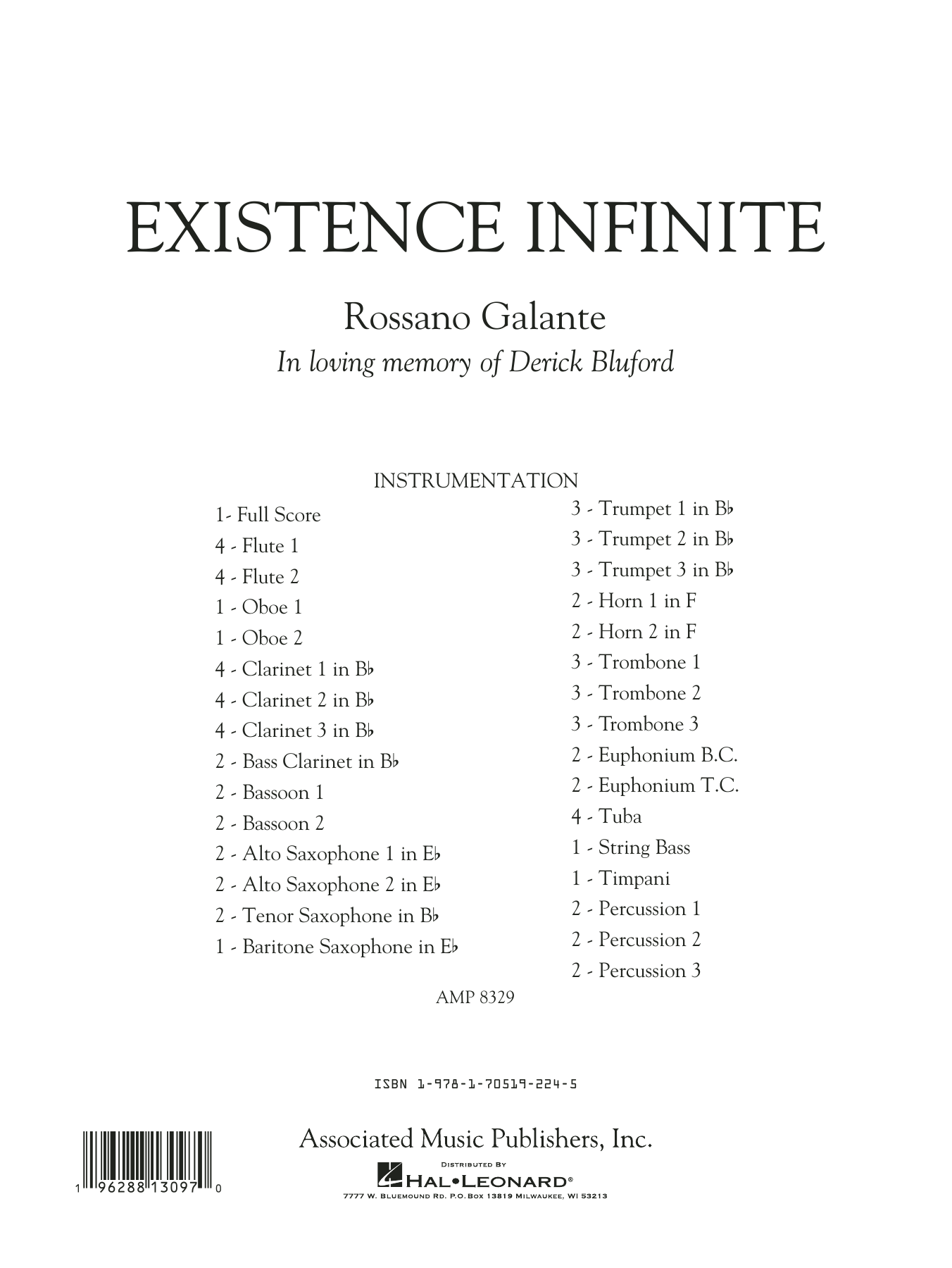

Existence Infinite: Concert Band Conductor Score & Parts
By Rossano Galante
Grade: 3.5
Item: 35-PK01255249
$80.00
Pickup currently not available
Buy Extra Parts (Digital PDF Download)
Parts Added to Cart!
Description
Composed as a reverent memorial for an inspirational musician and educator, "Existence Infinite" is the composer's way of conveying the sense of loss, but also the emotional healing that follows. Featuring a tender and flowing style, this poignant work strikes a perfect balance between light, sensitive scoring and dramatic moments for the full ensemble. Dur: 4:15


Discover MakeMusic Cloud: thousands of interactive titles your students can play along with today.
Sample Audio
No sample audio found.
Sample Video
Additional Details
Publisher:
Hal Leonard
SKU:
35-PK01255249
More about this title
About the Composer: Rossano Galante

Rossano Galante studied trumpet performance at SUNY Buffalo, graduating in 1992, and was immediately accepted to the University of Southern California's prestigious Film Scoring Program where he studied composition with Academy Award winner Jerry Goldsmith. Since relocating to California in 1999, he has worked as an orchestrator and composer on over eighty studio films, collaborating with Oscar-nominated composers and contributing to franchises including the Avengers, Fast, Venom, and A Quiet Place series.
Beyond his film work, Galante receives commissions from concert bands and orchestras worldwide, with more than 68 published compositions across major music publishers including Alfred, Schirmer, Hafabra, and Curnow. His dual expertise in orchestral film writing and band composition brings cinematic sophistication to his concert works.
Why we love this
Galante writes with the orchestral sensibility of a film composer, which means every section has a clear dramatic arc and emotional purpose. The Grade 3.5 difficulty sits exactly where you need it for developing ensembles that are ready to handle nuanced dynamic control and sustained lyricism without getting overwhelmed by technical demands. Programming a memorial work offers your band a rare chance to explore reverence and healing as emotional concepts rather than just playing notes.
What to expect
Tender and flowing, with moments of quiet introspection broken by surges of full ensemble sound. The scoring balances delicate vulnerability with underlying strength, creating a work that honors loss while ultimately offering a sense of quiet resolve and peace.
Who it's for
Directors programming works that deepen ensemble musicianship and emotional maturity. This piece works beautifully for bands with strong fundamentals who are ready to move beyond technical exercises into interpretive playing.
How to get the most out of it
- Balance the tender passages by resisting the urge to add weight; let the lighter voicings breathe and carry the melodic line through the ensemble without doubling unnecessarily.
- Mark the dramatic moments clearly in rehearsal so students understand when the texture shifts. The contrast between intimate writing and full ensemble sound drives the piece's emotional arc.
- Attend to phrase endings with care. In memorial works, the space after a phrase often carries as much weight as the notes themselves; avoid rushing into the next section.
- Use the recorded accompaniment as a reference for tempo and pacing, but encourage your musicians to feel the emotional weight beneath the surface rather than simply following along.
How to use it
Use this as a centerpiece for a concert devoted to reflective or commemorative themes, or pair it with other Grade 3 works to show your ensemble's range from lyrical expression to dramatic intensity. Its 4:15 duration makes it ideal as the second or third selection on a program, giving audiences and performers space to settle into its contemplative mood.
Skills your students will build
- Sustaining long phrases with consistent tone and intonation
- Balancing dynamics across the ensemble in soft, transparent textures
- Interpreting emotional content and shaping music expressively beyond technical execution
- Responding to and executing clear dramatic contrasts within a single work
- Ensemble blend in open voicings and mixed instrumental combinations