
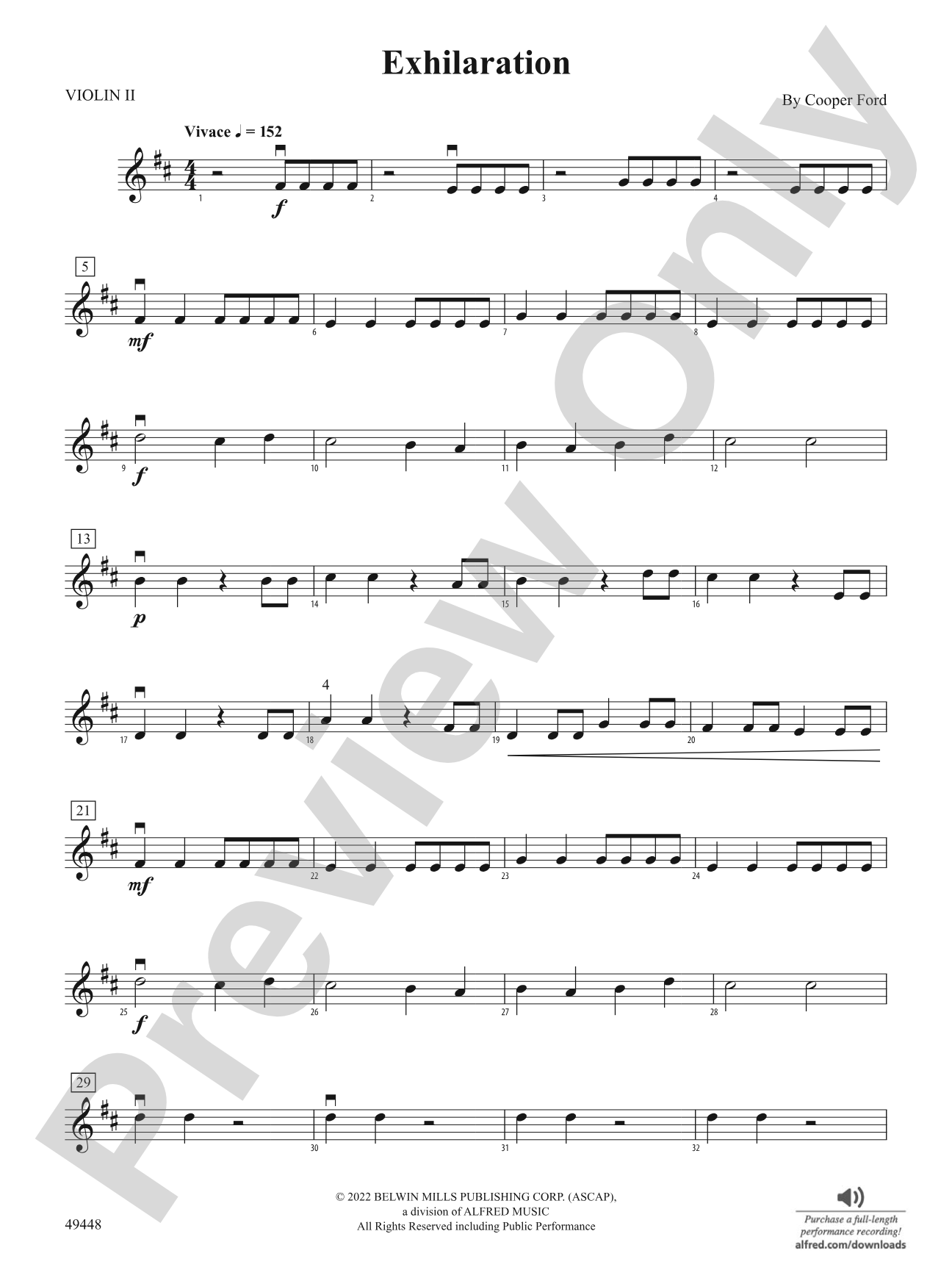

Exhilaration: 2nd Violin
By Cooper Ford
Grade: 1
Item: 00-PC-0018774_VN2
$3.00
Pickup currently not available
Description
Many special experiences are joyful or thrilling, such as flying for the first time, a big sports moment, or the excitement of a first concert. Whatever it might be, Cooper Ford's Exhilaration is a musical expression of the emotions that come from these memorable moments. Young musicians should find this both easily accessible and fun to play, as melodies are passed around to different sections while reinforcing foundational rhythms, notes within a D major scale, and playing with a big sound. Written with the young orchestra in mind, 2nd violin and viola parts are doubled, as well as cello and string bass. (1:40)


Don't just read it, hear it, play along with it, and watch your students grow with it. In MakeMusic Cloud, Exhilaration: 2nd Violin comes alive with professional accompaniment, adjustable tempo, and built-in practice tools that turn solo practice into real progress.
Open in the Player
Jump straight in and assign it today.
Start Your Free Trial
Open this title and explore the full library in minutes.
Sample Audio
1
Audio File
--:--
0:00
0:00
Sample Video
Additional Details
Series:
Belwin Beginning String Orchestra
Publisher:
Alfred Music
SKU:
00-PC-0018774_VN2
More about this title
About the Composer: Cooper Ford

Cooper Ford grew up in Chatham, New Jersey, where he began studying violin and trumpet through his school music program. Recognizing his compositional voice early, his teachers encouraged him to develop that interest alongside his performance skills. He earned his Bachelor of Music in Music Education from The College of New Jersey and his Master of Music in Music Education from the University of Florida.
Ford has served on the conducting staff of the New Jersey Youth Symphony, where he worked with intermediate students in grades 5-7. He currently directs the orchestra program at North Brunswick Township High School in New Jersey and teaches Music Production courses there. Active as a guest conductor and clinician, Ford participates in ASTA and NAfME, bringing his classroom experience directly into his compositional work.
Why we love this
Ford understands exactly what Grade 1 string players can execute and enjoy because he teaches them every day. The piece sits at that ideal sweet spot where young musicians feel genuinely challenged while experiencing the reward of playing something celebratory and energetic, making it a natural fit for concert programming and festival performances alike.
What to expect
Exhilaration opens with genuine musical joy, the kind of bright, forward energy you feel after something wonderful has just happened. Melodies bubble up from different parts of the ensemble, creating layers of warmth and excitement without ever feeling complicated or strained.
Who it's for
Grade 1 string orchestras and flexible string ensembles looking for accessible, uplifting concert repertoire. Young musicians benefit from the reinforcement of D major tonality, foundational rhythms, and the collaborative experience of passing melodies across sections.
How to get the most out of it
- Bring energy to the opening statement without rushing; younger ensembles often play fast music even faster when they're excited, so establish a steady tempo in rehearsal and remind players they're painting with a big, broad brush.
- Rotate the melodic material so every section gets a moment in the spotlight. This keeps players invested and helps them understand how orchestration works when the tune passes from violins to violas to cellos.
- Encourage full bows and resonant tone when the melody arrives in lower voices. Many young cellists and bassists are conditioned to play softly; this piece gives them permission to sing.
How to use it
Program this early in a concert to establish an upbeat mood, or use it as a bridge between a slower opening piece and heavier repertoire. Its 1:40 length makes it ideal for festival play-throughs and adjudicated performances where time is limited and first impressions matter.
Skills your students will build
- Playing within a D major scale and reinforcing key-specific intonation
- Foundational rhythm reading in simple meters
- Passing melodic material between sections and listening for harmonic support
- Producing a full, resonant tone across the entire ensemble
- Reading and executing doubled parts on 2nd violin, viola, cello, and string bass