

Excursions (for right hand alone) - Piano Solo: Piano
By Martha Mier
Level: Late Intermediate
Item: 00-PB-0000759
$3.50
Pickup currently not available
Related Items
Excursions (for right hand alone): Piano Sheet |
$3.50
|
View |
Description
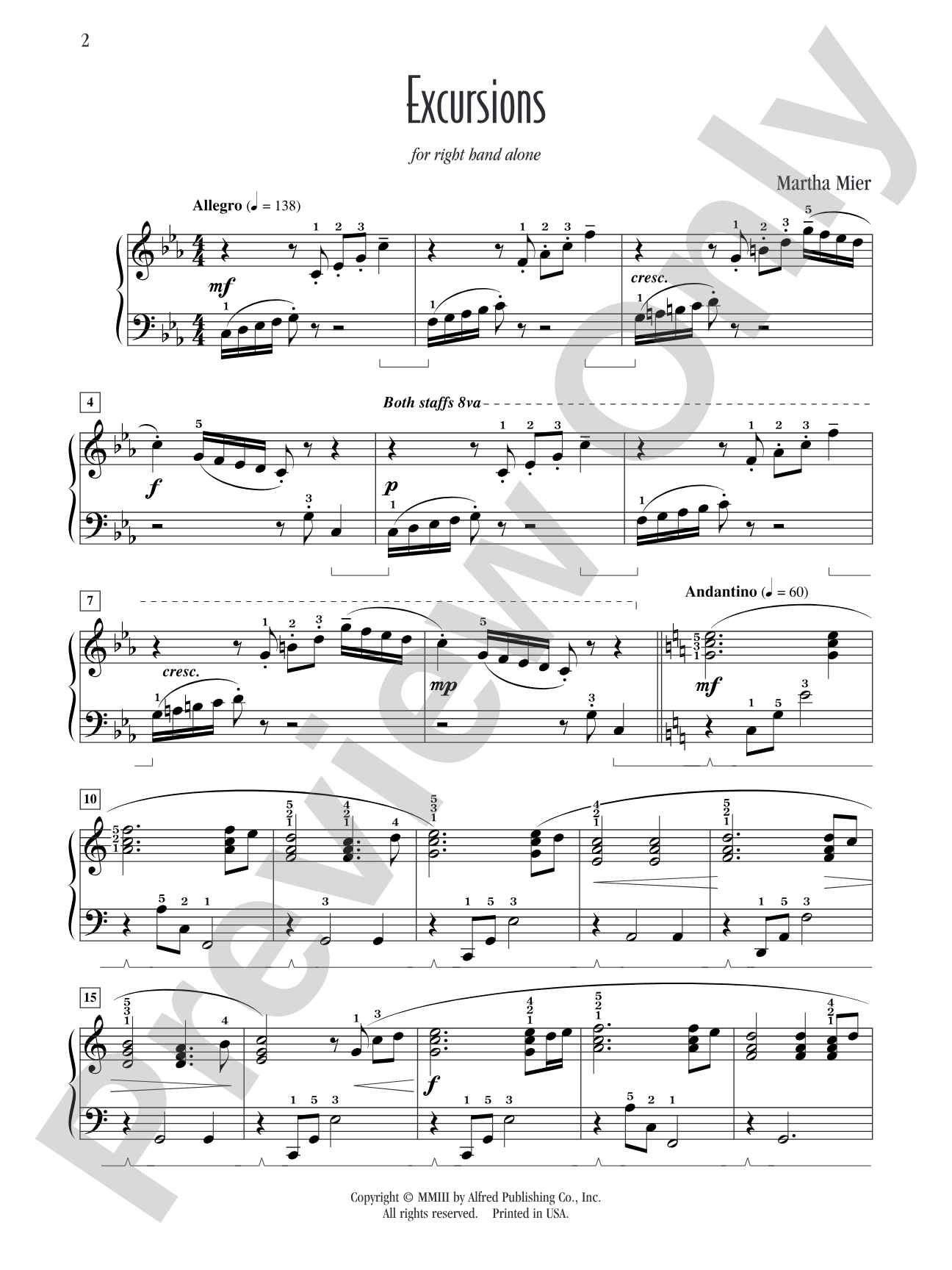
This solo, written in C minor, provides an excellent technical workout for the right hand. Sixteenth-note five-finger patterns and broken chords in the A section must be played cleanly and quickly. The B section is slower and more lyrical, requiring the voicing of the top melody note of the three-note chords. The return of the A section builds to an exciting finish. A Federation Festivals 2016-2020 selection. A Federation Festivals 2020-2024 selection.


Excursions (for right hand alone) - Piano Solo: Piano isn't in MakeMusic Cloud just yet...but it could be. Let us know you'd like to see it, and you'll help shape what comes next. In the meantime, start a free trial and dive into thousands of interactive titles your students can play along with today.
Request This Title
Tell us you want it.
Start Your Free Trial
Explore everything that's ready to play right now.
Sample Audio
No sample audio found.
Sample Video
No sample videos found.
Additional Details
Publisher:
Alfred Music
Page Count:
4
SKU:
00-PB-0000759
More about this title
About the Composer: Martha Mier

Martha Mier has shaped music education for generations through her prolific output of piano repertoire tailored to student development. Since joining Alfred Music Publishing in 1989, she has become known for writing music that engages students while building technique—from her Jazz, Rags & Blues series to the Romantic Impressions collection. Her work appears regularly on National Federation of Music Clubs festival lists, a testament to how well her writing balances accessibility with musical substance.
Mier's deep background in piano pedagogy informs every piece she writes. She maintained a private studio in Lake City, Florida, served as a church musician and accompanist, and has been active in MTNA, the Florida State Music Teachers Association, and the National Guild of Piano Teachers as both a member and certified teacher. Her work as a clinician and adjudicator has taken her across the United States and internationally to Australia and New Zealand. Mier is a coauthor of Alfred's Premier Piano Course and has published over 200 educational piano works.
Why we love this
Excursions gives late intermediate students exactly what they need at this level: a piece that demands real technical facility without straying into unnecessary complexity. The contrast between the energetic, fingerwork-intensive A section and the more song-like B section keeps the piece engaging for both player and listener, while the return to A with its building excitement reminds students that technique serves musicality, not the reverse. Festival judges and parents both recognize this kind of writing as serious preparation for advancing pianists.
What to expect
Excursions balances energetic, almost athletic passage work with moments of lyrical breathing room. The C minor tonality gives the piece a focused intensity, particularly in the driving A section, while the B section offers genuine musical respite before the exhilarating final push.
Who it's for
This solo suits pianists at the late intermediate level who are ready to tackle sustained technical passages and need a confidence-building piece for festivals or recitals. It works especially well for students who enjoy contemporary but tonal music and benefit from clear structural contrasts.
How to get the most out of it
- In the sixteenth-note passages of the A section, maintain a steady tempo even as you work for clarity; rushing these figures will bury the rhythmic intent that makes the passage sparkle.
- Shape the B section's three-note chords by bringing out the top melodic voice while letting the lower notes recede slightly in the mix, creating a natural singing quality.
- Build momentum toward the final return of A by gradually adding dynamic interest rather than simply playing louder; this gives the exciting finish real forward motion.
- Practice the five-finger patterns at a slow tempo first, focusing on even key release and consistent pressure rather than speed, then gradually increase tempo as accuracy becomes automatic.
How to use it
Program this as a solid mid-recital piece that showcases technical growth without demanding the interpretive maturity of a Romantic-era sonata movement. It pairs well alongside baroque inventions or contemporary simplified pieces, and its four-page length makes it ideal for festival competitions where time limits matter.
Skills your students will build
- Clean execution of rapid sixteenth-note five-finger patterns
- Breaking and voicing three-note chords to highlight melody
- Maintaining steady tempo through technical passages
- Building dynamic shape and momentum across structural sections
- Balancing technical precision with musical phrasing