
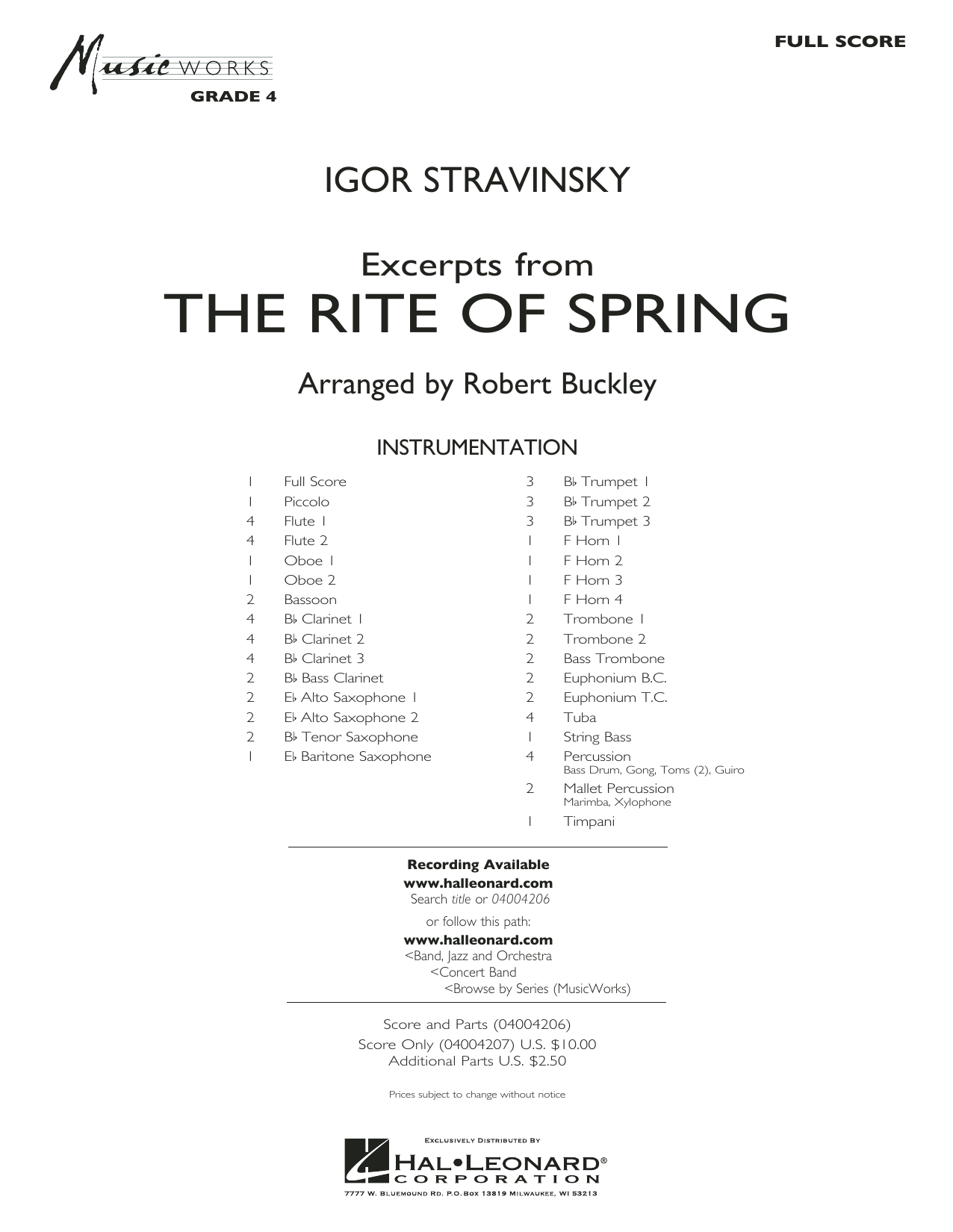

Excerpts from The Rite of Spring: Concert Band Conductor Score & Parts
As performed by Igor Stravinsky / Arranged by Robert Buckley
Grade: 4
Item: 35-PK00306612
$90.00
Pickup currently not available
Buy Extra Parts (Digital PDF Download)
Parts Added to Cart!
Description
The premier performance of "The Rite of Spring" in 1913 is the stuff of legend. There was disagreement among the people who attended as to whether it was the music or the choreography that caused the near-riot in the audience. Since then "The Rite" has been performed regularly and is considered to be one of the most influential works of the 20th century, laying the basis for modern jazz, film music and even heavy metal. It's all here: the driving rhythms, haunting Russian folk melodies, brilliant scoring, crunching harmonies and the epic drama! The intention with this arrangement for band was to stay as true as possible to the original and choose the sections that would work well in this context. Sure to become a valued and important addition to the wind band repertoire! Dur: 6:30


Excerpts from The Rite of Spring: Concert Band Conductor Score & Parts isn't in MakeMusic Cloud just yet...but it could be. Let us know you'd like to see it, and you'll help shape what comes next. In the meantime, start a free trial and dive into thousands of interactive titles your students can play along with today.
Request This Title
Tell us you want it.
Start Your Free Trial
Explore everything that's ready to play right now.
Sample Audio
No sample audio found.
Sample Video
No sample videos found.
Additional Details
Publisher:
Hal Leonard
SKU:
35-PK00306612
More about this title
About the Artist: Igor Stravinsky
Igor Stravinsky (1882–1971) fundamentally changed how composers approached rhythm, orchestration, and harmonic language. His three early ballets for Sergei Diaghilev's Ballets Russes pushed the boundaries of what concert music could express, and "The Rite of Spring" stands as the watershed moment in twentieth-century classical music. His willingness to break from Romantic convention inspired generations of composers across classical, jazz, and popular idioms.
In the classroom and rehearsal room, Stravinsky's work teaches students about rhythmic precision, tonal clarity, and the expressive power of dissonance. His scores demand focused listening and technical discipline while rewarding players with music that feels urgent and alive.
Why we love this
This arrangement distills one of music history's most revolutionary scores into a shape that works for student musicians without sacrificing what makes "The Rite" transformative. Robert Buckley has chosen sections that preserve the piece's driving energy and modernist bite while remaining playable for a Grade 4 ensemble. Your students will perform music that shaped everything from Gershwin to film scores to progressive rock.
What to expect
Raw, physical, ancient and futuristic at once. Russian folk melody collides with harmonies that shouldn't work but do; sparse textures suddenly explode into layered dissonance. The overall effect is propulsive and primal, somewhere between ritual and riot.
Who it's for
Any director wanting to introduce students to twentieth-century classical music through a work that actually changed music history. This excerpt arrangement suits Grade 4 bands with solid fundamentals in rhythm reading and ensemble balance but doesn't require virtuoso soloists.
How to get the most out of it
- Commit fully to the rhythmic intensity. These meters and syncopations feel awkward only if the ensemble is tentative; clarity and confidence turn the rhythmic challenges into forward momentum.
- Balance the folk melody sections with restraint. The Russian melodies are haunting precisely because they're not lush; let them breathe in a relatively bare harmonic context.
- Use dynamics as a structural tool rather than expressive color. The leap from quiet to crushing dissonance defines the drama here, so mark dynamic changes crisply in all parts.
- Address intonation in the crunching harmonies with particular care. When voices move in unconventional directions, small tuning problems become obvious. Isolate these passages by section.
How to use it
Place this as a concert anchor that anchors a thematic program about twentieth-century innovation or non-Western music influences. It also serves as a bridge piece: pair it with Copland or early Duke Ellington on the same concert to show students how Stravinsky's innovations rippled outward.
Skills your students will build
- Reading complex and changing meters with confidence
- Playing dissonant harmonic language with accurate intonation
- Balancing rhythmic layers within an ensemble texture
- Interpreting dynamic contrasts as structural markers
- Sustaining focus during rhythmically challenging passages