
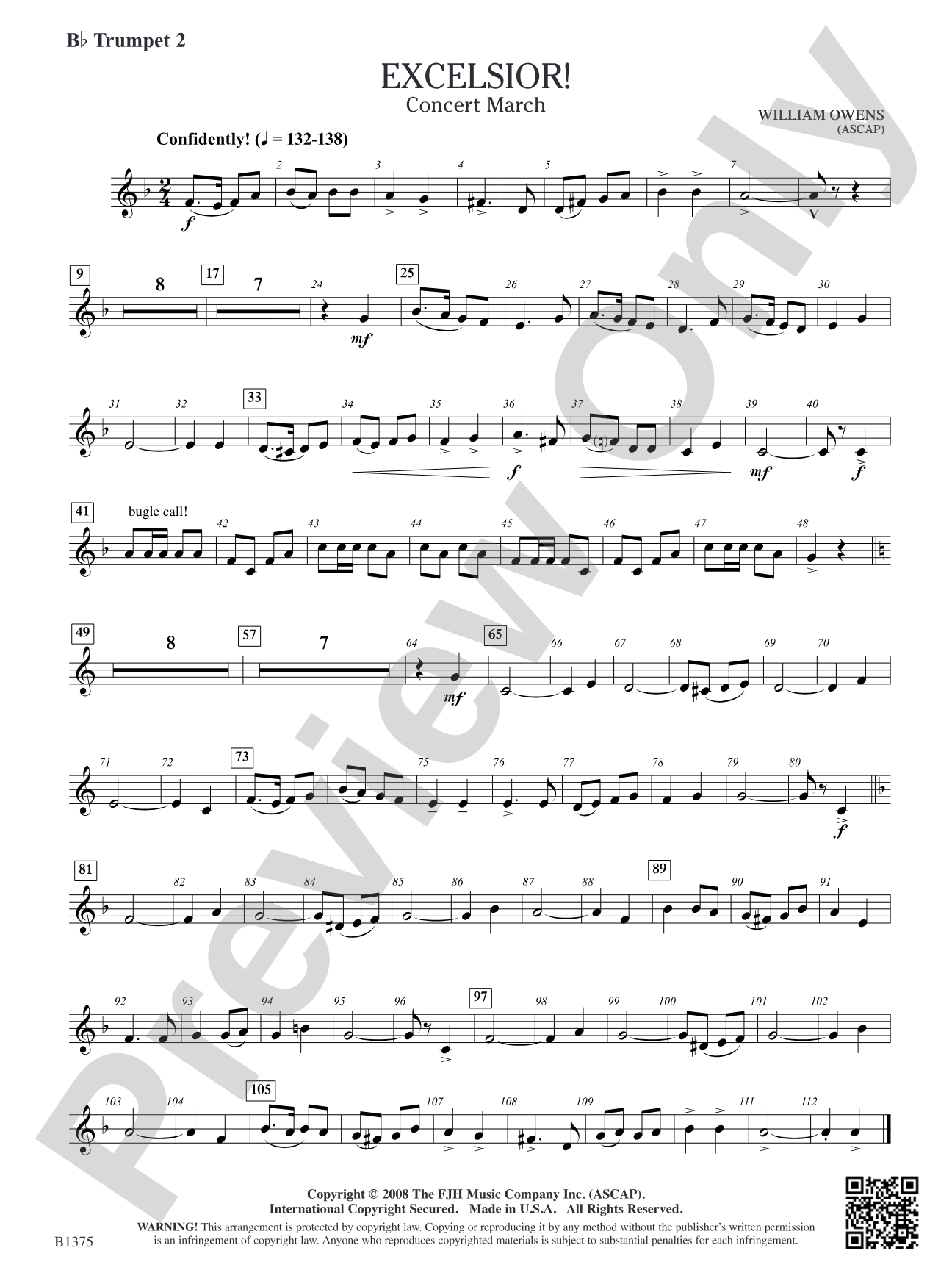

Excelsior! (Concert March): B-flat Trumpet 2
Concert March
By William Owens
Grade: 2
Item: 98-PC-DB1375_T2
$7.00
Pickup currently not available
Description
This lively march is a muscial blast of energy from beginning to end! After a full statement of the theme, a military style drum and bugle call introduces a new melody presented by woodwinds with countermelodies in the euphonium. The full band joins in as the piece comes to a rousing and exciting conclusion. An excellent original march for young bands!


Excelsior! (Concert March): B-flat Trumpet 2 isn't in MakeMusic Cloud just yet...but it could be. Let us know you'd like to see it, and you'll help shape what comes next. In the meantime, start a free trial and dive into thousands of interactive titles your students can play along with today.
Request This Title
Tell us you want it.
Start Your Free Trial
Explore everything that's ready to play right now.
Sample Audio
1
Audio File
--:--
0:00
0:00
Sample Video
No sample videos found.
Additional Details
Series:
FJH Young Band
Publisher:
The FJH Music Company, Inc.
SKU:
98-PC-DB1375_T2
More about this title
About the Composer: William Owens
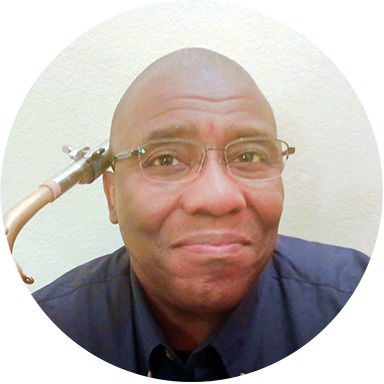
William Owens was born in Gary, Indiana, and has spent his career establishing himself as a prolific composer for young ensembles. A 1985 graduate of VanderCook College of Music, he combines his background as a music educator and clinician with compositional work that balances accessibility and musical substance. Since 1993, he has created over 300 compositions across concert band, string orchestra, and small ensemble settings, many of which have become standard repertoire in school music programs nationwide.
Owens's approach to composition reflects three decades of band directing experience in Texas and his involvement with major music organizations including ASCAP, TMEA, and Phi Beta Mu International. His work has been recognized through commissions from South Plains College, the American Bandmasters Association, and numerous state and regional honors. He retired from full-time teaching in 2014 and continues to compose and clinician throughout North America.
Why we love this
Owens writes marches that actually sound like marches: they move forward with purpose and personality without relying on exhausted clichés. The drum and bugle call is a smart structural moment that gives your rhythm section and percussion something distinctive to anchor, and the shift to woodwind-led melody with euphonium countermelody creates a real textural conversation rather than simple unison doubling. For a Grade 2 piece, this has the kind of compositional clarity that keeps rehearsals focused and performances confident.
What to expect
From the first measure, Excelsior! radiates optimism and straightforward purpose. The full-band opening statement feels ceremonial and grounded, then the drum and bugle call injects a moment of playful military character before the piece turns toward the warmth of woodwind melody. By the final pages, the full ensemble is marching together with unmistakable conviction and joy.
Who it's for
This march is ideal for Grade 2 concert bands looking for a piece with genuine orchestration and forward momentum. It works equally well for young ensembles preparing for contests and festivals or for programs seeking strong concert-opener material that builds confidence without overwhelming instrumentation or technical demands.
How to get the most out of it
- Shape the opening theme statement with a gentle forward motion in the tempo; resist the urge to rush the march rhythm, which will help the subsequent drum and bugle call land with sharper impact.
- Balance the woodwind melody against the euphonium countermelody by having your euphonium player (or small section) match the woodwind dynamic and phrasing rather than doubling underneath; this keeps both lines audible.
- Tighten the transition into the full band conclusion with a clear conductor preparation; the energy shift from the sectional writing to tutti voicing needs intentional ensemble unity to land with the "rousing" character the piece asks for.
How to use it
Open a concert with this to establish energy and set an upbeat tone without requiring technical difficulty from your ensemble. It pairs well with slower works or more contemporary pieces later in the program, and it is equally effective as a festival selection where judges appreciate solid fundamentals and clear musical structure in young band writing.
Skills your students will build
- Executing march rhythm with articulation clarity and consistent ensemble pulse
- Balancing sectional countermelodies and avoiding unintentional doublings
- Responding to structural transitions and dynamic shifts across the full ensemble
- Sustaining forward momentum through repeated phrases and sectional variations