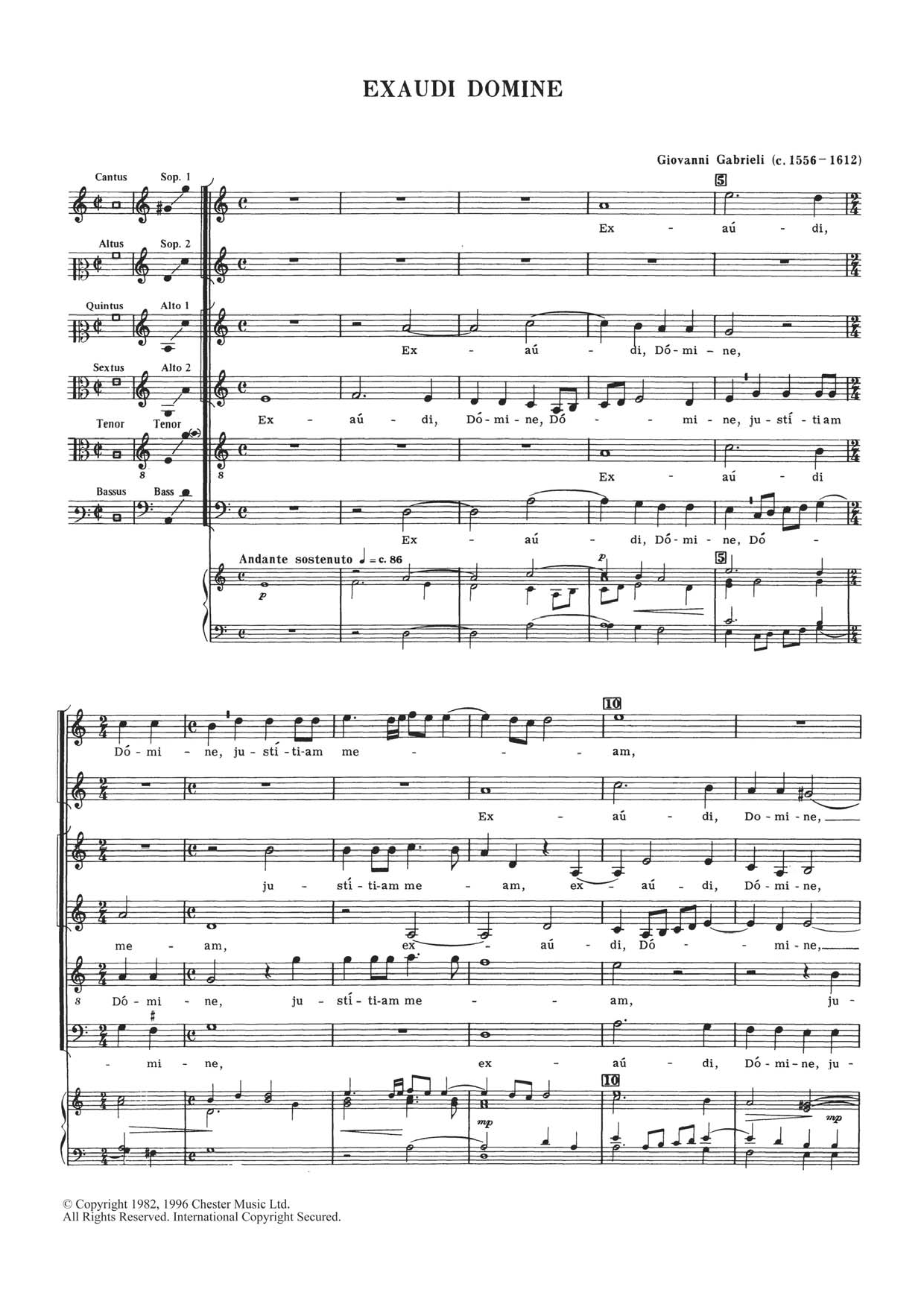
Exaudi Domine Sheet Music Preview

Exaudi Domine: SATB Choral Octavo

As performed by Giovanni Gabrieli

Item: 35-DS00366718

Digital Download
$2.99
Description

Exaudi Domine: SATB Choral Octavo isn't in MakeMusic Cloud just yet...but it could be. Let us know you'd like to see it, and you'll help shape what comes next. In the meantime, start a free trial and dive into thousands of interactive titles your students can play along with today.

Sample Audio
No sample audio found.
Sample Video
Additional Details
Publisher: Hal Leonard
Page Count: 7
SKU: 35-DS00366718

More about this title

About the Artist: Giovanni Gabrieli

Giovanni Gabrieli (c. 1557–1612) was Venice's most influential composer and the undisputed master of the polychoral tradition. His decades as maestro di cappella at St. Mark's Basilica gave him access to the building's multiple organ lofts and spatial acoustics, which shaped his compositional approach in revolutionary ways. His sacred works blend Renaissance counterpoint with bold harmonic language and spatial sound effects that still astonish performers today.

Gabrieli's legacy rests on his ability to write music that is both intellectually rigorous and immediately moving. He published two major collections of sacred works that became models for composers across Europe, and his influence on the Baroque generation cannot be overstated. For choral directors, his music offers a gateway to understanding how spatial arrangement, dynamic control, and timbral balance function as compositional tools.

Why we love this

Exaudi Domine sits in that sweet spot where Renaissance polyphonic craftsmanship meets the dramatic possibilities that Gabrieli championed. The text setting is direct and expressive without sacrificing musical sophistication, and the harmonic language gives singers real color to explore. A piece this historically significant deserves a place in your season because it teaches your ensemble something they can't learn from later Baroque works.

What to expect

The music breathes with quiet reverence, then opens into moments of unexpected harmonic depth. Gabrieli's gift for writing memorable melodic gestures means that even the inner voices feel purposeful and singable, creating a sense that every voice belongs to the whole rather than serving it.

Who it's for

Strong SATB ensembles comfortable with Renaissance polyphony and who want to expand into early Baroque sacred repertoire. This works equally well for concert choirs seeking substantial choral octavos and for church musicians serving liturgical contexts where Gabrieli's work is historically at home.

How to get the most out of it

  • Shape the melodic lines as continuous arcs rather than phrase-by-phrase units; Gabrieli's text declamation rewards singers who think across longer spans and resist breaking the musical thought.
  • Attend closely to the harmonic rhythm and vertical sonorities. Where chords shift, those moments often carry the text's emotional weight, so make them heard with slight broadening and clarity.
  • Let the text guide your vowel colors and vowel modifications. Sacred Latin paired with Gabrieli's harmonic language asks for warmth and focus without forcing or artificial brightening.
  • Balance the inner voices with intention. This isn't about burying altos and tenors; their counterlines often carry crucial harmonic information that prevents the piece from sounding chordal.

How to use it

Consider pairing this with other Renaissance and early Baroque sacred music to frame a thematic concert on the evolution of polyphonic writing. It also serves as a substantial concert closer that doesn't demand flashy vocal showmanship, allowing your ensemble to shine through musical substance alone.

Skills your students will build

  • Balancing independent melodic lines within a four-part texture
  • Interpreting Renaissance text underlay and syllable placement
  • Navigating harmonic language that shifts between diatonic and chromatic voice leading
  • Developing sustained tone production across longer phrase arcs
  • Shaping polyphonic phrases without losing sense of the overall harmonic progression

You May Also Like