
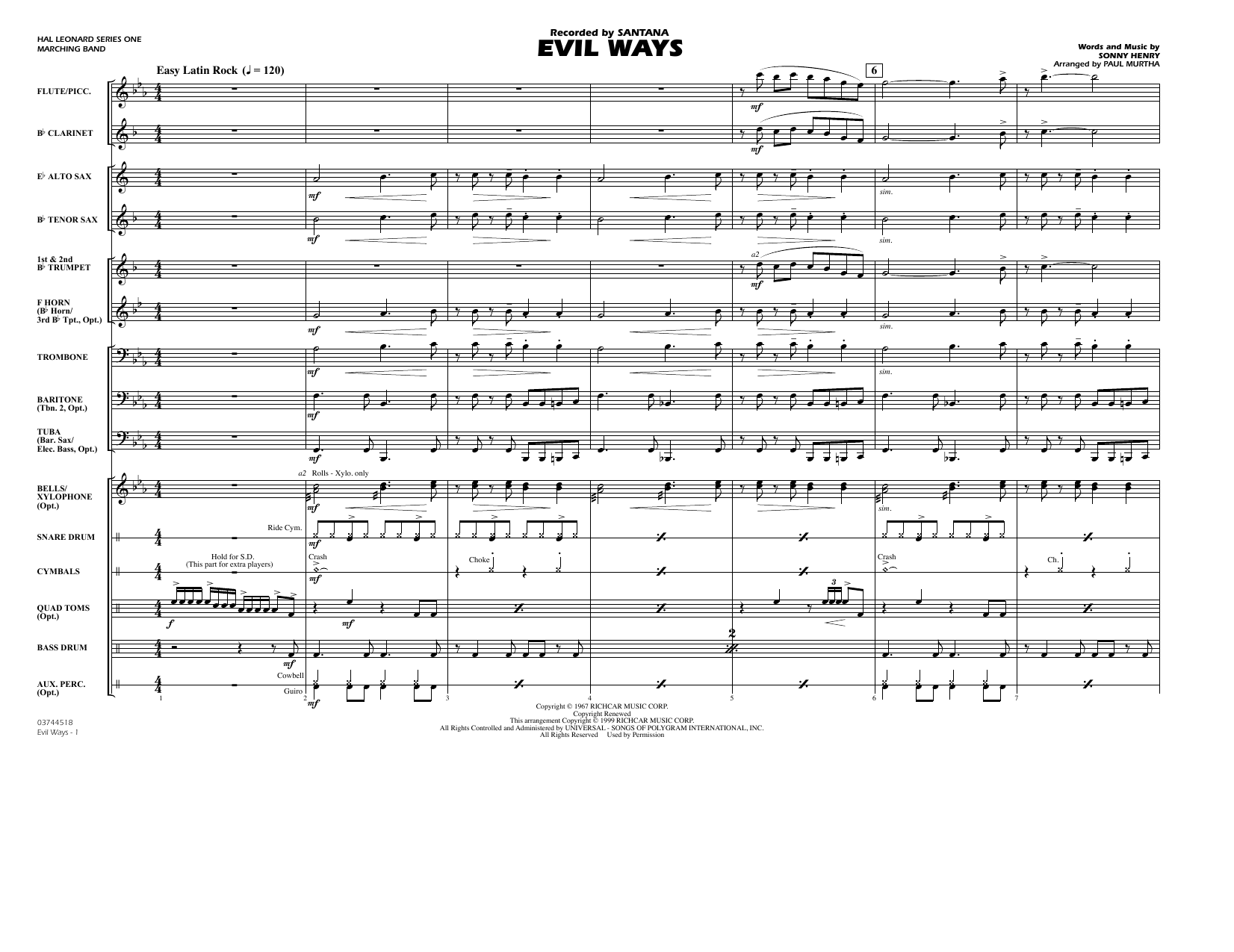

Evil Ways (arr. Paul Murtha): Marching Band Conductor Score & Parts
As performed by Santana / Arranged by Paul Murtha
Grade: 2
Item: 35-PK00690526
$55.00
Pickup currently not available
Buy Extra Parts (Digital PDF Download)
Parts Added to Cart!
Description
Here's a great chart for younger bands of this classic tune by the group Santana. This is an excellent Latin change-of-pace production number, and it features the driving double time feel at the end.


Evil Ways (arr. Paul Murtha): Marching Band Conductor Score & Parts isn't in MakeMusic Cloud just yet...but it could be. Let us know you'd like to see it, and you'll help shape what comes next. In the meantime, start a free trial and dive into thousands of interactive titles your students can play along with today.
Request This Title
Tell us you want it.
Start Your Free Trial
Explore everything that's ready to play right now.
Sample Audio
No sample audio found.
Sample Video
No sample videos found.
Additional Details
Publisher:
Hal Leonard
SKU:
35-PK00690526
More about this title
About the Artist: Santana
Santana emerged from San Francisco's Latin rock scene in the late 1960s, blending Latin percussion grooves with blues-based guitar and psychedelic rock sensibilities. The band's self-titled 1969 debut and follow-up albums established them as innovative forces who proved that Latin rhythms and rock instrumentation were natural partners, influencing generations of musicians across genres.
Why we love this
Paul Murtha's arrangement distills "Evil Ways" into something a Grade 2 band can execute without sacrificing the funk and swagger of the original. The Latin groove anchors the piece while the double time section at the end gives your section leaders something exciting to lock into, and the chart naturally builds energy that audiences feel immediately.
What to expect
Hypnotic and propulsive. The opening establishes a rolling Latin groove that feels both relaxed and intensely focused, then builds into a double time push that makes both players and listeners sit up. There's a swagger here that keeps young musicians engaged because they're playing something that sounds genuinely cool.
Who it's for
Grade 2 bands ready to move beyond standard march repertoire without getting lost in complexity. This chart works well for groups with developing Latin percussion experience and students who respond to music with contemporary energy and groove.
How to get the most out of it
- Lock the percussion section into a steady clave or montuno pattern early in rehearsals; the entire ensemble's pocket depends on the low brass and battery moving as one unit.
- Emphasize the space between notes rather than rushing. Latin grooves live in their breath and rebound, not in pushing the tempo forward.
- Bring out the transition to double time as a genuine gear shift. Rehearse the tempo change separately until the band can execute it cleanly without losing the groove.
How to use it
Use this as a change-of-pace opener on a spring concert, pairing it with contrasting material like a traditional march or a ballad to show your band's range. It's also ideal for pep band performances and outdoor events where the driving rhythm cuts through ambient noise and gets crowds moving.
Skills your students will build
- Maintaining pocket rhythm in Latin grooves
- Executing clean tempo changes without losing ensemble cohesion
- Balancing rhythmic precision with musical relaxation (not rushing)
- Reading percussion parts with multiple independent lines
- Responding to dynamic control in an up-tempo rock context