
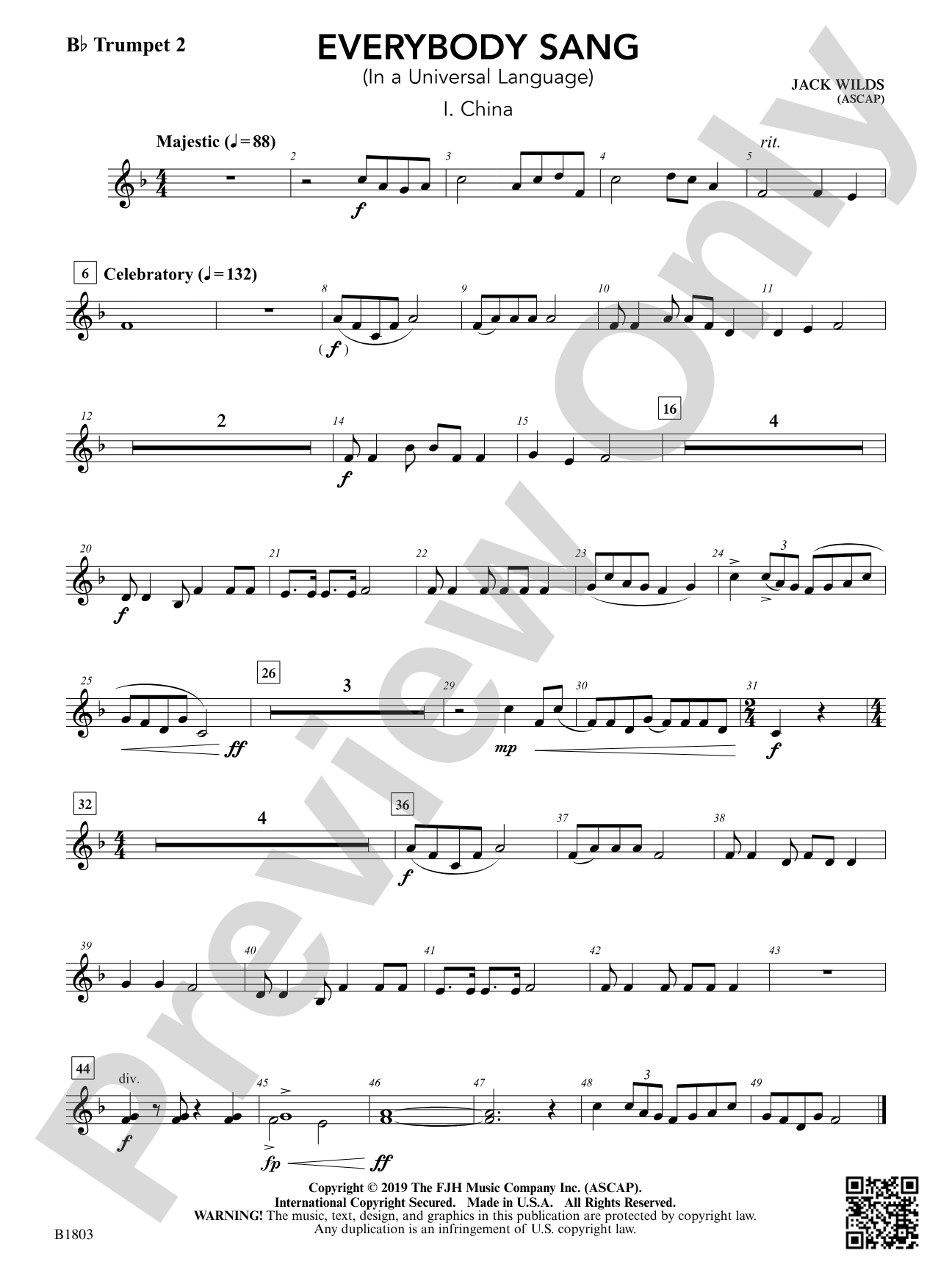

Everybody Sang (In a Universal Language): B-flat Trumpet 2
In a Universal Language
By Jack Wilds
Grade: 3
Item: 98-PC-DB1803_T2
$7.00
Pickup currently not available
Description
Written to celebrate the universal tradition of folksong, this multi-movement suite is based on songs from China, Mexico, and Bulgaria. The piece runs the emotional gamut with nostalgic harmonies, beginning with the invigorating first movement and serene second movement. The final movement invokes a dramatic fanfare and irresistible rhythmic drive, bringing the entire piece to a powerful conclusion.


Discover MakeMusic Cloud: thousands of interactive titles your students can play along with today.
Sample Audio
1
Audio File
--:--
0:00
0:00
Sample Video
No sample videos found.
Additional Details
Series:
FJH Concert Band
Publisher:
The FJH Music Company, Inc.
SKU:
98-PC-DB1803_T2
More about this title
About the Composer: Jack Wilds

Jack Wilds composes for performers across the entire age spectrum, from young children through professional ensembles. His works have been championed by groups ranging from youth choirs to the New York Philharmonic, and his compositions draw from visual art, literature, philosophy, and musical tradition to create pieces that honor where musicians are while pushing them toward genuine artistic expression.
A former public school band director, Wilds has published over 40 works for developing musicians in wind and choral settings. His compositions appear regularly on festival required repertoire lists worldwide and have been performed at the Midwest Clinic and major educator conferences. He teaches composition, theory, ear training, and music technology at Texas State University and serves as Co-Director of Music at First Presbyterian Church in San Marcos, where he has worked for 13 years. His chamber works have been performed by ensembles including the Attacca Quartet, members of the Atlanta Symphony, and the University of Texas New Music Ensemble.
Why we love this
This suite respects the intelligence of Grade 3 musicians while offering genuine artistic depth. Wilds draws from three distinct folksong traditions (Chinese, Mexican, and Bulgarian) without reducing them to surface-level borrowing; each movement builds character and emotional weight that your students will feel performing and audiences will hear clearly. The arc from invigoration through serenity to dramatic triumph gives your band a satisfying narrative arc, and the rhythmic drive of the finale makes this a piece that stays with people after the concert ends.
What to expect
The piece unfolds like a carefully curated museum exhibition: the first movement welcomes you with energy and forward motion, the second invites quiet reflection and harmonic richness, and the third builds toward a climactic fanfare that feels earned rather than imposed. The folksong roots give everything a sense of cultural weight and human connection, even as the harmonization and orchestration feel decidedly modern.
Who it's for
Concert bands at the Grade 3 level looking for repertoire that takes global musical traditions seriously. This suite works well for bands wanting to program something contemporary and substantive without programming complexity, and for directors seeking a multi-movement work that tells a story from beginning to end.
How to get the most out of it
- Let the folksong melodies breathe in the second movement; resist the temptation to push the tempo. The serenity Wilds creates depends on ensemble restraint and lyrical phrasing across the sections carrying the primary material.
- The first movement's invigorating character comes from rhythmic precision more than volume. Focus rehearsal time on locked ensemble rhythm before worrying about dynamic range.
- Shape the final movement's fanfare with clarity of articulation rather than sheer force. The dramatic effect depends on crisp attacks and controlled releases that let the rhythmic drive propel the ending naturally.
- Use the conductor score to track the relationships between movements; understanding how Wilds weaves these global traditions into a coherent whole will help you communicate intent to your musicians during rehearsal.
How to use it
Program this as the centerpiece of a concert exploring global musical traditions, or open a program with the first movement's energy before moving into lighter fare. The three-movement design also makes it effective as a mid-concert building block, where the contrast of moods holds audience attention across an entire concert arc.
Skills your students will build
- Sustaining lyrical phrasing through harmonic changes
- Balancing independent section melodies against ensemble texture
- Executing rhythmic precision that drives forward momentum
- Responding to conductor interpretation across contrasting tempos and character changes
- Understanding folksong melody as a foundation for contemporary arranging