
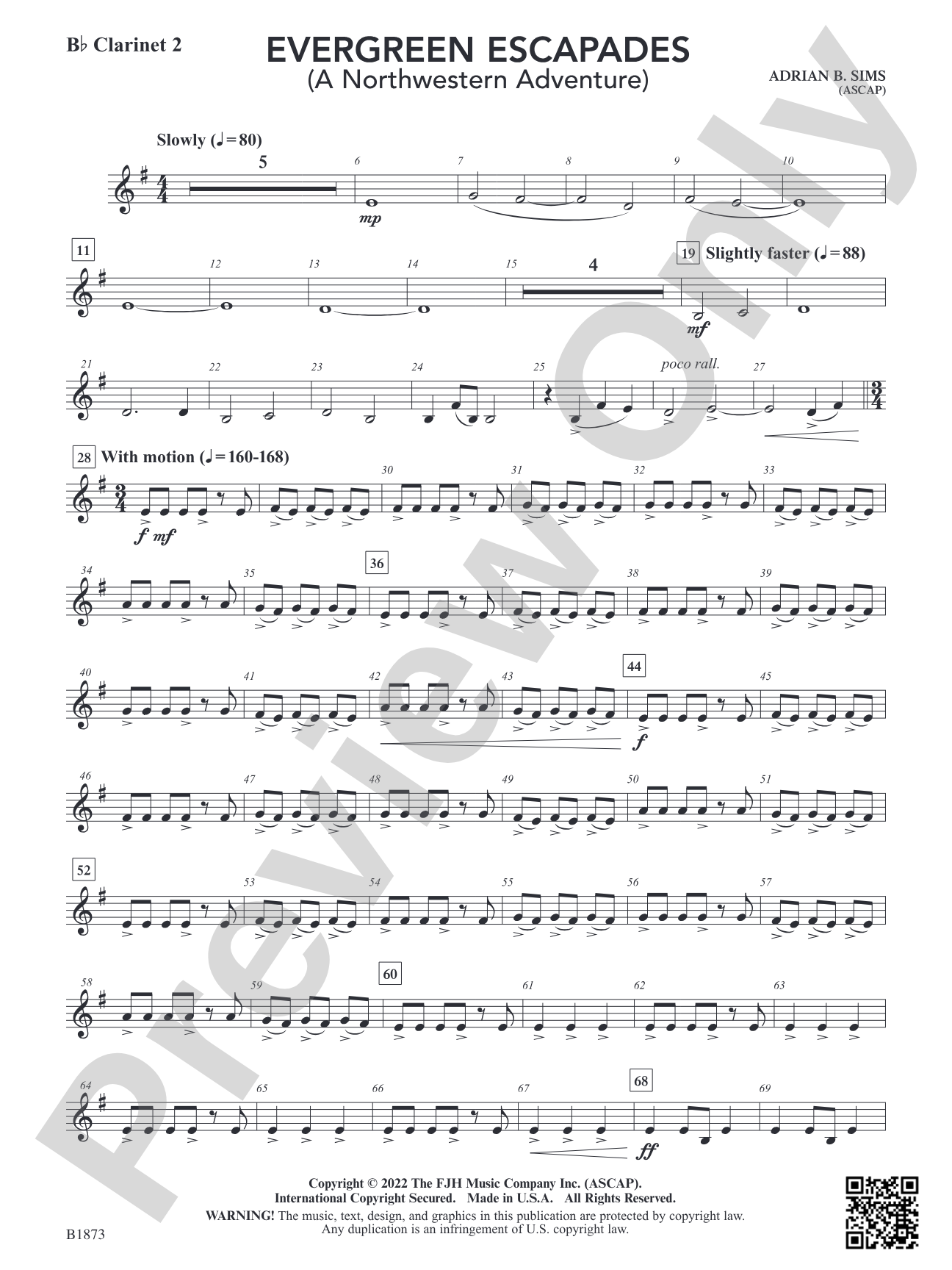

Evergreen Escapades: B-flat Clarinet 2
By Adrian B. Sims
Grade: 2.5
Item: 98-PC-DB1873_C2
$7.00
Pickup currently not available
Description
Explore the terrain and weather conditions of the Pacific Northwest, beginning with a cold, fog-covered morning, concealing the beauty of the surrounding landscapes. As the sun continues to rise, the fog fades and a gloomy rainstorm takes its place while we traverse through the evergreens. As the music persists onwards, rays of sunshine break through the clouds and bring about a warm, joyous afternoon filled with light, breathtaking mountain views, and the scent of pine needles.


Don't just read it, hear it, play along with it, and watch your students grow with it. In MakeMusic Cloud, Evergreen Escapades: B-flat Clarinet 2 comes alive with professional accompaniment, adjustable tempo, and built-in practice tools that turn solo practice into real progress.
Open in the Player
Jump straight in and assign it today.
Start Your Free Trial
Open this title and explore the full library in minutes.
Sample Audio
1
Audio File
--:--
0:00
0:00
Sample Video
Additional Details
Series:
FJH Young Band
Publisher:
The FJH Music Company, Inc.
SKU:
98-PC-DB1873_C2
More about this title
About the Composer: Adrian B. Sims

Adrian B. Sims was born in Seattle in 2000 and has emerged as a composer, conductor, educator, and trombonist with significant recognition in young composer circles. His work has been programmed at The Midwest Band and Orchestra Clinic, earned selection on the Bandworld Top 100 List, and won honors in multiple competitions including the Maryland Music Educators Association Young Composers Project and the Make Music Young Composers Contest. He has conducted his own compositions in performances across Maryland schools.
As a performer, Sims has worked extensively across pit orchestras, symphony orchestras, jazz ensembles, and concert bands. His trombonist credentials include multiple selections to the Maryland All-State Band and collaborative performances with the Baltimore Symphony Orchestra. He is pursuing a dual degree in Music Education and Composition at The University of Maryland, where he studies composition with Dr. Robert Gibson and has been mentored by acclaimed composer Brian Balmages.
Why we love this
Sims captures a complete narrative arc within a Grade 2.5 framework, moving from atmospheric fog through stormy intensity and into triumphant clarity without losing musical coherence or overcomplicating the parts. The piece balances accessibility with genuine compositional craft, giving young musicians real storytelling to convey rather than simple exercises. This is the kind of programming choice that reminds students why they joined band in the first place.
What to expect
The piece unfolds like a Pacific Northwest morning breaking into afternoon light. Early passages are muted and introspective, shrouded in fog and mystery; the middle section churns with moisture and movement as rain sweeps through the landscape; the finale opens into warmth and clarity, with dancing light filtering through dense evergreen canopies. Throughout, the music feels rooted in place and season.
Who it's for
Grade 2.5 concert bands seeking a programmatic piece with genuine musical substance and clear narrative arc. This works well for directors who want their students to experience sophisticated compositional thinking while remaining within confident technical reach.
How to get the most out of it
- Shape the opening fog section with careful dynamic control and sustained tones; resist the urge to rush through the quieter material, as the stillness creates the emotional foundation for what follows.
- Treat the rainstorm transition as a rhythmic event that builds momentum; lock the ensemble around the percussion foundation to establish the driving energy without losing precision.
- Balance the final section's brightness with tonal quality; major key and full sonority can overwhelm a young band, so encourage players to maintain support and focus rather than simply playing louder.
How to use it
Program this as an opening piece for a concert celebrating regional composers or environmental themes, or place it early in a concert to establish atmosphere and draw the audience into a themed program. Its Grade 2.5 rating makes it accessible for a first-half slot while the sophisticated narrative justifies programming it alongside stronger Grade 3 works that share similar musical or conceptual goals.
Skills your students will build
- Sustaining long tones with dynamic control and ensemble blend
- Executing smooth transitions between contrasting sections and key areas
- Responding to programmatic cues and shaping musical character to reflect narrative intent
- Balancing rhythmic precision in driven sections with lyrical phrasing in sustained passages