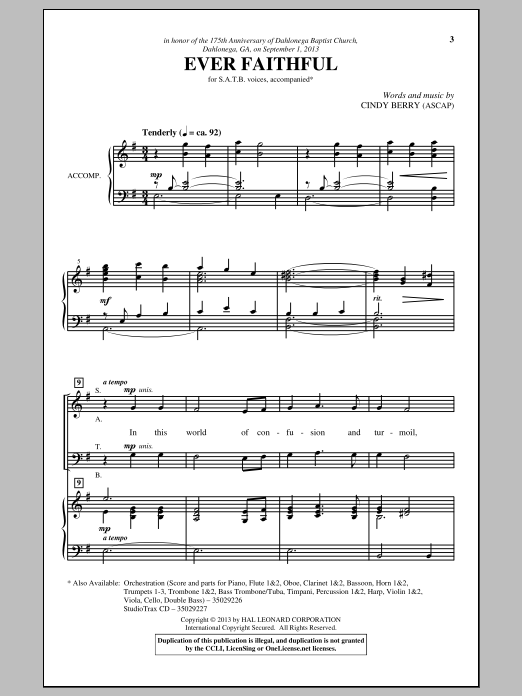
Cindy Berry brings decades of experience as both a composer and arranger of sacred choral music, children's musicals, and keyboard works. Based in Texas, she studied at Houston Baptist University and has built a reputation for crafting worship-centered music that serves church musicians and choral programs across the country. Her work has earned repeated recognition through ASCAP Special Awards, reflecting her consistent contributions to sacred music.
Berry's approach to composition is rooted in her faith and her practical knowledge of what works in the church and school settings. Alongside her husband Bruce, a Minister of Music, she directs children's choir and serves as a church pianist, giving her firsthand insight into the needs of volunteer and developing singers. Through composer weekends and clinician workshops, she mentors other musicians and continues to shape sacred choral literature for ensembles at all levels.
Why we love this
Berry's writing for SATB is refreshingly singable without sacrificing musical depth. The piece respects the realities of church and school choirs, where singers span a wide range of experience, yet it sounds genuinely accomplished when performed well.
What to expect
The music embodies a quiet devotion, with harmony that feels both accessible and genuinely moving. There is sincerity here, the kind that connects with singers and listeners without requiring virtuosity or dramatic excess.
Who it's for
This octavo serves church choirs, school select ensembles, and community choruses looking for repertoire that respects limited rehearsal time while delivering a polished sound. Soloists and small chamber choirs can also perform it with strong results.
How to get the most out of it
Balance the ensemble in full four-part sections by listening carefully to whether any voice part is overshadowing the others; church acoustics often flatter sopranos, so pay particular attention to the inner voices.
Work the text independently of the melody first, ensuring diction clarity across all voice parts before integrating it with the musical line.
Shape the piece around the harmonic movements rather than beat-by-beat dynamics; this reveals the underlying structure and makes phrasing feel inevitable rather than imposed.
How to use it
Position this as an anthem for a Sunday service or as part of a sacred concert program where you want something that builds goodwill and lets your singers shine without exhausting them. It pairs well alongside longer or more complex pieces in a mixed choral program.
Skills your students will build
Ensemble balance and blend in four-part voicing
Sustained legit singing over longer phrases
Text clarity and articulation across multiple vocal lines
Harmonic hearing and listening for inner voice movement
You May Also Like
Scan to Complete Your Purchase
Use your phone's camera to scan the code below
You'll log in on your phone and the order will be added to your account