
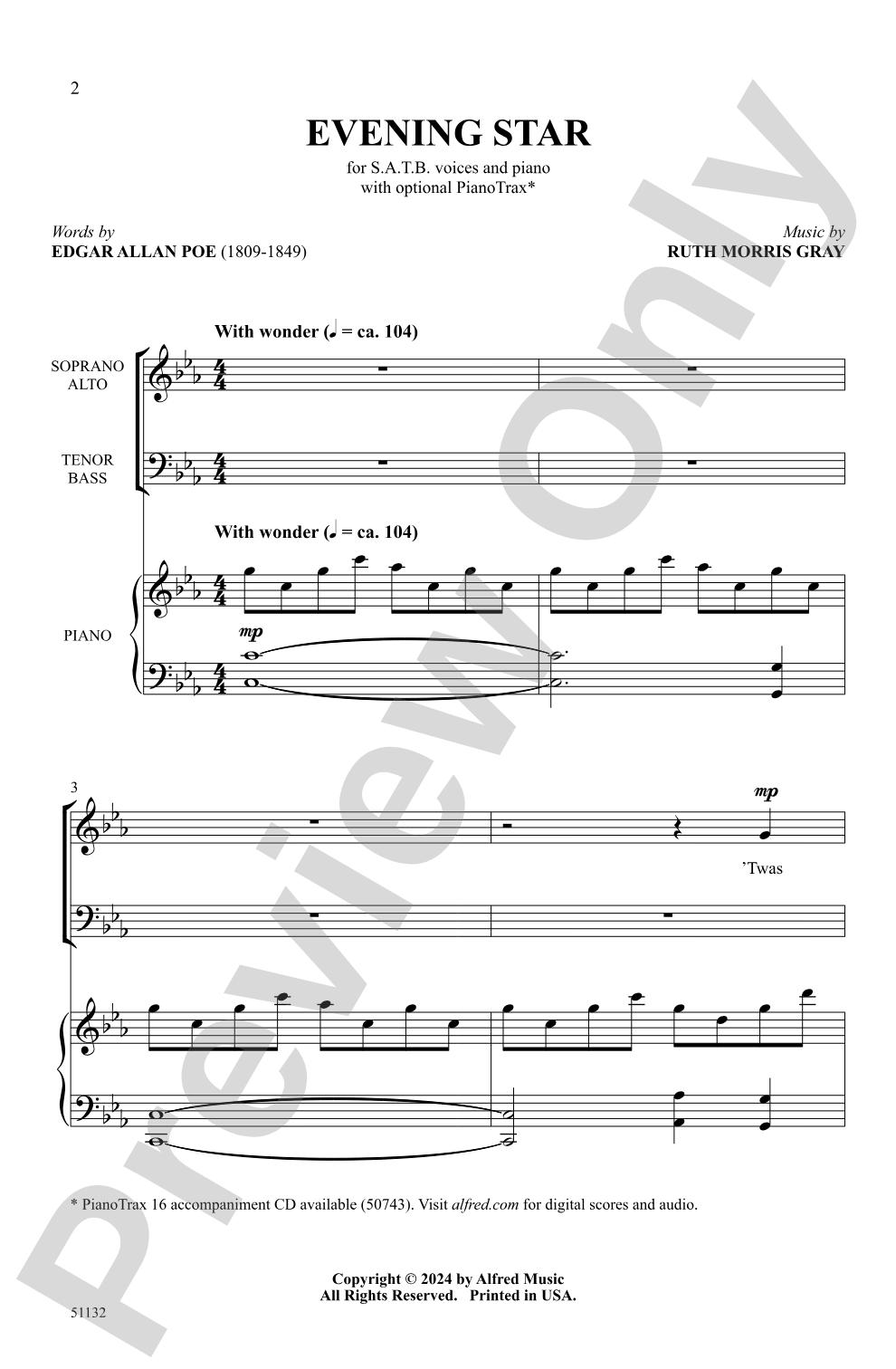

Evening Star: SATB Choral Octavo
Words by Edgar Allan Poe, music by Ruth Morris Gray
Item: 00-PO-0007230
$2.30
Minimum order quantity: 20 copies
Pickup currently not available
Description
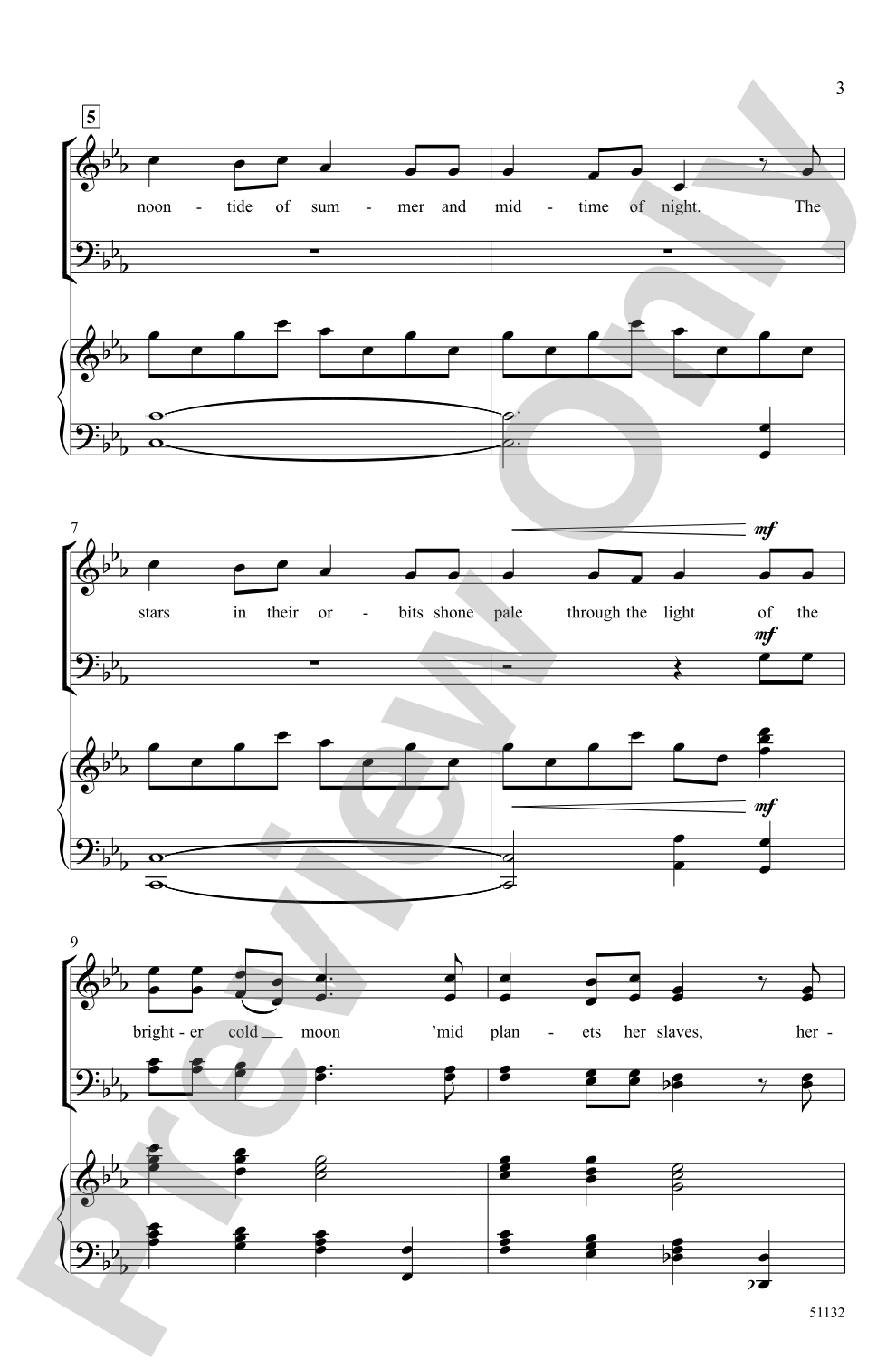
A meditation on the restorative power of nature, this Edgar Allan Poe poem compares a proud star with the cold moon. Colorful homophonic harmonies and a brief canon beam with wonder in this dramatic mixed voice feature. Excellent for exploring legato singing, choral intonation, musical expression, and text interpretation.


Evening Star: SATB Choral Octavo isn't in MakeMusic Cloud just yet...but it could be. Let us know you'd like to see it, and you'll help shape what comes next. In the meantime, start a free trial and dive into thousands of interactive titles your students can play along with today.
Request This Title
Tell us you want it.
Start Your Free Trial
Explore everything that's ready to play right now.
Sample Audio
1
Audio File
--:--
0:00
0:00
Sample Video
Additional Details
Series:
Alfred Choral Designs
Publisher:
Alfred Music
Page Count:
12
SKU:
00-PO-0007230
More about this title
About the Composer: Ruth Morris Gray

Ruth Morris Gray has directed choirs at Rosemead High School in California since 2004, where she also teaches piano. She holds a Bachelor of Music in Piano Performance and Composition from Biola University and earned her Master of Arts in Music Composition from UC Santa Barbara. Her California Single Subject Music Credential comes from Cal State Northridge.
With over 100 published choral works to her name, Gray has established herself as a prolific voice in contemporary choral literature. Beyond the classroom and rehearsal hall, she performs and composes actively, and balances her musical life with travel, reading, swimming, and cycling.
Why we love this
Gray's setting captures the architectural beauty of Poe's poem while remaining vocally accessible. The homophonic textures and brief canon create immediate impact without technical overreach, making this a smart choice for choirs building confidence in legato singing and intonation work. The dramatic arc and literary substance mean singers engage both musically and intellectually.
What to expect
Contemplative and luminous, with moments of wonder and dramatic depth. The piece unfolds like gazing upward at night, finding both solace and longing in the stars. Poe's imagery transforms into sound through rich, shifting harmonies that reward attentive listening.
Who it's for
Mixed choirs at the high school or early college level seeking repertoire that develops core vocal skills without sacrificing musical substance. Directors working with singers who respond well to literary texts and appreciate settings that illuminate poetic meaning through harmonic language.
How to get the most out of it
- Shape each phrase around the breath marks carefully; the meditative character depends on unhurried phrasing that lets the harmonic colors land.
- Attend to the canon section as a moment of textural contrast. Balance the independent lines so the overlapping voices remain clear rather than muddy.
- Ground the dynamic journey in the text. Poe's comparison of star and moon invites singers to differentiate brightness (the star) from coldness (the moon) through tone color and intensity.
- Use the recorded accompaniment to lock intonation on the colorful harmonic progressions, then gradually phase it out in rehearsal to build choral independence.
How to use it
Program this as a thoughtful centerpiece in a concert exploring nature, reflection, or evening themes. It sits well alongside both contemporary and classical repertoire and works equally effectively in festival or contest settings. The literary weight makes it strong material for programs that pair music with spoken word or visual art.
Skills your students will build
- Legato vocal line shaping and phrase breathing
- Intonation tuning within colorful harmonic progressions
- Text interpretation and expressive singing
- Independent voice part singing (canon section)
- Listening and balance in homophonic four-part textures