Euge Caeli Sheet Music Preview

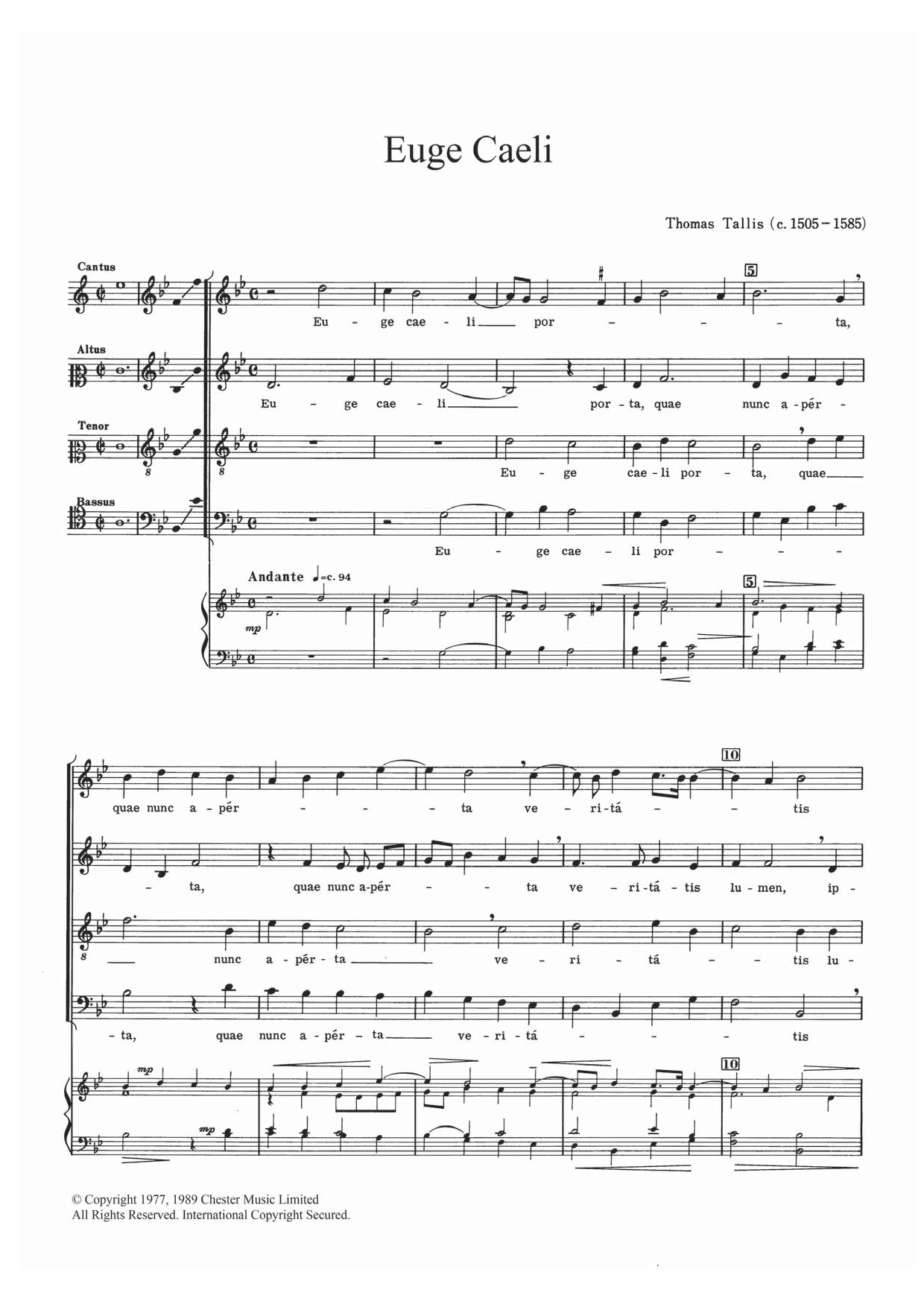
Euge Caeli: SATB Choral Octavo

As performed by Thomas Tallis

Item: 35-DS00366854

Digital Download
$2.99
Description

Euge Caeli: SATB Choral Octavo isn't in MakeMusic Cloud just yet...but it could be. Let us know you'd like to see it, and you'll help shape what comes next. In the meantime, start a free trial and dive into thousands of interactive titles your students can play along with today.

Sample Audio
No sample audio found.
Sample Video
Additional Details
Publisher: Hal Leonard
Page Count: 2
SKU: 35-DS00366854

More about this title

About the Artist: Thomas Tallis

Thomas Tallis (c. 1505-1585) was an English composer whose career spanned from the Tudor period through the Elizabethan era. He navigated the religious and political upheaval of sixteenth-century England with remarkable adaptability, composing music for both Catholic and Protestant liturgies and earning the respect of monarchs from Henry VIII to Elizabeth I. His output ranges from large-scale Latin motets to English anthems, but his genius lies in his ability to create profound spiritual expression within any constraint imposed upon him.

Why we love this

Tallis's gift for sustained vocal writing keeps singers engaged without taxing endurance, making this a refreshing choice for mixed choirs seeking repertoire that sounds more complex than it actually is to execute. The piece rewards careful attention to blend and phrasing rather than technical fireworks, which means your ensemble's musicality becomes the star. Programming a Tallis motet signals serious musical intent while remaining genuinely accessible to singers at many levels.

What to expect

The music unfolds with a crystalline stillness, each voice weaving through the others in gentle imitation. There's an almost meditative quality to Tallis's counterpoint; the harmony sounds both distant in time and intimately present.

Who it's for

This piece suits choirs comfortable with Renaissance polyphony and singers who can maintain tuning within close harmonic writing. It works equally well for church musicians seeking liturgical repertoire and concert choirs looking for early English sacred music that resonates with modern audiences.

How to get the most out of it

  • Treat each phrase as a continuous arc rather than separate musical ideas; Tallis's lines often breathe across what might seem like natural break points
  • Balance the parts so no single voice dominates the harmonic fabric; this is music where four independent melodic lines create the magic
  • Let the text drive your interpretation; clarity of consonants and natural word stress will shape the phrasing far better than imposed dynamics

How to use it

Pair this with other Renaissance motets for a program exploring sacred vocal writing across centuries, or place it strategically in a mixed concert to provide contrast between larger contemporary works and intimate early music. The two-page length makes it ideal for filling a specific programmatic moment without requiring extensive rehearsal time.

Skills your students will build

  • Independent voice leading within four-part harmony
  • Sustaining tone and steady intonation across long phrase lines
  • Balancing four equal melodic lines without a designated focal voice
  • Phrasing and breathing in Renaissance polyphonic writing
  • Reading and interpreting underlay in early English music

You May Also Like