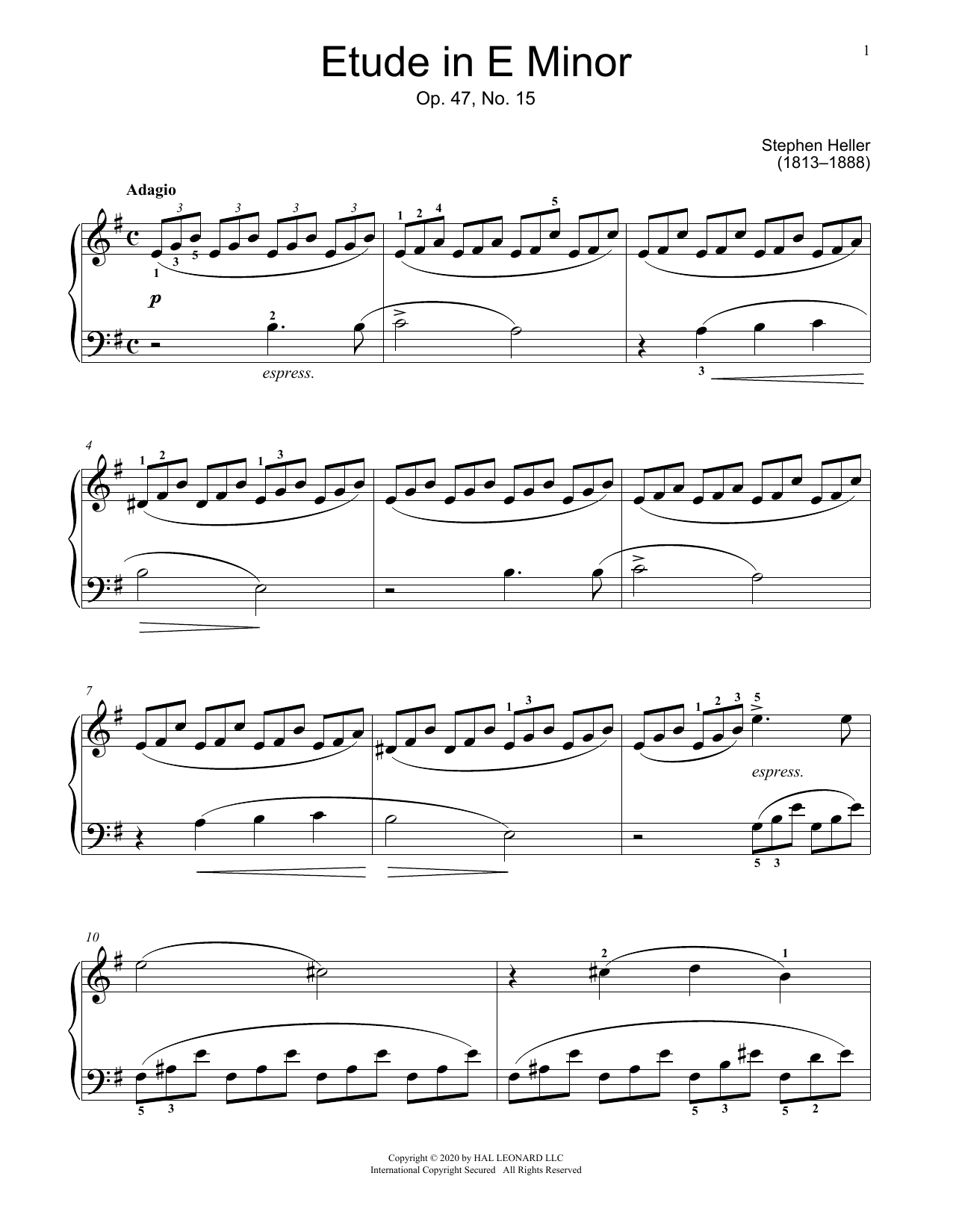
The technical demands in this etude remain focused and achievable without sacrificing musical substance. Three pages of concentrated work on finger independence and scalar facility gives students real progress without the sprawl of longer character pieces.
What to expect
The E minor tonality creates a contemplative, introspective atmosphere without becoming heavy or dramatic. Flowing passagework alternates with moments of harmonic richness, giving the piece both forward momentum and depth.
Who it's for
Intermediate pianists working through classical etude literature who need material that bridges technical development with musical expression. This sits well in the repertoire of upper elementary or early intermediate students ready to explore Romantic period technique.
How to get the most out of it
Establish the hand position early and resist the urge to shift unnecessarily; the E minor tonality rewards a settled approach to the keyboard.
Shape the melodic line with subtle dynamic inflection rather than dramatic swells; this etude responds better to refined control than romantic interpretation.
Identify the scalar passages that anchor the piece and drill them separately at various tempos before integrating them into the full texture.
How to use it
Include this in a recital exploring the etude genre across different periods and composers. It works equally well as a standalone showpiece or as part of a themed program pairing etudes with character pieces in the same key.
Skills your students will build
Scalar patterns in E minor across multiple octaves and hand positions
Finger independence and evenness in rapid passagework
Balance between melody and accompanying figures
Pedal control to enhance harmonic color without muddying texture
Reading and executing articulation markings specific to Romantic period style
You May Also Like
Scan to Complete Your Purchase
Use your phone's camera to scan the code below
You'll log in on your phone and the order will be added to your account