Étude in D flat, Op. 41 No. 5 (Encore Plus, Book 4) Sheet Music Preview

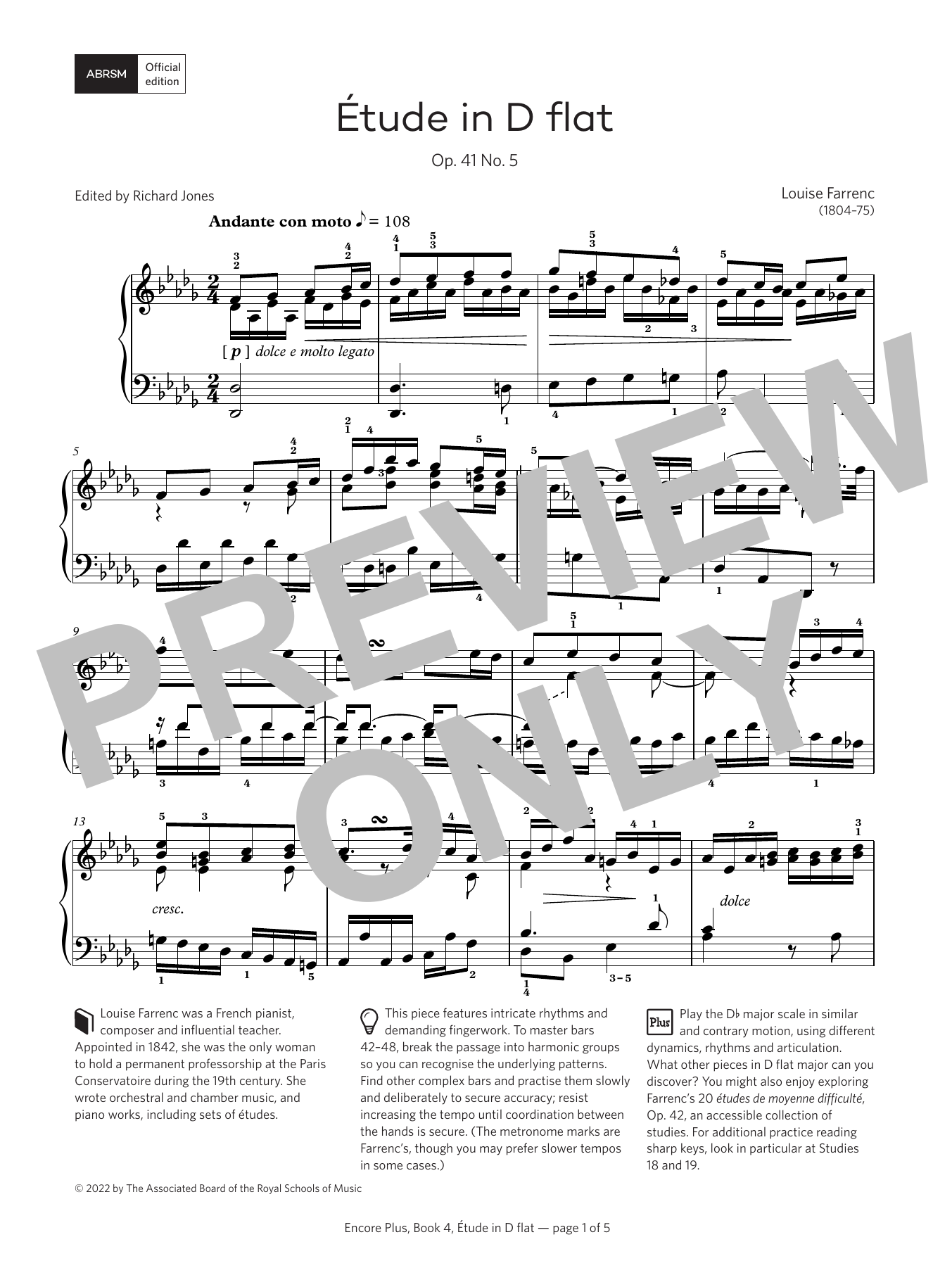
Étude in D flat, Op. 41 No. 5 (Encore Plus, Book 4): Piano Solo

By Louise Farrenc

Grade: 8

Item: 35-DS01989532

Digital Download
$4.99
Description

Discover MakeMusic Cloud: thousands of interactive titles your students can play along with today.

Sample Audio
No sample audio found.
Sample Video
Additional Details
Publisher: Hal Leonard
Page Count: 5
SKU: 35-DS01989532

More about this title

About the Composer: Louise Farrenc

Louise Farrenc (1804–1875) was a French pianist, composer, and pedagogue whose work bridged Romantic idealism with Classical rigor. She earned recognition as a concert pianist and composed over 160 works across multiple genres, including chamber music, symphonies, and solo keyboard pieces that showcase both technical brilliance and musical substance. Her études remain essential teaching tools because they demand genuine musicianship alongside finger facility.

Why we love this

This étude resists the trap of empty virtuosity. Farrenc embeds singing melodic lines within technically demanding passagework, forcing students to think architecturally about phrasing rather than simply executing notes. Grade 8 pianists encounter material that feels genuinely pianistic without veering into empty showmanship.

What to expect

Brilliant and conversational. The piece has the sparkle of a well-constructed saloon étude, but underneath lives a sophisticated harmonic palette and genuine lyricism. It feels like a conversation between hands rather than a display of technical bravura.

Who it's for

Intermediate to advanced pianists ready to reconcile technical demands with interpretive responsibility. Students preparing for competitions or recitals benefit from material that asks for both mechanical precision and musical maturity.

How to get the most out of it

  • Shape the melodic line through the figurations by planning breath points before you begin; the ornamental writing can obscure the underlying phrase if you're not deliberate about voice leading.
  • Work the left hand voice independently first, establishing its own musicality and independence rather than treating it as mere accompaniment.
  • Experiment with rubato in the opening gesture to bring out the Classical elegance without sliding into Romantic excess; Farrenc's harmonic language rewards subtle temporal flexibility.
  • Balance pedal use carefully so that sustained tones support the line without muddying the rapid passagework in the right hand.

How to use it

Include this on a recital focused on 19th century French salon music or on a program exploring women composers alongside their male contemporaries. It pairs naturally with Mendelssohn or early Chopin and gives students a significant learning work that also stands up as performance material.

Skills your students will build

  • Managing rapid figuration across registers while maintaining melodic clarity
  • Pedaling through complex harmonic changes without blur
  • Interpreting rubato within a Classical framework
  • Independence between hands at substantial tempo
  • Phrasing ornamental passagework as integral to form rather than decoration

You May Also Like