
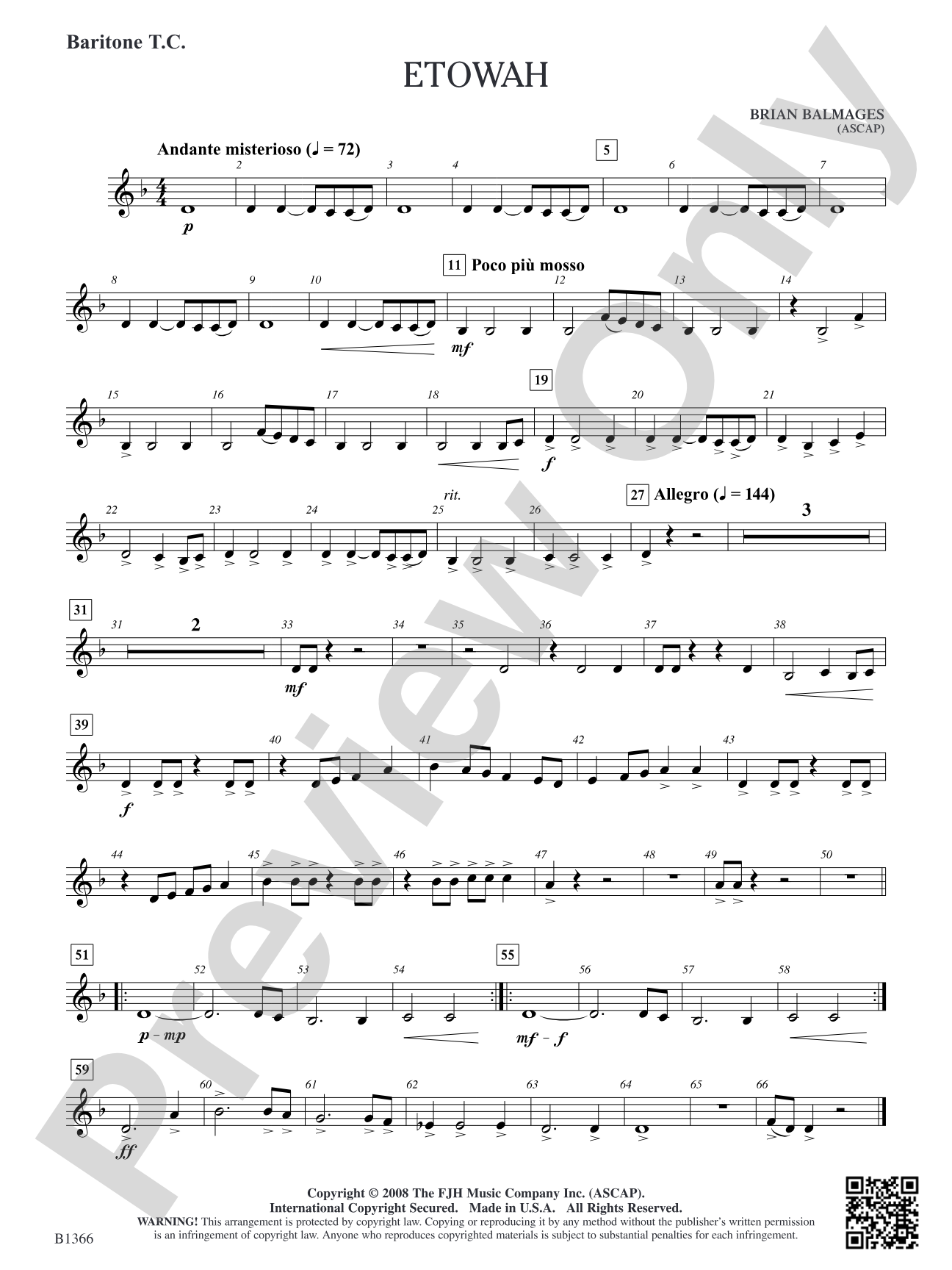

Etowah: Baritone T.C.
By Brian Balmages
Grade: 1.5
Item: 98-PC-DB1366_BTC1
$7.00
Pickup currently not available
Description
Heavily influenced by Native American sounds, Etowah pays homage to the great Cherokee and Creek nations that once thrived in modern day Georgia. The opening sounds echo the spirit of the ancient city of Etowah before the music builds, taking the listener back to when the city thrived. Including a large battery of percussion, innovative harmonies, and interesting textures not normally found in young band music, this is certain to be a huge favorite!


Don't just read it, hear it, play along with it, and watch your students grow with it. In MakeMusic Cloud, Etowah: Baritone T.C. comes alive with professional accompaniment, adjustable tempo, and built-in practice tools that turn solo practice into real progress.
Open in the Player
Jump straight in and assign it today.
Start Your Free Trial
Open this title and explore the full library in minutes.
Sample Audio
1
Audio File
--:--
0:00
0:00
Sample Video
No sample videos found.
Additional Details
Series:
FJH Developing Band
Publisher:
The FJH Music Company, Inc.
SKU:
98-PC-DB1366_BTC1
More about this title
About the Composer: Brian Balmages

Brian Balmages composes across orchestral, band, and chamber idioms with equal fluency, and his works have graced stages from Carnegie Hall to the Sydney Opera House. He has received the A. Austin Harding Award from the American School Band Directors Association, claimed the 2020 NBA William D. Revelli Composition Contest with Love and Light, and holds membership in the American Bandmasters Association. His music appeared in the 2013 Presidential Inaugural Prayer Service and he has conducted all-state ensembles, university orchestras, and professional groups on multiple continents.
As Director of MakeMusic Publications and Digital Education for Alfred and MakeMusic, Balmages continues to shape the landscape of music education. He holds degrees from James Madison University and the University of Miami, where he was honored with distinguished alumni recognition and later commissioned to compose for a presidential inauguration. His guest conducting appearances span the Midwest Clinic, Western International Band Clinic, and major professional conferences worldwide.
Why we love this
Balmages crafts something rare at the 1.5 level: music that sounds sophisticated without demanding virtuosity. The percussion writing alone gives young musicians genuine textural and timbral responsibility, while the harmonies push beyond typical Grade 1 progressions in ways that feel organic to the piece's cultural narrative rather than arbitrary.
What to expect
Etowah opens with haunting, sparse textures that feel like stepping into ancient ruins, then gradually awakens the ensemble into fuller, richer harmonies. The journey feels respectful and reflective, never rushed, building from introspection toward vibrant life without losing its reverent quality.
Who it's for
Young bands at the upper end of Grade 1.5 who are ready for more sophisticated compositional thinking. This works equally well for ensembles building toward contest season or simply looking for repertoire with genuine cultural substance.
How to get the most out of it
- Balance the opening's sparse, atmospheric writing carefully. Those opening sounds need space to breathe and register as intentional, not tentative.
- Give the percussion section ownership of the piece's character arc. They're not supporting; they're telling the story alongside the winds.
- Shape the building sections with deliberate dynamic control. The trajectory from ancient Etowah to its thriving era demands patience and clear phrasing from every voice.
- Encourage your band to listen to recordings of authentic Native American music before rehearsals begin. Even young musicians will perform with more authenticity when they understand what they're honoring.
How to use it
Consider programming this as an opening piece in a concert built around cultural narratives, or use it to anchor a set exploring American history. Its length and accessibility make it ideal for showcasing ensemble growth mid-season while offering something substantive enough for festival consideration.
Skills your students will build
- Sensitive control of sparse textures and atmospheric opening gestures
- Balance between competing melodic lines and percussion accompaniment patterns
- Dynamic shaping across longer musical phrases that develop gradually
- Awareness of cultural context and respectful interpretation of music beyond Western classical tradition
- Ensemble listening skills in unconventional harmonic contexts