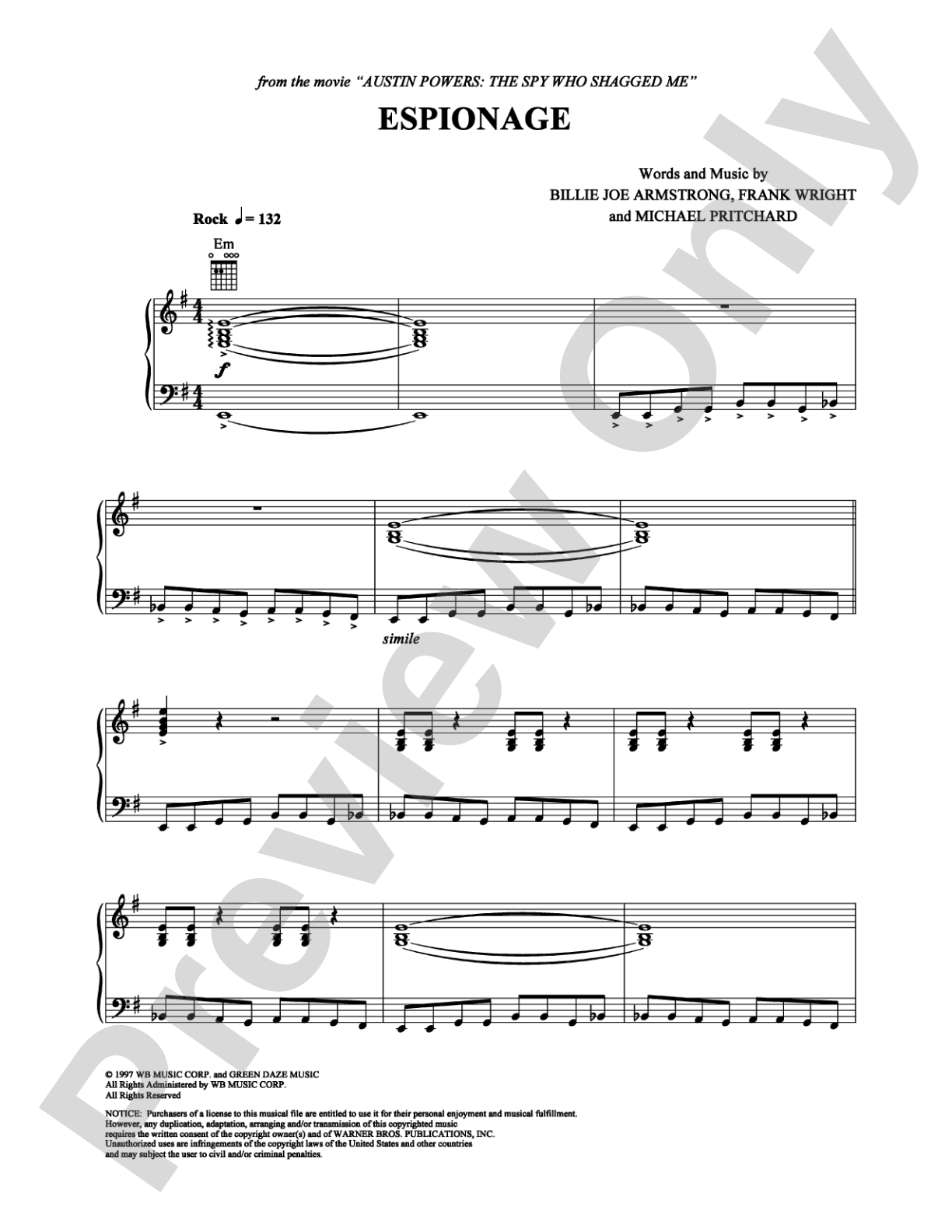
Espionage: Piano Digital Sheet Music

Espionage: Piano Digital Sheet Music

Green Day, Billie Joe Armstrong, Frank Wright, Michael Pritchard

Item: 00-PS-0001379

Digital Download
$3.99
Description

Espionage: Piano Digital Sheet Music isn't in MakeMusic Cloud just yet...but it could be. Let us know you'd like to see it, and you'll help shape what comes next. In the meantime, start a free trial and dive into thousands of interactive titles your students can play along with today.

Sample Audio
No sample audio found.
Sample Video
Additional Details
SKU: 00-PS-0001379

More about this title

About the Artist: Green Day

Green Day emerged from the Berkeley punk scene in the late 1980s and became one of the defining rock bands of the 1990s and beyond. Their 2004 album American Idiot marked a creative peak, blending punk energy with theatrical storytelling and sophisticated pop-rock songwriting. The band's influence on contemporary music education extends beyond their commercial success; their work demonstrates how accessible instrumentation and memorable melodies can coexist with lyrical depth and complex emotional narratives.

Why we love this

"Espionage" captures the cinematic drama of American Idiot's narrative arc without sacrificing the propulsive energy that makes Green Day's catalog engaging for pianists. The track rewards careful attention to dynamics and phrasing while remaining grounded enough for students to connect with the song's original intent rather than getting lost in overly complex arrangements.

What to expect

Brooding and cinematic, with undercurrents of tension that echo the concept album's paranoid themes. The piece moves with quiet intensity, building atmosphere through careful layering rather than explosive volume, creating a sense of unease that resolves into moments of clarity and forward drive.

Who it's for

Piano students drawn to contemporary rock and pop music who want to study how rock songwriting translates to the keyboard. This works equally well for pianists preparing recital pieces outside the classical canon and for students exploring how Green Day's theatrical approach to song structure can deepen their understanding of form and dramatic arc.

How to get the most out of it

  • Shape the left hand patterns to maintain rhythmic momentum without letting them feel mechanical; the repetition should feel like forward motion, not metronome marking time.
  • Pay attention to where the dynamic intensity shifts between verses and the chorus, using the full range of the keyboard to color those transitions rather than treating them as sudden switches.
  • Anchor the accompaniment figures so that the melody stands out clearly; this piece depends on the listener following its storyline, which means the supporting material must stay supportive.
  • Experiment with sustain pedal placement around harmonic changes to avoid muddiness while still capturing the slightly darker sonic palette the original track carries.

How to use it

Include this in a recital or concert exploring contemporary rock arranged for solo piano, where it pairs naturally with other 2000s-era songwriting that emphasizes narrative and emotional complexity. It also works as a bridge piece in educational programs that aim to validate students' non-classical listening interests while maintaining rigorous musical standards.

Skills your students will build

  • interpreting rock melody and harmony within a classical instrument context
  • managing repetitive left-hand figures while maintaining musical energy
  • balancing accompaniment texture against clear melodic projection
  • understanding how dynamic contrast serves dramatic storytelling in rock music
  • reading and executing contemporary songwriting notation on traditional keyboard

You May Also Like